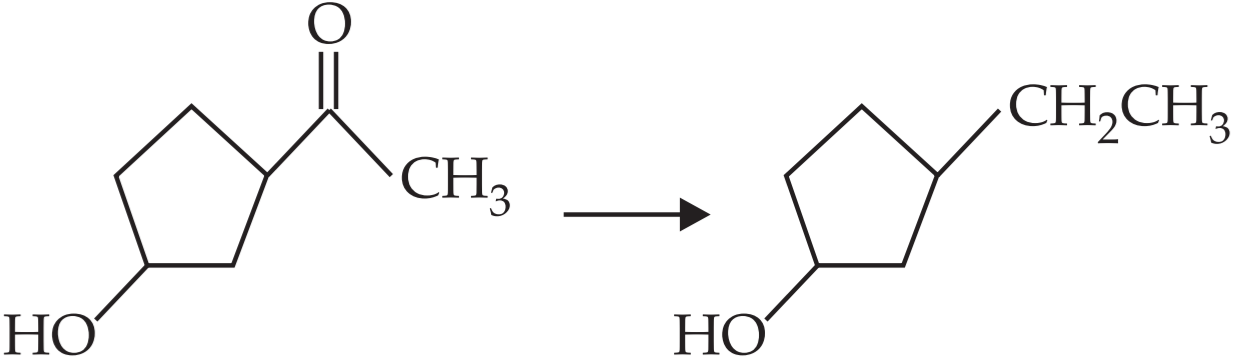
Question
Read the passage given below and answer the following questions:
Iron forms many complexes in its $+2$ and $+3$ oxidation states such as $[Fe(H_2O)_6]^{2+} (A); [Fe(CN)_6]^{4-} (B); [Fe(H_2O)_6]^{3+} (C); [Fe(CN)_6]^{3-} (D),$ etc., They exhibit, different magnetic properties and undergo different hybridisation of iron.
The following questions are multiple choice questions. Choose the most appropriate answer:
Iron forms many complexes in its $+2$ and $+3$ oxidation states such as $[Fe(H_2O)_6]^{2+} (A); [Fe(CN)_6]^{4-} (B); [Fe(H_2O)_6]^{3+} (C); [Fe(CN)_6]^{3-} (D),$ etc., They exhibit, different magnetic properties and undergo different hybridisation of iron.
The following questions are multiple choice questions. Choose the most appropriate answer:
- Which of the following statements is correct?
- $(B)$ is paramagnetic while $(C)$ is diamagnetic.
- Both $(B)$ and $(D)$ are outer orbital complexe.
- Both $(A)$ and $(C)$ are paramagnetic.
- $(A)$ is outer orbital complex and $(C)$ is inner orbital complex.
- The complex having maximum magnetic moment is:
- $(A)$
- $(B)$
- $(C)$
- $(D)$
- Which of the following does not represent correct configuration of the d-orbitals in the given complexes?
- $\text{(A)}:\text{t}^4_{2\text{g}}\text{e}^2_\text{g}$
- $\text{(B)}:\text{t}^6_{2\text{g}}\text{e}^0_\text{g}$
- $\text{(C)}:\text{t}^4_{2\text{g}}\text{e}^1_\text{g}$
- $\text{(D)}:\text{t}^5_{2\text{g}}\text{e}^0_\text{g}$
- The spin only magnetic moment of complexes $(A), (B), (C)$ and $(D)$ are respectively $($in $BM).$
- $2\sqrt{6},0,\sqrt{35},\sqrt{3}$
- $0,2\sqrt{6},\sqrt{35},\sqrt{3}$
- $\sqrt{15,}2\sqrt{6},\sqrt{3},0$
- $\sqrt{3},\sqrt{8},0,\sqrt{15}$
- Which of the given complexes are outer orbital complexes?
- $(A)$ and $(B)$ only
- $(B)$ and $(C)$ only
- $(A)$ and $(C)$ only
- $(B)$ and $(D)$ only
 The most stable product (s) is/ are: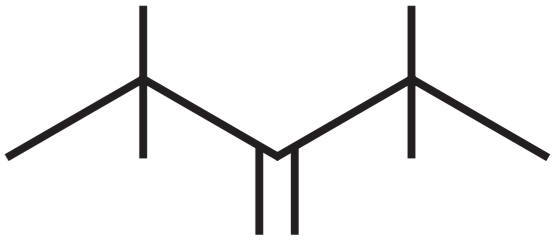
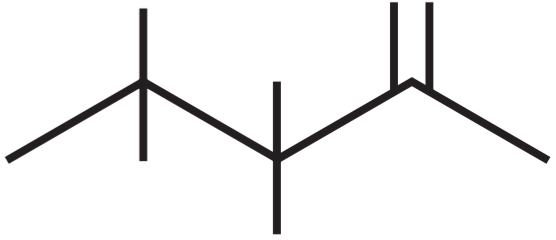
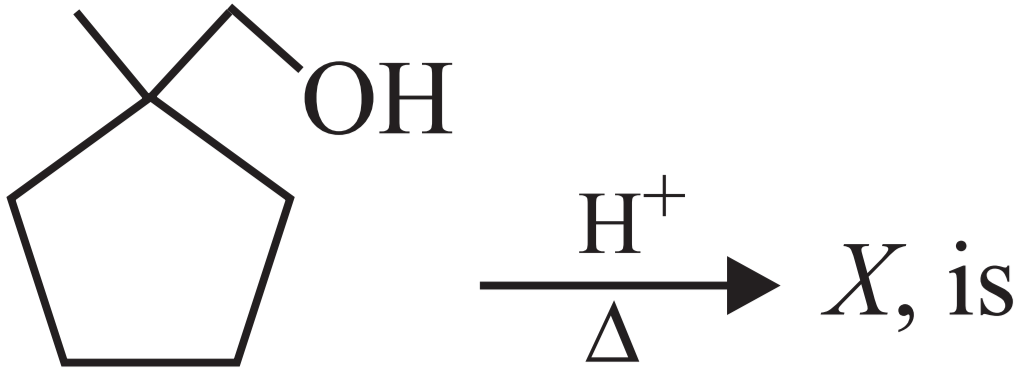




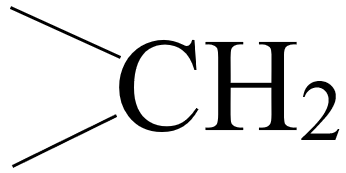 group on treatment with Zn-Hg and cone. HCl (Clemmensen reduction) or with hydrazine followed by NaOH or KOH in highly boiling solvent such as ethylene glycol (Wolff-Kishner reduction).Aldehydes differ from ketones in their oxidation reactions. Aldehydes are easily oxidised to carboxylic acids on treatment with $HNO_3, KMnO_4, K_2Cr_2O_7$ etc. Even mild oxidising agents mainlyTollens' reagent and Fehling's solution also oxidise aldehydes. Ketones are generally oxidised under vigorous conditions i.e., strong oxidising agents and at elevated temperatures, to give mixture of carboxylic acids having lesser number of C-atoms than the parent ketone.
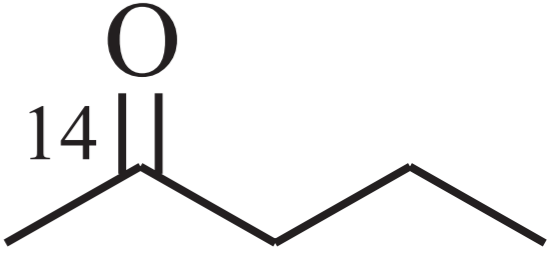 by acidified $K_2Cr_2O_7$, the products are: