Question
Describe Faraday’s coil-coil experiment. What conclusion can be drawn from the experiment?

Answer

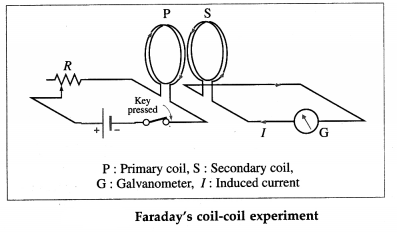
(1) A copper coil P of several turns is connected in series to a rheostat, a tap key and a battery. The terminals of another copper coil Q of several turns are connected to a sensitive galvanometer. The coils are placed close to each other such that when a current is passed through coil P by closing the key K, the magnetic flux through P is linked with coil Q.
(2) On closing the key K, the rise of current in coil P changes the flux linked with the coil Q nearby as shown by a momentary deflection (throw) of the galvanometer G, from below figure. A similar deflection in the same direction is seen if the key closed and either coil is moved swiftly towards the other.
Image
(3) On releasing the tap key, the current in the coil P does not reduce to zero instantaneously. With the decreasing flux through its turns, and a consequent decrease in the flux linked with coil Q, there is an opposite throw of the galvanometer. A similar deflection in the same direction is seen if the key is kept closed and either coil is moved swiftly away from the other.
Conclusion : A current is induced in an electric circuit whenever the magnetic flux linked with the circuit keeps on changing, either as a result of changing current in a nearby circuit or due to relative motion between them.
 

Need a full question paper?

Generate a complete, print-ready paper with questions like this in minutes — across 16+ boards, with answer keys.

Start Generating Free

Similar questions

Draw a diagram showing the equipotential surfaces and electric field lines in the plane of (i) an electric dipole (ii) a system of two equal positive charges.
Earth's mean temperature can be assumed to be 280 K . How will the curve of blackbody radiation look like for this temperature? Find out $\lambda_{\text {max }}$. In which part of the electromagnetic spectrum, does this value lie? (Take Wien's constant $\left.b =2.897 \times 10^{-3} m K \right)$
State the expressions for the displacement, velocity and acceleration of a particle performing linear SHM, starting from the positive extreme position. Hence, draw their graphs with respect to time. Draw your conclusions from the graphs.
OR
A particle performs linear SHM starting from the positive extreme position. Plot the graphs of its displacement, velocity and acceleration against time.
Obtain the balancing condition in case of a Wheatstone’s network.
Derive an expression for the angular speed of the bob of a conical pendulum.
OR
Derive an expression for the frequency of revolution of the bob of a corical pendulum.
A coil has $1000$ turns, each of area $0.5 m ^2$. What is the magnetic moment of the coil when it carries a current of $1 \ mA$ ?
Explain the capillary action.
A metallic ring of mass $1\ kg$ has moment of inertia $1\ kg\ m^2$​​​​​​​ when rotating about one of its diameters. It is molten and remoulded into a thin uniform disc of the same radius. How much will its moment of inertia be, when rotated about its own axis.
 
Prove that an ideal capacitor in an AC circuit does not dissipate power
Name two materials that have negative magnetic susceptibility.