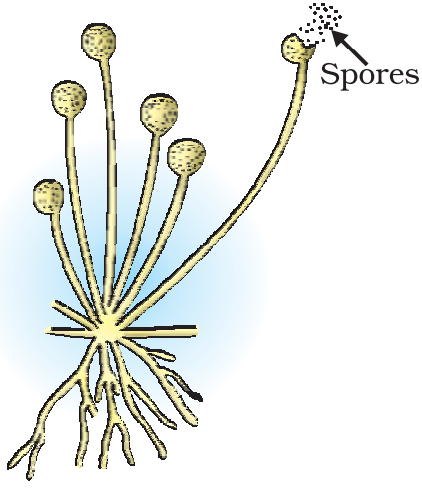
Describe reproduction by spores in Rhizopus.
CBSE OUTSIDE DELHI - SET 2 2017
Download our app for free and get started
Rhizopus reproduces by spore formation which is a type of asexual reproduction. It contains tiny blob-on-a stick-like structures which are involved in reproduction. The blobs are sporangia which contain spores which are covered by thick walls that protect them until they come in contact with moist surface and can begin to grow.

Download our appand get started for free
Experience the future of education. Simply download our apps or reach out to us for more information. Let's shape the future of learning together!No signup needed.*
Similar Questions
- 1View SolutionReproduction is one of the most important characteristics of living beings. Give three reasons in support of the statement.
- 2View SolutionExplain, what happens to the egg once it gets fertilized in a human female?
- 3View SolutionJustify the statement ‘Primary sex organs control the growth, function and maintenance of secondary sex organs’.
- 4View SolutionDraw a diagram of the male reproductive system and explain its various parts.
- 5View SolutionDefine the term pollination. Differentiate between self pollination and cross pollination. What is the significance of pollination?
- 6View SolutionWhat is the effect of DNA copying, which is not perfectly accurate, on the reproduction process? How does the amount of DNA remain constant though each new generation is a combination of DNA copies of two individuals?
- 7View SolutionWhat constitutes a female reproductive part in a flower?
- 8View SolutionWhat happens when:
- Accidently, Planaria gets cut into many pieces?
- Bryophyllum leaf falls on the wet soil?
- On maturation sporangia of Rhizopus bursts?
- 9View SolutionState one reason why cross-pollination is preferred over self-pollination.
- 10View SolutionWrite two examples each of sexually transmitted diseases caused by (i) virus, (ii) bacteria. Explain how the transmission of such diseases be prevented?