Question
Describe the activity that shows that a current-carrying conductor experiences a force perpendicular to its length and the external magnetic field. How does Fleming’s left-hand rule help us to find the direction of the force acting on the current carrying conductor?

Answer


The activity is as follows:
Take a small aluminium rod AB. Using two connecting wires suspend it horizontally from a stand, as shown in figure given below.
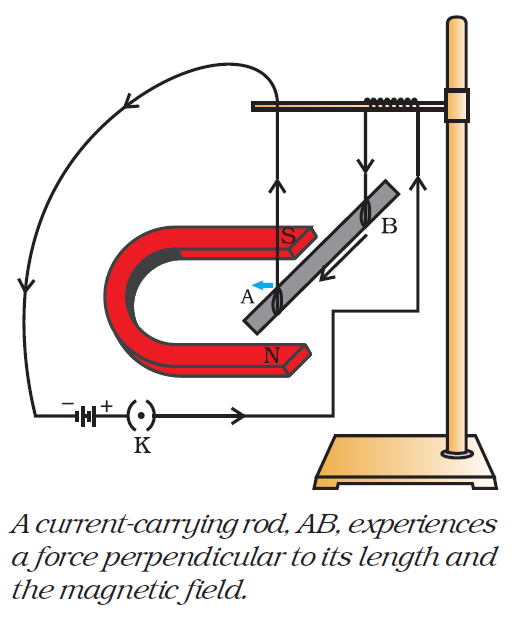
Place a strong horse-shoe magnet in such a way that the rod lies between the two poles with the magnetic field directed upwards. For this put the North Pole of the magnet vertically below and South Pole vertically above the aluminium rod.
Connect the aluminium rod in series with a battery, a key and a rheostat.
Now pass a current through the aluminium rod from end B to end A.
It is observed that the rod is displaced towards the left and rod gets displaced.
Reverse the direction of current flowing through the rod and observe the direction of its displacement. It is now towards the right.

Need a full question paper?

Generate a complete, print-ready paper with questions like this in minutes — across 16+ boards, with answer keys.

Start Generating Free

Similar questions

Mendeleev predicted the existence of certain elements not known at that time and named two of them as Eka-silicon and Eka-aluminium.
  1. Name the elements which have taken the place of these elements.
  2. Mention the group and the period of these elements in the Modern Periodic Table.
  3. Classify these elements as metals, non-metals or metalloids.
  4. How many valence electrons are present in each one of them?
Write laws of refraction. Explain the same with the help of ray diagram, when a ray of light passes through a rectangular glass slab.
You are given samples of three metals — sodium, magnesium and copper. Suggest any two activities to arrange them in order of their decreasing reactivities.
  1. If the image formed by a mirror for all positions of the object placed in front of it is always diminished, erect and virtual, state the type of the mirror and also draw a ray diagram to justify your answer. Write one use such mirrors are put to and why.
  2. Define the radius of curvature of spherical mirrors. Find the nature and focal length of a spherical mirror whose radius of curvature is + 24 cm.
Define magnetic field lines. Describe an activity to draw a magnetic field line outside a bar magnet from one pole to another pole.
List the parts of the human eye that control the amount of light entering into it. Explain, how they perform this function?
  1. Name the following:
  1. Metal that can be cut by knife.
  2. Lustrous non-metal.
  3. Metal that exists in liquid state at room temperature.
  4. Most malleable and ductile metal.
  5. Metal that is best conductor of electricity.
  6. Non-metal that can exist in different forms.
  1. How are alloys better than metals? Give composition of solder and amalgam.
For a heater rated at 4kW and 220V, calculate:
  1. The current,
  2. The resistance of the heater,
  3. The energy consumed in 2 hours, and
  4. The cost if 1kWh is priced at ₹60.
How phototropism does occur in plants?
  1. List in tabular from three chemical properties on the basis of which we can differentiate between a metal and a non-metal.
  2. Give reasons for the following:
  1. Most metals conduct electricity well.
  2. The reaction of iron (III) oxide $\left[ Fe _2 O _3\right]$ with heated aluminium is used to join cracked machine parts.