Question
How phototropism does occur in plants?

Answer

The directional movement of a plant part/plant in response to light is called phototropism. The shoot responds by bending towards light while roots respond by bending away from the light. We know that the plant stem responds to light and bends towards it due to the action of auxin hormone. When sunlight comes from above, then the auxin hormone present at the tip of the stem spreads uniformly down the stem. Due to the equal presence of auxin, both the sides of the stem grow straight and with same rapidity.This is because auxin hormone moves away from the light.
Thus, more auxin hormone is present in the left side of stem as compared to the right. The left side of stem, grows faster than its right side and therefore, the stem bends towards the right side (direction of light).
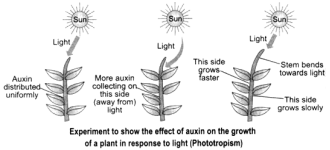
Image

The effect of auxin on the growth of a root is exactly opposite to that on a stem. Auxin hormone increases the rate of growth in stem but it decreases the rate of growth in a root. The side of root away from light will have all the auxin concentrated in it. Due to this, the side of root which is away from light will grow slower than the other side and make the root bends away from light.

Need a full question paper?

Generate a complete, print-ready paper with questions like this in minutes — across 16+ boards, with answer keys.

Start Generating Free

Similar questions

If a person holds his breath after expiration for about 25sec, would there be occurrence of any exchange of respiratory gases in the lungs during this period? Explain.
State five uses of metals and five of non-metals.
Explain how, sex is determined in human babies.
What are the main uses of coal and petroleum products?
Explain tissue culture technique. In which area this technique is finding its application?
a. List the sequence of events in the uterus of a human female from fertilisation of egg till childbirth.
b. State the changes that are observed in the uterus if fertilisation of egg does not occur.
Every household produces a lot of material A daily. In one of the methods of disposal B, material A is burned at a very high temperature of about 1000°C in a structure called C. During this process, the organic matter present is removed as D and E whereas F is left behind (which can be dumped in a landfill site).
  1. What is material A?
  2. Name the method of disposal B.
  3. What is structure C known as?
  4. What are (i) D (ii) E, and (iii) F?
  5. This method is especially suitable for the disposal of materials produced by certain institutions. Name such institutions.
Define ‘speciation’. Explain how speciation occurs.
State Ohm’s law? How can it be verified experimentally? Does it hold good under all conditions? Comment.
A carbon compound ‘P' on heating with excess cont. $H2SO_4$ forms another carbon compound ‘Q' which on addition of hydrogen in the presence of nickel catalyst forms a saturated carbon compound ‘R'. One molecule of ‘R' on combustion forms two molecules of carbon dioxide and three molecules of water. Identify P, Q and R and write chemical equations for the reactions involved.