Question
Describe the bones of forelimb.

Answer

Forelimb consists of humerus, radius and ulna (together forming forearm bones), carpals (bones of wrist), metacarpals (bones of palm) and phalanges (bones of digits). It consists of 30 bones.

i. Humerus:

1. This is the bone of upper arm.
2.It has a hemispherical head at its proximal end. On either side of head of humerus are present a pair of projections termed greater and lesser tubercles.

Image
3. Bicipital groove is a deep groove present between the tubercles where a tendon of biceps muscle is attached.
4. The shaft of humerus shows deltoid tuberosity. Distal end of humerus shows pulley like part called trochlea that articulates with ulna.

ii. Radius and Ulna:
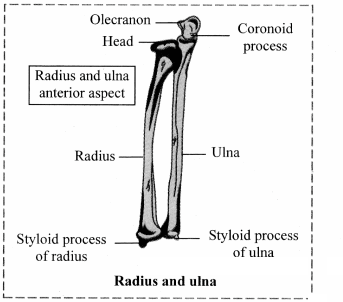
  1. Radius is located laterally on thumb side of the forearm.
  2. The proximal end of radius has disc like head that articulates with humerus bone.
  3. The shaft of radius widens distally to form styloid process.
  4. Ulna is located medially on little finger side of forearm.
  5. At the proximal end of ulna there is a prominent process called Olecranon process that forms elbow joint with humerus bone. On the lateral side, near the upper end of ulna is present the radial notch into which the side of head of radius is fixed.
Image
6. Radius and ulna articulate with each other at upper and lower extremities by superior and inferior radio-ulnar joints. In between the shaft of two bones, interosseous membrane is present

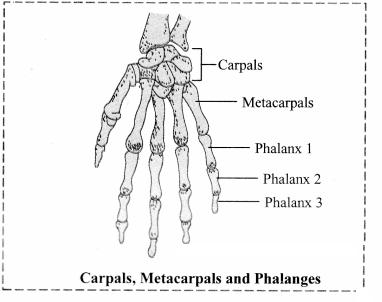
iii. Carpals: These are bones of wrist, arranged in two rows of four each.

iv. Metacarpals: Five elongated metacarpals form the bones of palm. Their proximal ends join with carpals and distal ends form knuckles.

v. Phalanges: Phalanges form the bones of fingers and thumb. There are 14 phalanges in each hand (Four fingers have three phalanges each and thumb has two).

Image

Need a full question paper?

Generate a complete, print-ready paper with questions like this in minutes — across 16+ boards, with answer keys.
Start Generating Free