Question
Describe the cleansing action of detergents.

Answer

Cleansing action of detergents: Oil stains and grease on dirty clothes cannot be removed by simply washing the clothes with water because water does not wet them. By adding detergent or soap to water, the greasy dirt can be easily removed. The cleansing action of detergents can be explained as follows:
i. Soap or detergent molecules have the shape of a hairpin.
ii. When detergent is dissolved in water, the heads of its hairpin shape molecules get attracted to water surface.
iii. When clothes with greasy stains are dipped in water containing detergent, the pointed ends of detergent molecules get attached to the molecules of grease. So a water-grease interface is formed. Thus surface tension is greatly reduced. The greasy dirt is held suspended.
iv. When the clothes are rinsed in water, the greasy dirt is washed away by running water.
So when detergent is added to water, the surface tension of water is reduced, its area of contact with grease is increased and hence its cleansing ability is increased.
Need a full question paper?

Generate a complete, print-ready paper with questions like this in minutes — across 16+ boards, with answer keys.

Start Generating Free

Similar questions

Water rises to a height of 10cm in a certain capillary tube. The level of mercury in the same tube is depressed by 3.42cm. Compare the surface tensions of water and mercury. Specific gravity of mercury is 13.6g/cc and angle of contact for water and mercury are zero and 135° respectively.
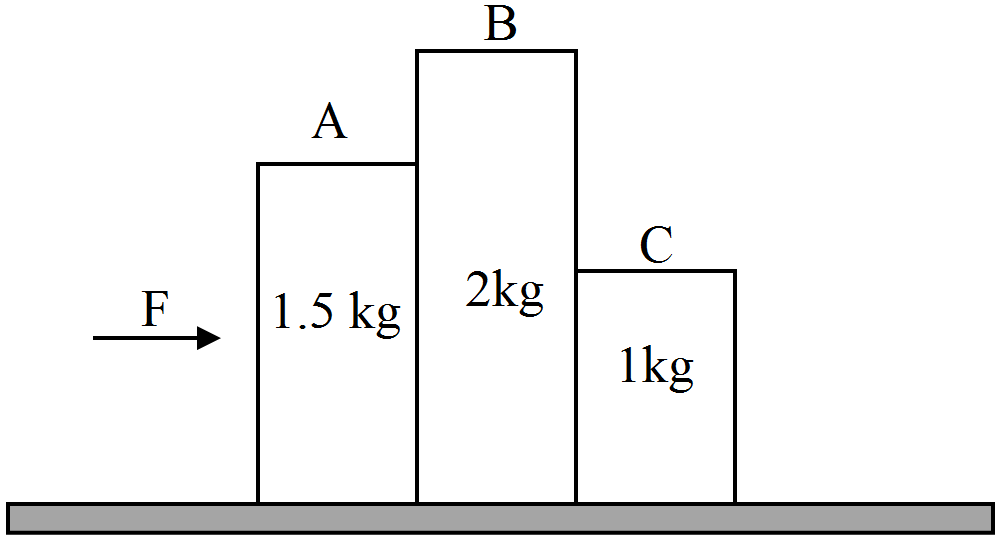
In the system of three blocks $A , B$ and C shown in figure,
(i) how large a force $F$ is needed to give the blocks an acceleration of $3 m / s ^2$, if the coefficient of friction between blocks and table is $0.27$
(ii) how large a force does the block $A$ exert on the block $B$ ?
By using the method of dimension, check the accuracy of the following $\text{T}=\frac{\text{rh } \rho\text{g}}{2\cos\theta}$ where T is the surface tension, h is the height of the liquid in a capillary tube, $\rho$ is the density of the liquid, g is the acceleration due to gravity, $\theta$ is the angle of contact, and r is the radius of the capillary tube.
Angular momentum of a system is conserved if its M.I. is changed. Is its rotational K.E. also conserved?
Calculate the Q-value of the fusion reaction
${ }^4 \mathrm{He}+{ }^4 \mathrm{He}={ }^8 \mathrm{Be} .$
A $60kg$ man skating with a speed of 10m/s collides with a $40kg$ skater at rest and they cling to each other. Find the loss of kinetic energy during the collision.
What is Graham's law of gas diffusion ? Propound this law on the basis of molecular motion theory.
Plot the corresponding reference circle for each of the following simple harmonic motions. Indicate the initial (t = 0) position of the particle, the radius of the circle, and the angular speed of the rotating particle. For simplicity, the sense of rotation may be fixed to be anticlockwise in every case: (x is in cm and t is in s).$\text{x}=3\sin\Big(2\pi\text{t}+\frac{\pi}{4}\Big)$
Draw the energy$-$distribution graph of a black body. List some salient features.
When an apple falls from a tree what happens to its gravitational potential energy just as it reaches the ground? After it strikes the ground?