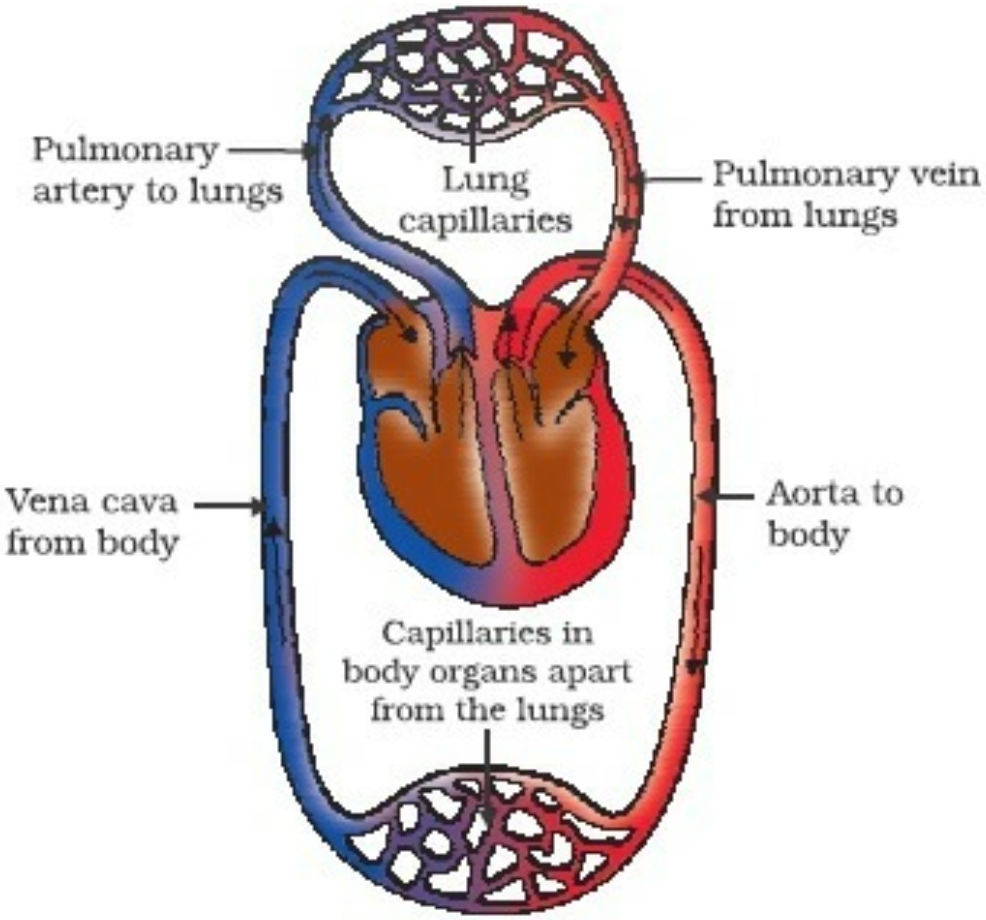
Draw a schematic representation of transport and exchange of oxygen and carbon dioxide during transportation of blood in human beings and label on it, Lung capillaries, Pulmonary artery to lungs Aorta to body, Pulmonary veins from lungs.
Download our app for free and get started

Download our appand get started for free
Experience the future of education. Simply download our apps or reach out to us for more information. Let's shape the future of learning together!No signup needed.*
Similar Questions
- 1View SolutionExplain the three pathways of breakdown in living organisms.
- 2View SolutionClassify the following into herbivores, carnivores and omnivores:
Lion, Man, Dog, Goat, Crow, Elephant, Snake, Hawk, Rabbit, Deer. - 3View SolutionAn organism X having breathing organs A lives on land. When organism X goes under water, it cannot survive for a long time unless carrying an oxygen cylinder. On the other hand, the organism Y having breathing organs B always lives in water and if taken out of water, it dies after a short while. A third organism Z having breathing organs C and D which lives on the banks of ponds, lakes and rivers can survive on land as well as in water equally well.
- What could organism X be? Name the breathing organs A.
- What could organism Y be? Name the breathing organs B.
- What could organism Z be? Name the breathing organs C and D.
- Out of X, Y and Z, which organism is.
- Amphibian,
- Aquatic,
- Terrestrial?
- 4View SolutionWhy do we need a proper transportation system in plants?
- 5View SolutionName the raw materials required for photosynthesis. How do plants obtain these raw materials?
- 6View Solution‘Aerobic respiration produces more ATP than anaerobic respiration’. Justify this statement.
- 7View SolutionDifferentiate between left lung and right lung of humans.
- 8View SolutionExplain how deoxygenated blood travel from body to lung for purification. Draw well-labeled diagram in support of your answer.
- 9View Solution
- Define excretion.
- Name the basic filtration unit present in the kidney.
- Draw excretory system in human beings and label the following organs of excretory system which perform following functions:
- Form urine.
- Is a long tube which collects urine from kidney.
- Store urine until it is passed out.
- 10View SolutionA liquid X of colour Y circulates in the human body only in one direction: from body tissues to the heart. Among other things, liquid X contains germs from cells and dead cells. The liquid X is cleaned of germs and dead cells by a special type of white blood cells called Z. This cleaned liquid is then put into blood circulatory system in subclavian veins.
- What is (i) liquid X and (ii) colour Y?
- What are Z.
- The liquid X is somewhat similar to a component of blood. Name this component.
- Why is liquid X not red?