Question
Where does anaerobic respiration occur in human body?

Answer

Anaerobic respiration is a type of respiration that takes place in the absence of oxygen and aerobic respiration. The steps of anaerobic respiration have some similarities to aerobic respiration. Both forms start their process with glycolysis, which is the beginning of carbohydrate catabolism, or the breakdown of larger molecules into smaller ones.Anaerobic respiration takes place in the fluid portion of the cytoplasm of cells, away from the mitochondria or any other organelles. It begins with glycolysis, which breaks apart glucose and generates energy and a compound known as pyruvate, and also includes fermentation, which breaks down the pyruvate for more energy.
Need a full question paper?

Generate a complete, print-ready paper with questions like this in minutes — across 16+ boards, with answer keys.

Start Generating Free

Similar questions

Explain the following.
1. Reactivity of Al decreases if it is dipped in $HNO _3$.
2. Carbon cannot reduce the oxides of Na or Mg .
3. NaCl is not a conductor of electricity in solid state whereas it does conduct electricity in aqueous solution as well as in molten state.
4. Iron articles are galvanised.
5. Metals like $Na , K , Ca$ and Mg are never found in their free state in nature.
Draw a labelled circuit diagram of a simple electric motor and explain its working. In what way these simple electric motors are diffferent from commercial motors?
A small part of the shoot of a plant is removed with a sharp knife. When the lower end of this small part of the shoot is buried in moist soil, it gradually develops roots and shoots and grows to become a new plant.
  1. What is the name of this method of propagating plants?
  2. What care should be taken while removing a small part of the shoot from the parent plant with a knife?
  3. Name any two plants which provide us with food directly or indirectly and are grown by this method.
  4. Give one advantage of this method of producing new plants.
  5. State whether it is a sexual method of reproduction or an asexual method. Why?
  6. What special name can be given to the genetically identical new plants produced by this technique?
With the help of a labelled diagram, explain the construction and working of a solar cooker.
Draw a labelled diagram of:
  1. A xylem vessel.
  2. A sieve tube (or phloem).
Why are budding, fragmentation and regeneration all considered as asexual types of reproduction? With neat diagrams explain the process of regeneration in Planaria.
  1. Draw a ray diagram to show the formation of image by a convex lens when an object is placed in front of the lens between its optical centre and principal focus.
  2. In the above ray diagram mark the object-distance (u) and the image-distance (v) with their proper signs (+ve or – ve as per the new Cartesian sign convention) and state how these distances are related to the focal length (f) of the convex lens in this case.
  3. Find the power of a convex lens which forms a real, and inverted image of magnification -1 of an object placed at a distance of 20cm from its optical centre.
What is the difference between excretion and defecation? Explain the process of excretion in humans.
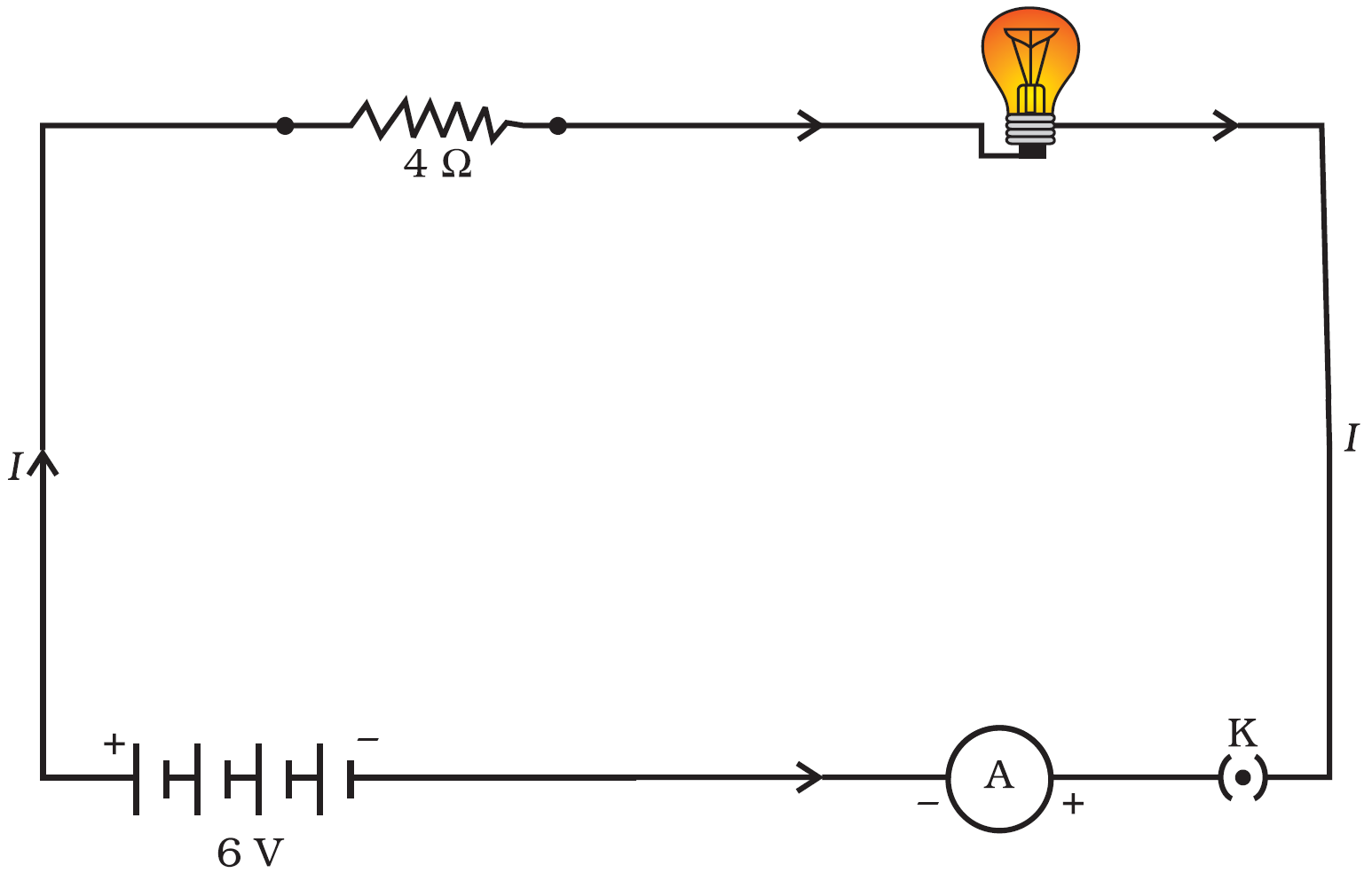
An electric lamp of resistance $20\Omega$ and a conductor of resistance $4\Omega$ are connected to a 6V battery as shown in the circuit. Calculate:
  1. The total resistance of the circuit,
  2. The current through the circuit,
  3. The potential difference across the (i) electric lamp and (ii) conductor, and
  4. Power of the lamp.
State two uses each of the following compounds:
  1. Sodium hydroxide.
  2. Chlorine.
  3. Hydrogen.
  4. Hydrochloric acid.