Describe the process of nutrition in Draw labelled diagrams to show the various steps in the nutrition in Amoeba.
Download our app for free and get started
Nutrition in amoeba: Nutrition in amoeba involves the following steps
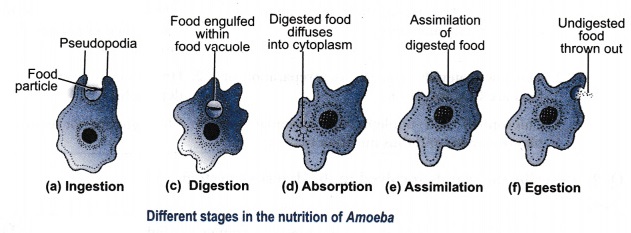
- Ingestion? Amoeba has no mouth for ingestion of food. It ingests the food by using its pseudopodia. The food is engulfed with little water to form a food vacuole.
- Digestion? The food is digested by digestive enzymes present in the cytoplasm which breaks the food into small soluble molecules by chemical reactions.
- Absorption? The digested food is absorbed directly into the cytoplasm by diffusion. The digested food spreads out from the food vacuole into the whole cell and after absorption the food vacuole disappears.
- Assimilation? Food is used to obtain energy through respiration and the remaining part of the food is used for growth.
- Egestion? The undigested food collects inside the cell and the cell membrane ruptures. Through this, the undigested food is thrown out of the body.

Download our appand get started for free
Experience the future of education. Simply download our apps or reach out to us for more information. Let's shape the future of learning together!No signup needed.*
Similar Questions
- 1View SolutionMention the major events during photosynthesis.
- 2View SolutionAn organism X having breathing organs A lives on land. When organism X goes under water, it cannot survive for a long time unless carrying an oxygen cylinder. On the other hand, the organism Y having breathing organs B always lives in water and if taken out of water, it dies after a short while. A third organism Z having breathing organs C and D which lives on the banks of ponds, lakes and rivers can survive on land as well as in water equally well.
- What could organism X be? Name the breathing organs A.
- What could organism Y be? Name the breathing organs B.
- What could organism Z be? Name the breathing organs C and D.
- Out of X, Y and Z, which organism is.
- Amphibian,
- Aquatic,
- Terrestrial?
- 3View SolutionIf the teeth are not cleaned regularly, they become covered with a sticky yellowish layer W of food particles and bacteria. Since layer W covers the teeth, the alkaline liquid X secreted by glands Y inside the mouth cannot reach the teeth surface to neutralise the acid formed by the action of organisms Z on sugary food, and hence tooth decay sets in.
- What is W known as?
- What is (i) X, and (ii) Y?
- What are organisms Z?
- State one way of removing layer W from the teeth.
- 4View SolutionSome sugar solution is taken in a test-tube and a little of substance X in powder form is added to it. The mouth of test - tube is closed with a cork and allowed to stand for sometime. On opening the cork, a characteristic smell of substance Y is obtained and a gas Z is also observed to be formed. The gas Z extinguishes a burning matchstick.
- What could be X, Y and Z?
- What is the process of converting sugar into substance Y by the action of X known as?
- What type of respiration is exhibited by X in the above process?
- 5View SolutionExplain the process of digestion of food in mouth, stomach and small intestine in human body.
- 6View SolutionHow is double circulation different from single circulation?
- 7View Solution
- Mention any two components of blood.
- Trace the movement of oxygenated blood in the body.
- Write the function of valves present in between atria and ventricles.
- Write one structural difference between the composition of artery and veins.
- 8View SolutionX is a wild animal which eats only the flesh of other animals whereas Y is a domestic animal which feeds mainly on green grass.
- What are animals like X known as?
- What are animals Y known as?
- Which animal, X or Y, has a longer small intestine? Why?
- Name one animal which is like X.
- Name one animal which is like Y.
- 9View SolutionWhy do we need a proper transportation system in plants?
- 10View SolutionGive the steps involved in photosynthesis.