Question
Describe the role of lymph

Answer

(i) Transport of nutrients and oxygen to the cells and tissues.
(ii) Removal of $CO_2$​​​​​​​ and nitrogenous wastes from the tissues and carry them to the blood.
(iii) It absorbs fatty acids and glycerol through lacteals.
(iv) It destroys harmful pathogens by its lymphocytes.
(v) It maintains body temperature.
(vi) It regulates protein level in the tissue fluid.

Need a full question paper?

Generate a complete, print-ready paper with questions like this in minutes — across 16+ boards, with answer keys.

Start Generating Free

Similar questions

Write short note on the following:
Hydathodes
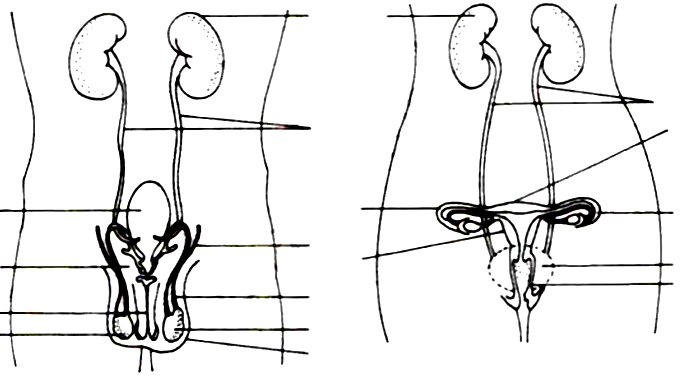
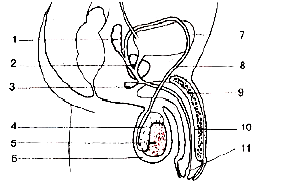
Given below is the schematic diagram of the sectional view of the human male reproductive system.

Name the parts numbered 1-11.
The diagram given below represents a structure found in a leaf.
Study the same and answer the questions that follow:
(i) Name the parts labelled as $A$ and $B$.
(ii) What is the biological term for the above structure?
(iii) What is the function of the part labelled A?
Label the folowing diagram
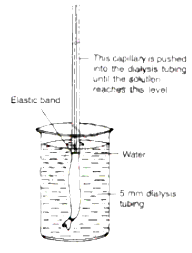
The apparatus arranged alongside signifies an important process.
(i) Name the process.
(ii) Where does this process occur in plants?
(iii) What solution is placed inside the dialysis tubing?
(iv) What happens to the level of the solution in the capillary tube?
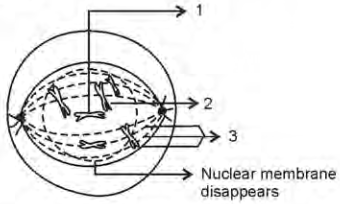
Given below is a diagram representing a stage during mitotic cell division in an animal cell. Examine it carefully and answer the questions which follow.
Image
(i) Identify the stage. Give one reason in support of your answer.
(ii) Name the cell organelle that forms the 'aster'.
(iii) Name the parts labelled as 1, 2, and 3.
(iv) Name the stage that follows the one shown here. How is that stage identified?
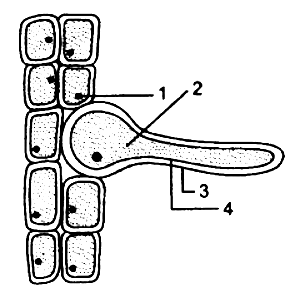
The below figure shows a root hair:

(i) Label the parts 1 to 4.
(ii) What is the role of part 4?
(iii) Why is the root hair one-celled?
(iv) What will happen to the root hair if some fertilizer is added to the soil near the root hair?
Give any four differences between photosynthesis and respiration.
In the figure below ‘A’ shows a cell in the normal state and ‘B’ shows the same cell after leaving it in a certain solution for a few minutes.
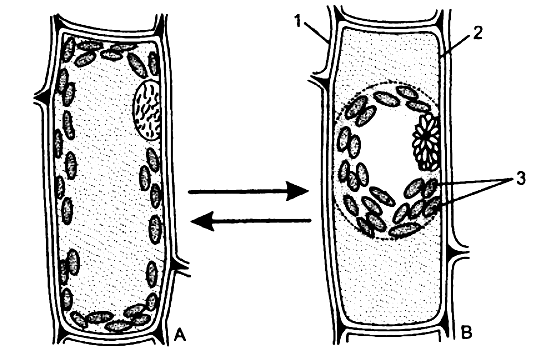

(i) Describe the change which has occurred in the cell as seen in B.
(ii) Give the technical term for the condition of the cell as reached in B and as it was in A.
(iii) Define the process which led to this condition.
(iv) What was the solution-isotonic, hypotonic or hypertonic, in which the cell was kept?
(v) How can the cell in B, be brought back to its original condition?
(vi) Name the parts numbered 1 to 3.
How is root hair structurally adapted for absorption of water from the soil?