Question
In the figure below ‘A’ shows a cell in the normal state and ‘B’ shows the same cell after leaving it in a certain solution for a few minutes.
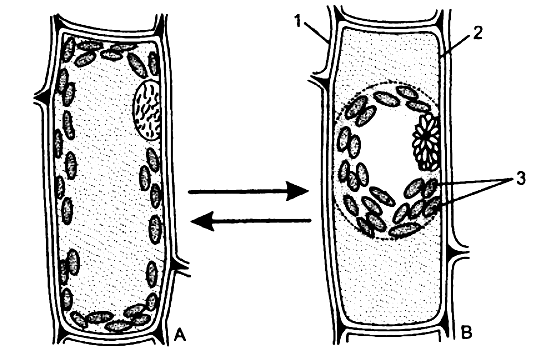

(i) Describe the change which has occurred in the cell as seen in B.
(ii) Give the technical term for the condition of the cell as reached in B and as it was in A.
(iii) Define the process which led to this condition.
(iv) What was the solution-isotonic, hypotonic or hypertonic, in which the cell was kept?
(v) How can the cell in B, be brought back to its original condition?
(vi) Name the parts numbered 1 to 3.
Answer

(i) Exosmosis (exit of water) has resulted in the shrinkage of the protoplasm of cell B.
(ii) Plasmolysis and deplasmolysis.
(iii) When plant cells are kept in a hypertonic solution, exosmosis takes place. This process is called plasmolysis.
(iv) Hypertonic solution.
(v) The cell in B can be brought back to its original condition by placing it in a drop of distilled water.
(vi) 1. Cell wall, 2. Plasma membrane, 3. Chloroplast.

Need a full question paper?

Generate a complete, print-ready paper with questions like this in minutes — across 16+ boards, with answer keys.

Start Generating Free

Similar questions

Enumerate the steps involved in testing a green leaf for the presence of starch.
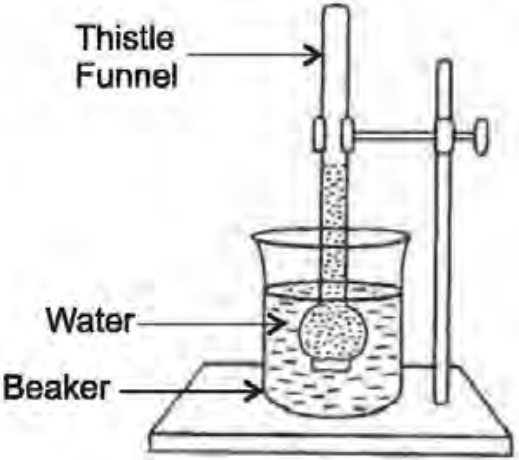
Given diagram represents an apparatus set-up to study a very important physiological process.
(i) Name the process being studied.
(ii) Explain the process.
(iii) What change would you observe in the thistle funnel containing sugar Thistle Funnel solution after about 10 minutes?

Image
Differentiate: Cretinism and Myxedema.
You must have heard about marble cancer of Taj Mahal. Answer the given questions based on it:
(i) What is the marble cancer?
(ii) What causes this to the Taj Mahal?
(iii) What steps did the Supreme Court of India take regarding it?
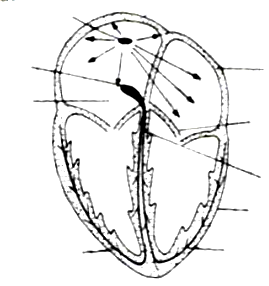
Label the following diagram :
The figure below represents an experiment performed to demonstrate a particular aspect of photosynthesis. The apparatus was kept in sunlight for almost the whole day. The numeral $‘1’$ represents a certain condition inside the flask and the numeral $‘2’$ represents a chemical responsible for this condition.
(i) What is the object of the experiment?
(ii) What is the special condition inside the flask?
(iii) What is the chemical substance numbered ‘2’?
(iv) In what way will the three leaves ($A, B$, and $C$) differ at the end of the experiment, when tested with iodine solution?
Sketch and label the structure of adrenal gland.
Give two examples of turgor movements in plants.
Differentiate between the following:
Blood and lymph
A certain couple got four daughters in a sequence and no son. Does it mean that the husband does not produce Y-chromosome bearing sperms? Explain. What is the chance of this couple having a daughter?