Question
Describe the structure and functions of nucleus.
Describe the structure and functions of nucleus.
Structure of Nucleus: Nucleus is a dense, spherical or oval, dot like structure located centrally in the cell. It is bounded by two nuclear membranes, both forming nuclear envelope. Nuclear envelope separates the nucleus from the cytoplasm. It contains large number of pores which control the passage of substances outside or inside the nucleus.
Inside the nuclear envelope is the nucleoplasm or nuclear sap. It is transparent, semi-fluid and contains a large number of enzymes which are required for the synthesis and functioning of RNA and DNA. Within the nucleoplasm, two structures are embedded-chromatin material and nucleolus.
Chromatin material is a tangled fibrous mass. The chromatin material condenses to form chromosomes during cell division. Chromosomes contain information for inheritance of features from parents to next generation in the form of DNA (Deoxyribo Nucleic Acid) molecules. Chromosomes are composed of DNA and protein. DNA molecules contain the information necessary for constructing and organising cells. Functional segments of DNA are called genes.
Nucleolus may be one or more in number and is not bounded by any membrane. It is rich in protein and RNA molecules. Nucleolus acts as the site for ribosome formation, hence it is known as factory of ribosomes.
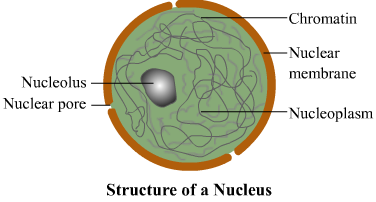
Functions of nucleus:
Generate a complete, print-ready paper with questions like this in minutes — across 16+ boards, with answer keys.
Name seven types of cells found in stem of sun flower.
Write about structure and function of smooth muscle fibres.
What is sclerenchyma? Describe location, structure and economic importance of this tissue.
Set up an experiment to demonstrate osmosis.
What is symbiosis? Name a symbiotic life form. Mention specific organisms which display the symbiotic relationship in this life form.
Write short notes on:
Discuss the structure and functions of mitochondria.