Question
Describe Young’s double slit interference experiment and derive conditions for occurrence of dark and bright fringes on the screen. Define fringe width and derive a formula for it.
Answer


Description of Young’s double-slit interference experiment:
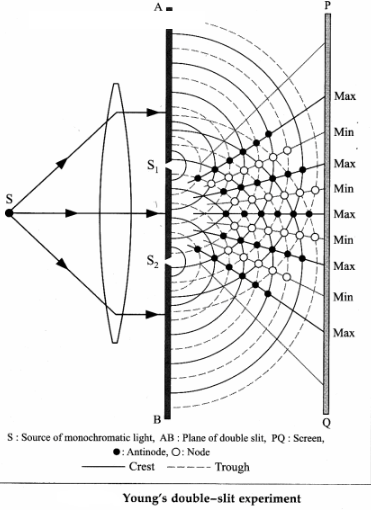
1. A plane wavefront is obtained by placing a linear source $S$ of monochromatic light at the focus of a convex lens. It is then made to pass through an opaque screen $A B$ having two narrow and similar slits $S_1$ and $S_2 \cdot S_1$ and $S_2$ are equidistant from $S$ so that the wavefronts starting simultaneously from $S$ and reaching $S_1$ and $S_2$ at the same time are in phase. A screen PQ is placed at some distance from screen $A B$ as shown in below figure

Image
  1. $S_1$ and $S_2$ act as secondary sources. The crests/-troughs of the secondary wavelets superpose and interfere constructively along straight lines joining the black dots shown in above figure. The point where these lines meet the screen have high intensity and are bright.
  2. Similarly, there are points shown with red dots where the crest of one wave coincides with the trough of the other. The corresponding points on the screen are dark due to destructive interference.
  3. These dark and bright regions are called fringes or bands and the whole pattern is called interference pattern.
Conditions for occurence of dark and bright fringes on the screen :
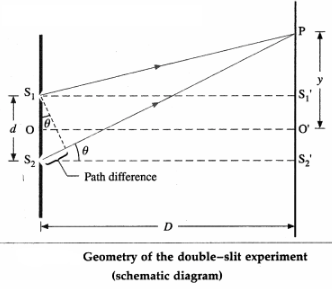
Consider Young's double-slit experimental set up. Two narrow coherent light sources are obtained by wavefront splitting as monochromatic light of wavelength $\lambda$ emerges out of two narrow and closely spaced, parallel slits $S_1$ and $S _2$ of equal widths. The separation $S _1 S_2= d$ is very small. The interference pattern is observed on a screen placed parallel to the plane of and at considerable distance $D(D \gg d)$ from the slits. $O O$ ' is the perpendicular bisector of segment $S_1 S_2$.


Image
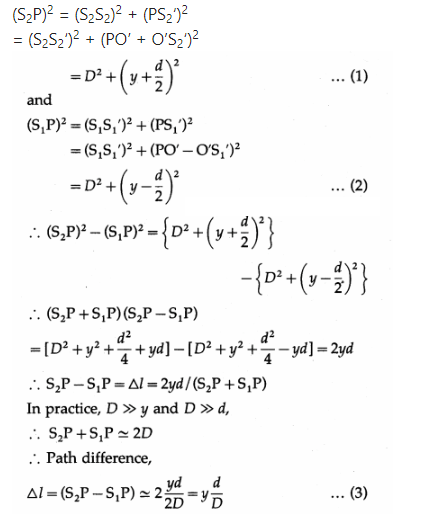
Consider, a point $P$ on the screen at a distance $y$ from $O^{\prime}(y \& D)$. The two light waves from $S_1$ and $S_2$ reach $P$ along paths $S_1 P$ and $S_2 P$, respectively. If the path difference $(\Delta I)$ between $S_1 P$ and $S_2 P$ is an integral multiple of $\lambda$, the two waves arriving there will interfere constructively producing a bright fringe at $P$. On the contrary, if the path difference between $S_1 P$ and $S_2 P$ is half integral multiple of $\lambda$, there will be destructive interference and a dark fringe will be produced at $P$.
From above figure,​​​​​​​
Image
Expression for the fringe width (or band width) : The distance between consecutive bright (or dark) fringes is called the fringe width (or band width) W. Point $P$ will be bright (maximum intensity), if the path difference, $\Delta l = y _{ n } \frac{d}{D}=n \lambda$ where $n=0,1,2,3 \ldots$, Point $P$ will be dark (minimum intensity equal to zero), if $y_m \frac{d}{D}=(2 m-1) \frac{\lambda}{2}$, where, $m=1,2,3 \ldots$, Thus, for bright fringes (or bands),
$y_n=0, \lambda \frac{D}{d}, \frac{2 \lambda D}{d} \ldots \ldots$
and for dark fringes (or bands),
$y_m=\frac{\lambda D}{2}, 3 \frac{\lambda}{2} \frac{D}{d}, 5 \frac{\lambda}{2} \frac{D}{d} \cdots \cdots$
These conditions show that the bright and dark fringes (or bands) occur alternately and are equally - spaced. For Point $O ^{\prime}$, the path difference $\left( S _2 O ^{\prime}- S _1 O ^{\prime}\right)=0$. Hence, point $O ^{\prime}$ will be bright. It corresponds to the centre of the central bright fringe (or band). On both sides of $O^{\prime}$, the interference pattern consists of alternate dark and bright fringes (or band) parallel to the slit.
Let y$_n $and $y_{n + 1},$ be the distances of the nth and $(n + 1)^{th}​​​​​​​$^ bright fringes from the central bright fringe.
$\therefore \frac{y_n d}{D}=n \lambda \quad \therefore y_n=\frac{n \lambda D}{d}$
and $\frac{y_{n+1} d}{D}=(n+1) \lambda \quad \therefore y_{n+1}=\frac{(n+1) \lambda D}{d} \ldots$
The distance between consecutive bright fringes $=y_{n+1}-y_n=\frac{\lambda D}{d}[(n+1)-n]=\frac{\lambda D}{d}$
Hence, the fringe width,
$\therefore W=\Delta y=y_{n+1}-y_n=\frac{\lambda D}{d} \text { (for bright fringes) } \ldots$
Alternately, let $y_m$ and $y_{m+1}$ be the distances of the $m$ th and $(m+1)^{\text {th }}$ dark fringes respectively from the central bright fringe.
$ \therefore \frac{y_m d}{D}=(2 m-1) \frac{\lambda}{2} \text { and }$
$\frac{y_{m+1} d}{D}=[2(m+1)-1] \frac{\lambda}{2}=(2 m+1) \frac{\lambda}{2}$
$\therefore y_m=(2 m-1) \frac{\lambda D}{2 d} \text { and }$
$y_{m+1}=(2 m+1) \frac{\lambda D}{2 d} $
$\therefore$ The distance between consecutive dark fringes,
$ y_{m+1}-y_m=\frac{\lambda D}{2 d}[(2 m+1)-(2 m-1)]=\frac{\lambda D}{d}$
$\therefore W=y_{m+1}-y_m$
$=\frac{\lambda D}{d} \text { (for dark fringes) }$
Eqs. $(7)$ and $(11)$ show that the fringe width is the same for bright and dark fringes.
[Note: In the first approximation, the path difference is $d \sin \theta$.]


Need a full question paper?

Generate a complete, print-ready paper with questions like this in minutes — across 16+ boards, with answer keys.

Start Generating Free

Similar questions

State the principle of working of the Van de Graaff generator. Describe its construction with a neat labelled diagram.
Represent graphically intensity distribution in
(a) Young’s double-slit interference
(b) single- slit diffraction and
(c) double-slit diffraction
Describe the phenomenon of surface tension, giving four examples.
What is a rectifier ? With the help of a neat circuit diagram, explain the working of a half wave rectifier.
A simple pendulum of length $100\ cm$ performs $S.H.M.$ Find the restoring force acting on its bob of mass $50\ g$ when the displacement from the mean position is $3\ cm.$
Deduce the expression for kinetic energy, potential energy, and total energy of a particle performing S.H.M. State the factors on which total energy depends.
Derive the relation between surface tension and surface energy per unit area.
The intensity of the light coming from one of the slits in Young’s experiment is twice the intensity of the light coming from the other slit. What will be the approximate ratio of the intensities of the bright and dark fringes in the resulting interference pattern? 
An electron is circulating around the nucleus of an $H-$atom in a circular orbit of radius $5.3 \times 10^{-11} m$ Calculate the electric potential energy of the atom in $eV$.
Complete the following equations describing nuclear decays.
(a) ${ }_{86}^{226} Ra \rightarrow \alpha+$
(b) ${ }_8^{19} O \rightarrow e^{-}+$
(c) ${ }_{90}^{228} Th \rightarrow \alpha+$
(d) ${ }_7^{12} N \rightarrow{ }_6^{12} C +$