Question
Describe/Explain single slit diffraction using a simple day to day life example.
###
Describe a simple experiment (/activity) to see single slit diffraction.

Answer

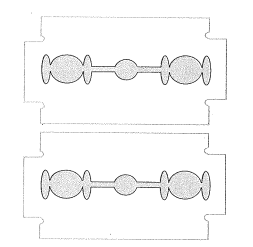
Image

It is very easy to see the single-slit diffraction pattern for oneself.
The equipment needed can be found in most homes-two razor blades and one clear glass electric bulb preferably with a straight filament.
One has to hold two blades so that the edges are parallel and have a narrow slit in between. This is easily done using the thumb and forefingers (fig.)
Keep the slit parallel to the filament, right in front of the eye. Use the spectacles if you normally do. With slight adjustment of the width of the slit and the parallelism of the edges, the pattern should be seen with its bright and dark bands.
Since the position of all the bands (except the central one) depends on wavelength, they will show some colours.
Using a filter for red or blue will make the fringes clearer. With both filters available, the wider fringes for red compared to blue can be seen.
→Another example :
In case of a dark room, where there is some light entering from outside, if the door is kept slightly open, the diffraction pattern can be seen on the tiles.
Need a full question paper?

Generate a complete, print-ready paper with questions like this in minutes — across 16+ boards, with answer keys.

Start Generating Free

Similar questions

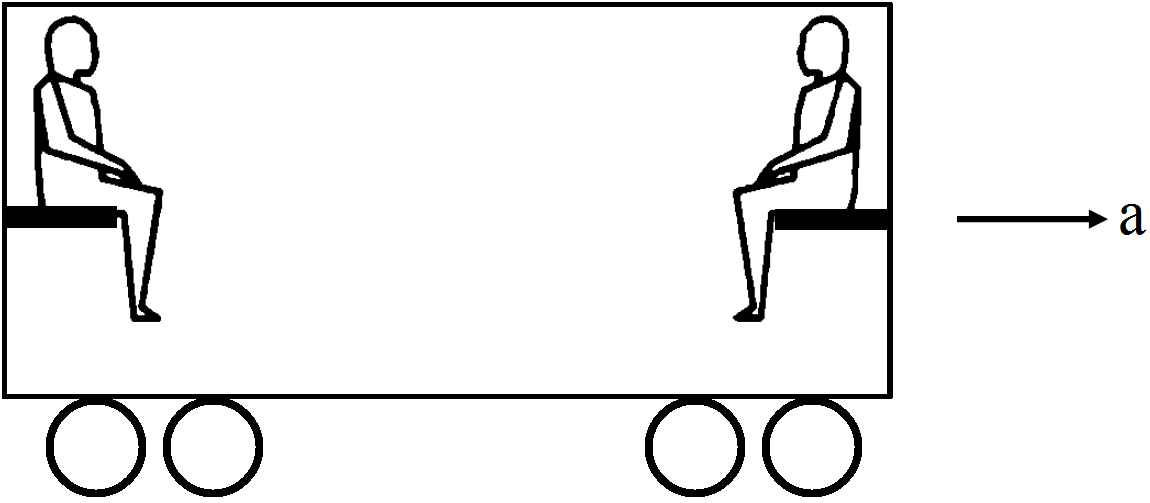
Which of the two persons shown in figure is more likely to fall down? Which external force is responsible for his falling down?
100%
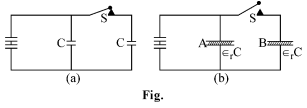
Two capacitors of equal capacitance are connected to a battery as shown. Switch $S$ is initially in closed state. Now the switch $S$ is opened and a material of dielectric constant $\epsilon_r=3$ is filled between the plates of the capacitor. Find the ratio of the values of electrical energy stored in the capacitors before and after placing the dielectric material. Image
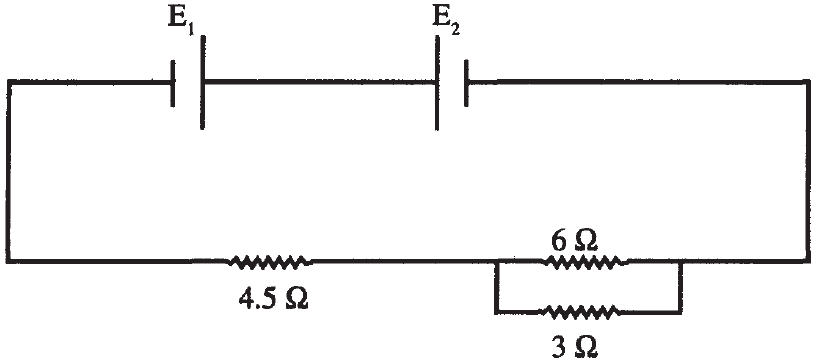
Two cells $E_1$ and $E_2$ in the given circuit diagram have an emf of $5 V$ and $9 V$ and internal resistance of $0.3 \Omega$ and $1.2 \Omega$ respectively.
Calculate the value of current flowing through the resistance of $3 \Omega$.
Electrons are continuously mobile in any conductor but then too, no electric current flows in the conductor till an electric source is joined across its ends. Explain.
Give an example for which $\overrightarrow{\text{A}}.\overrightarrow{\text{B}}=\overrightarrow{\text{C}}.\overrightarrow{\text{B}}$ but $\overrightarrow{\text{A}}\neq\overrightarrow{\text{C}}.$
Two cells of emf 10V and 2V and internal resistance $10\Omega$ and $5\Omega$ respectively, are connected in parallel as shown. Find the effective voltage across R. 
A lamp attached to a cycle glows by a dynamo. When cycle is moved at greater speed, the lamp glows brightly and when cycle moves with a lesser speed, it glows dimly. Why?
In a long straight wire, a current of 5 A is flowing. How much magnetic field will be produced at a distance of 10 cm from it? Which rule will give the direction of the field?
What is the importance of binding energy per nucleon ?
What is the average value of ac voltage
$\text{V = V}_0\sin\omega\text{t}$
Over the time interval t = 0 to $\text{t}=\frac{\pi}{\omega}.$