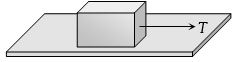
Determine the maximum acceleration in $m/s^2$ of the train in which a box lying on its floor will remain stationary, given that the co-efficient of static friction between the box and the train’s floor is $0.15.$
Easy
Download our app for free and get started
Answer since the acceleration of the box is due to the static friction.
$m a=f_{s} \leq \mu_{s} N=\mu_{s} m g$
ie. $a \leq \mu_{s} g$
$\therefore a_{\max }=\mu_{ s } g=0.15 \times 10 m s ^{-2}$
$=1.5 m s ^{-2}$

Download our appand get started for free
Experience the future of education. Simply download our apps or reach out to us for more information. Let's shape the future of learning together!No signup needed.*
Similar Questions
- 1A car of weight $W$ is on an inclined road that rises by $100\,m$ over a distance of $1\,Km$ and applies a constant frictional force $\frac {W}{20}$ on the car. While moving uphill on the road at a speed of $10\,ms^{-1},$ the car needs power $P.$ If it needs power $\frac {P}{2}$ while moving down hill at speed $v$ then value of $v$ is ........ $ms^{-1}$View Solution
- 2In the figure shown, a block of weight $10 \,N$ resting on a horizontal surface. The coefficient of static friction between the block and the surface ${\mu _s} = 0.4$. A force of $3.5\, N$ will keep the block in uniform motion, once it has been set in motion. A horizontal force of $3 \,N$ is applied to the block, then the block willView Solution
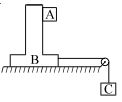
- 3In the arrangement shown in the figure, mass of the block $B$ and $A$ is $2m$ and $m$ respectively. Surface between $B$ and floor is smooth. The block $B$ is connected to the block $C$ by means of a string pulley system. If the whole system is released, then find the minimum value of mass of block $C$ so that block $A$ remains stationary $w.r.t. B$. Coefficient of friction between $A$ and $B$ is $\mu$View Solution
- 4A force of $750 \,N$ is applied to a block of mass $102\, kg$ to prevent it from sliding on a plane with an inclination angle $30°$ with the horizontal. If the coefficients of static friction and kinetic friction between the block and the plane are $0.4 $ and $0.3$ respectively, then the frictional force acting on the block is...... $N$View Solution
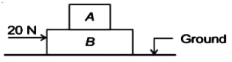
- 5Blocks shown in figure moves with constant velocity $10 \,m / s$ towards right. All surfaces in contact are rough. The friction force applied by $B$ on $A$ is ...........$N$View Solution
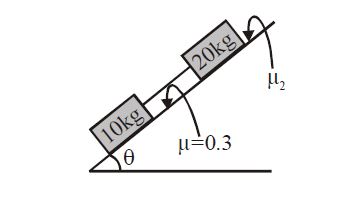
- 6Value of $\theta$ is increased gradually from $\theta = 0$ At $\theta=tan^{-1}(\frac{1}{2})$ both the block just start slipping. Then value of $\mu_2$ is : $(g = 10 m/s^2)$View Solution
- 7A car is moving with a constant speed of $20\,m / s$ in a circular horizontal track of radius $40\,m$. A bob is suspended from the roof of the car by a massless string. The angle made by the string with the vertical will be : (Take $g =10$ $\left.m / s ^2\right)$View Solution
- 8View SolutionChoose the correct statement.
- 9A child weighing $25$ kg slides down a rope hanging from the branch of a tall tree. If the force of friction acting against him is $2\, N$, ........ $m/s^2$ is the acceleration of the child (Take $g = 9.8\,m/{s^2})$View Solution
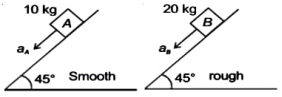
- 10The ratio of acceleration of blocks $A$ placed on smooth incline with block $B$ placed on rough incline is $2: 1$. The coefficient of kinetic friction between block $B$ and incline is .........View Solution