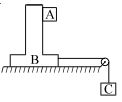
In the arrangement shown in the figure, mass of the block $B$ and $A$ is $2m$ and $m$ respectively. Surface between $B$ and floor is smooth. The block $B$ is connected to the block $C$ by means of a string pulley system. If the whole system is released, then find the minimum value of mass of block $C$ so that block $A$ remains stationary $w.r.t. B$. Coefficient of friction between $A$ and $B$ is $\mu$
Advanced
Download our app for free and get started

Download our appand get started for free
Experience the future of education. Simply download our apps or reach out to us for more information. Let's shape the future of learning together!No signup needed.*
Similar Questions
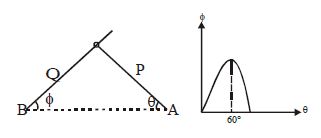
- 1A rod $P$ of length $1\ m$ is hinged at one end $A$ and there is a ring attached to the other end. Another long rod $Q$ is hinged at $B$ and it passes through the ring. The rod $P$ is rotated about an axis which is perpendicular to plane in which both the rods are present and the variation between the angles $\theta$ and $\phi $ are plotted as shown. The distance between the hinges $A$ and $B$ is ....... $m$.View Solution
- 2Find the maximum velocity for skidding for a car moved on a circular track of radius $100\, m$. The coefficient of friction between the road and tyre is $0.2$ ....... $m/s$View Solution
- 3A block of mass $4\, kg$ rests on an inclined plane. The inclination of the plane is gradually increased. it is found that when the inclination is $3$ in $5\left( {\sin \theta = \frac{3}{5}} \right)$, the block just begins to slide down the plane. The coefficient of friction between the block and the plane isView Solution
- 4Two stones of masses $m$ and $2\,m$ are whirled in horizontal circles, the heavier one in a radius $\frac{r}{2}$ and the lighter one in radius $r.$ The tangential speed of lighter stone is $n$ times that of the value of heavier stone when they experience same centripetal forces. The value of $n$ isView Solution
- 5A particle has initial velocity $10\,\, m/s$. It moves due to constant retarding force along the line of velocity which produces a retardation of $5\,\, m/s^2$. ThenView Solution
- 6A block of mass $10\, kg$ is placed on a rough horizontal surface having coefficient of friction $\,\mu = 0.5$. If a horizontal force of $100\, N$ is acting on it, then acceleration of the block will be ....... $m/s^2$View Solution
- 7A block of mass $5$ kg lies on a rough horizontal table. A force of $19.6\, N$ is enough to keep the body sliding at uniform velocity. The coefficient of sliding friction isView Solution
- 8If force $F$ is increasing with time and at $t = 0 , F = 0$ where will slipping first start?View Solution
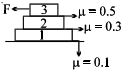
- 9The maximum $"F"$ which will not cause motion of any of the blocks. ...... $N$View Solution
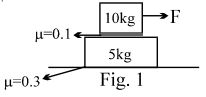
- 10View SolutionA motorcyclist of mass m is to negotiate a curve of radius r with a speed v. The minimum value of the coefficient of friction so that this negotiation may take place safely, is