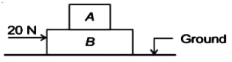
Blocks shown in figure moves with constant velocity $10 \,m / s$ towards right. All surfaces in contact are rough. The friction force applied by $B$ on $A$ is ...........$N$
Easy


Download our appand get started for free
Experience the future of education. Simply download our apps or reach out to us for more information. Let's shape the future of learning together!No signup needed.*
Similar Questions
- 1A bag is gently dropped on a conveyor belt moving at a speed of $2\,m / s$. The coefficient of friction between the conveyor belt and bag is $0.4$ Initially, the bag slips on the belt before it stops due to friction. The distance travelled by the bag on the belt during slipping motion is $.....m$ [Take $g=10\,m / s ^{-2}$ ]View Solution
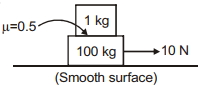
- 2The frictional force acting on $1 \,kg$ block is .................. $N$View Solution
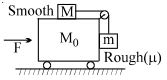
- 3Imagine $a$ situation in which the horizontal surface of block $M_0$ is smooth and its vertical surface is rough with $a$ coefficient of friction $\mu$ In above problem, choose the correct value $(s)$ of F which the blocks $M$ and $m$ remain stationary with respect to $M_0$View Solution
- 4A marble block of mass $2\, kg$ lying on ice when given a velocity of $6 \,m/s$ is stopped by friction in $10\,s$. Then the coefficient of friction isView Solution
- 5A body of mass $100\, g$ is sliding from an inclined plane of inclination $30^°$. What is the frictional force experienced if $\mu = 1.7$View Solution
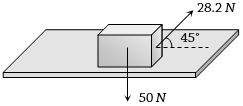
- 6A body of weight $50 \,N$ placed on a horizontal surface is just moved by a force of $28.2\, N$. The frictional force and the normal reaction areView Solution
- 7Consider a block and trolley system as shown in figure. If the coefficient of kinetic friction between the trolley and the surface is $0.04$ , the acceleration of the system in $\mathrm{ms}^{-2}$ is :View Solution
(Consider that the string is massless and unstretchable and the pulley is also massless and frictionless):
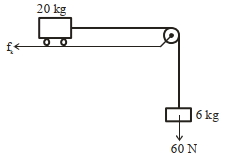
- 8View SolutionWhich one of the following statements is incorrect?
- 9A body of mass M is kept on a rough horizontal surface (friction coefficient $\mu $). A person is trying to pull the body by applying a horizontal force but the body is not moving. The force by the surface on the body is $F$, whereView Solution
- 10Two masses $M$ and $m$ are attached to a vertical axis by weightless threads of combined length $l$. They are set in rotational motion in a horizontal plane about this axis with constant angular velocity $\omega $. If the tensions in the threads are the same during motion, the distance of $M$ from the axis isView Solution