Question
  1. Determine the value of phase difference between the current and the voltage in the given series $\text{LCR}$ circuit.
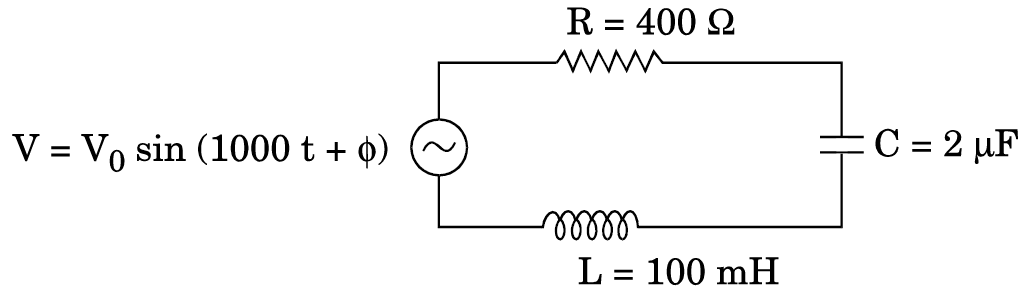
  1. Calculate the value of the additional capacitor which may be joined suitably to the capacitor $C$ that would make the power factor of the circuit unity.

Answer

  1. In $\text{LCR}$ circuit: $\tan\varphi= \frac{\text{X}_{L} - \text{X}_{c}}{\text{R}} = \frac{\text{wL} - \frac{1}{\text{wC}}}{\text{R}}$
Now $\text{X}_{L} = \text{wL} = ( 1000\times100\times10^{-3})\Omega$
$= 100\Omega$
and $\text{X}_{c} = \frac{1}{\text{wc}} = \bigg(\frac{1}{100\times2\times10^{-6}}\bigg)\Omega$
$\therefore\text{X}_{c} = 500 \Omega$
$\therefore\tan\varphi = \frac{500 - 100}{400} = 1 $
$\tan\varphi = 1 $
$\varphi = 45^{o}$
  1. Power Factor:
When power factor $= 1,$ we have $X_L=X_C$
$\therefore\text{X'}_{c} = \frac{1}{\omega\text{C}'} = 100 \Omega$
This gives $\text{C'} = \frac{1}{100\omega} = 10 \mu\text{F}$
We, therefore, need to add a capacitor of capacitance $(10-2) \mu F = 8\mu F$ in parallel with the given capacitor.
Alternate Answer
Let addition capacitance $C_1$ be connected:
$\text{X}'_{c} = \frac{1}{1000(2 + \text{C}_{1})\times10^{-6}}$
$\therefore100 = \frac{1}{1000(2 + \text{C}_{1})\times10^{-6}}$
$\therefore2 + \text{C}_{1} = 10 $
$\text{C}_{1} = 8 \mu\text{F}$.

Need a full question paper?

Generate a complete, print-ready paper with questions like this in minutes — across 16+ boards, with answer keys.

Start Generating Free

Similar questions

Two capacitors of unknown capacitances $C_1$ and $C_2$ are connected first in series and then in parallel across a battery of $100 V$. If the energy stored in the two combinations is $0.045 J$ and $0.25 J$ respectively, determine the value of $C_1 $ and $C_2$. Also calculate the charge on each capacitor in parallel combination.
A resistance R and a capacitor C are connected in series to a source $\text{V}=\text{V}_0\sin\omega\text{t}.$
Find:
  1. The peak value of the voltage across the (i) resistance and (ii) capacitor.
  2. The phase difference between the applied voltage and current. Which of them is ahead?
An $AC$ source of voltage $\text{V = Vm}\sin\omega\text{t}$ is applied across a series $\text{LCR}$ circuit. Draw the phasor diagrams for this circuit, when,
  1. Capacitive impedance exceeds the inductive impedance.
  2. Inductive impedance exceeds capacitive impedance.
State Lenz's law. Give one example to illustrate this law. "The Lenz's law is a consequence of the principle of conservation of energy." Justify this statement.
Draw a plot showing the variation of photoelectric current with collector plate potential for two different frequencies, $ν_1 > ν_2,$ of incident radiation having the same intensity. In which case will the stopping potential be higher? Justify your answer.
The electric field in a region is given by $\overrightarrow{\text{E}}=\frac{3}{5}\text{E}_0\overrightarrow{\text{i}}+\frac{4}{5}\text{E}_0\overrightarrow{\text{j}}$ with $\text{E}_0=2.0\times10^3\text{NC}^{-1}.$ Find the flux of this field through a rectangular surface of area $0.2m^2$ parallel to the $y-z$ plane.
Magnetic moment of a small bar magnet is 0.24 newton metre tesla ${ }^{-1}$. Calculate magnetising field of the magnet at a distance of 10 cm from the centre of the magnet on its axis.
A tank is filled with water to a height of 12.5 cm. The apparent depth of a needle lying at the bottom of the tank is measured by a microscope to be 9.4 cm. What is the refractive index of water? If water is replaced by a liquid of refractive index 1.63 up to the same height, by what distance would be the microscope have to be moved to focus on the needle again?
  1. Name the waves which are suitable for radar systems used in aircraft navigation. Write the range of frequency of these waves.
  2. If the earth did not have atmosphere, would its average surface temperature be higher or lower than what it is now? Explain.
  3. An wave exerts pressure on the surface on which it is incident. Justify.
A water particle of mass $10.0\ mg$ and having a charge of $1.50 \times 10^{-6}C$ stays suspended in a room. What is the magnitude of electric field in the room? What is its direction?