Question
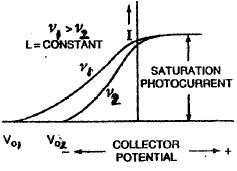
Draw a plot showing the variation of photoelectric current with collector plate potential for two different frequencies, $ν_1 > ν_2,$ of incident radiation having the same intensity. In which case will the stopping potential be higher? Justify your answer.
Answer


Stopping potential is more for the curve corresponding to frequency $v_{1 }$ Stopping potential is directly proportional to the frequency of incident radiation.
Alternate Answer
The maximum energy$($of the emitted photoelectrons$)$ increases with an increase in the frequency of the incident radiation.

Need a full question paper?

Generate a complete, print-ready paper with questions like this in minutes — across 16+ boards, with answer keys.

Start Generating Free

Similar questions

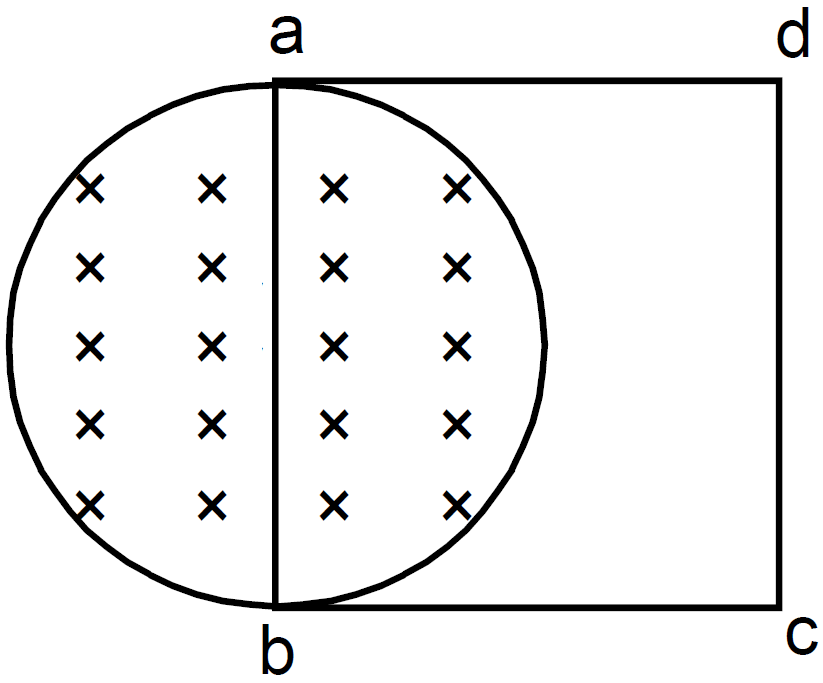
A uniform magnetic field B exists in a cylindrical region of radius 10cm as shown in figure. A uniform wire of length 80cm and resistance $4.0\Omega$ is bent into a square frame and is placed with one side along a diameter of the cylindrical region. If the magnetic field increases at a constant rate of 0.010T/s, find the current induced in the frame.
What physical quantity is the same for $X-$rays of wavelength $10^{-10} m,$ red light of wavelength $6800 \mathring A$ and radiowaves of wavelength $500m$?
A parallel plate capacitor is charged to a potential difference V from a direct current source, while there is air between the plates. Without separating the capacitor from the battery, a dielectric medium of dielectric constant K has been filled in place of air. Explain with reasons which of the following changes will occur? Also give explanation of the answers.(i) Potential difference (ii) Electric field between the plates (iii) Capacitance (iv) charge (v) energy.
A 12.5 eV electron beam is used to bombard gaseous hydrogen at room temperature. Upto which energy level the hydrogen atoms would be excited? Calculate the wavelengths of the first member of Lyman and first member of Balmer series.
Two small balls A and B, each of mass m, are joined rigidly by a light horizontal rod of length L. The rod is clamped at the centre in such a way that it can rotate freely about a vertical axis through its centre. The system is rotated with an angular speed w about the axis. A particle P of mass m kept at rest sticks to the ball A as the ball collides with it. Find the new angular speed of the rod.
A particle moves in a circle of radius 1.0cm at a speed given by v = 2.0t where v is in cm/s and t in seconds.
  1. Find the radial acceleration of the particle at t = 1s.
  2. Find the tangential acceleration at t = 1s.
  3. Find the magnitude of the acceleration at t = 1s.
A point charge is moving along a straight line with a constant velocity u. Consider a small area A perpendicular to the direction of motion of the charge (El). Calculate the displacement current through the area when its distance from the charge is x. The value of x is not large so that the electric field at any instant is essentially given by Coulomb's law.
A partially plane polarised beam of light is passed through a Polaroid. Show graphically the variation of the transmitted light intensity with angle of rotation of the Polaroid.
In a pure semiconductor, the number of conduction electrons is $6 \times 10^{19}$ per cubic metre. How many holes are there in a sample of size $1\ cm \times 1\ cm \times 1mm$?
It is said that any charge given to a conductor comes to its surface. Should all the protons come to the surface? Should all the electrons come to the surface? Should all the free electrons come to the surface?
