Question
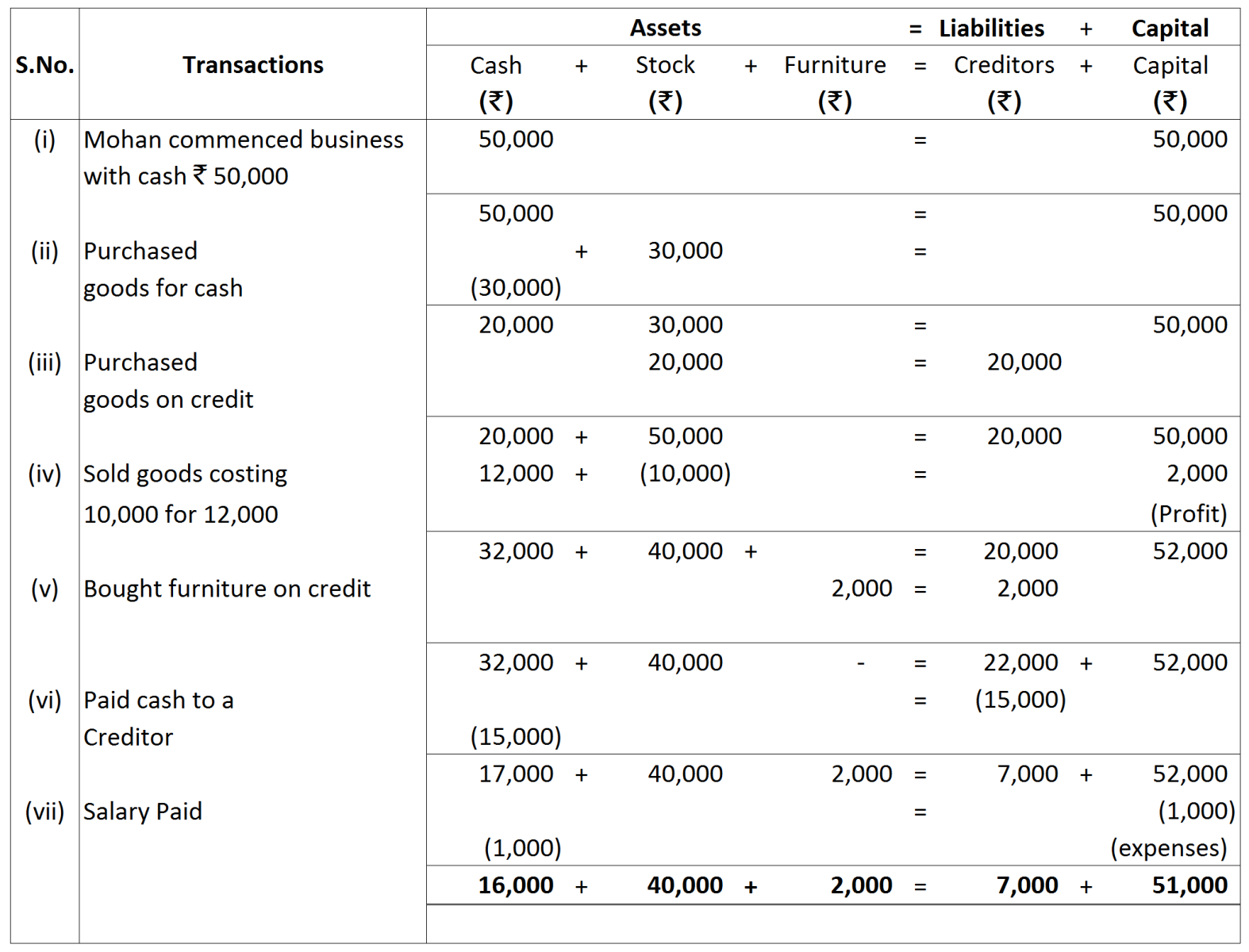
Develop an Accounting Equation from the following transactions:
S.no  
(i) Mohan commenced business with cash 50,000
(ii) Purchased goods for cash 30,000
(iii) Purchased goods on credit 20,000
(iv) Sold goods (costing ₹ 10,000) for 12,000
(v) Bought furniture on credit 2,000
(vi) Paid cash to a creditor 15,000
(vii) Salary paid 1,000

Answer


Assets = 16,000 + 40,000 + 2,000 = ₹ 58,000
Liabilities = ₹ 7,000
Capital = ₹ 51,000

Need a full question paper?

Generate a complete, print-ready paper with questions like this in minutes — across 16+ boards, with answer keys.

Start Generating Free

Similar questions

Trial Balance of a bookkeeper shows an excess of debits over credits by ₹ 261. This difference is placed in a Suspense Account to facilitate books closure. Later on the following errors were discovered:
  1. A credit item of ₹ 349 has been debited to a Personal Account as ₹ 439.
  2. A sum of ₹ 625 written off from fixtures as depreciation has not been posted to the Depreciation Account.
  3. ₹ 9,000 paid for furniture bought have been charged to the Purchases Account.
  4. A discount allowed to a customer has been credited to him as ₹ 145 in place of ₹ 154.
  5. A sale of ₹ 594 was posted as ₹ 495 in the Sales Account.
  6. The total of Returns Inward Book has been added ₹ 10 short.
Pass the Journal entries to correct these errors and prepare the Suspense Account.
2017
 
Jan 1
Assets: Cash in hand ₹ 12,400; Stock ₹ 3,60,000; Debtors : Abhilash ₹ 20,000; Bhuwan ₹ 30,000, Charu ₹ 52,000; Furniture ₹ 2,25,000.
 
Liabilities: Bank overdraft ₹ 38,000; Creditors : Dinesh ₹ 15,000; Eknath ₹ 25,000.  
Jan 3
Purchased from Raghuraj & Sons:
 
Jan 5
80 electric Kettles @ ₹ 300 each  
40 electric irons @ ₹ 420 each  
20% Trade Discount.  
Withdrew from Bank.
 
Jan 6
Acceptance received from Abhilash at one month for the amount due from him.
20,000
Jan 10
Purchased a computer from Gursharan Bros. on credit for office use
40,000
Jan 12
Returned 10 electric kettles to Raghuraj & Sons.
 
Jan 14
Paid Raghuraj & Sons by cheque the balance due to them.
 
Jan 15
Paid to Gursharan Bros. ₹ 30,000 in cash and the balance by a cheque.
 
Jan 16
Paid wages in cash
 
Jan 20
Purchased from Dinesh:
500
10 Washing Machines @ ₹ 16,000 each  
4 Vacuum cleaners @ ₹ 6,000 each  
15% Trade Discount  
Jan 22
Sold to Charu:
 
200 electric shavers @ ₹ 250 each  
400 toasters @ ₹ 150 each  
450 heaters @ ₹ 200 each  
10% Trade Discount  
Jan 24
Received from Charu a cheque in full settlement of his account. The cheque is paid into bank.
2,30,000
Jan 25
Acceptance given to Dinesh for 30 days.
1,50,000
Jan 25
Cheque issued to Dinesh in full settlement of his account.
21,000
 
Jan 25
Sold for Cash 20 electric irons
9,000
Jan 27
Deposited into bank
5,000
Jan 30
Paid staff salaries by cheque
15,000
Jan 30
Bank charged incidental expenses ₹ 50 and charged interest ₹ 1,200.
 
The accountant of X prepared the Trial Balance at the end of the year on 31st March, 2015. But there was a difference and the accountant put the difference in a Suspense Account. Rectify the following errors found and prepare the Suspense Account:
  1. The total of the returns outward book ₹ 420 has not been posted in the ledger.
  2. A purchase of ₹ 350 from Y has been entered in the sales book. However Y's Account has been correctly entered.
  3. A sale of ₹ 390 to Z has been credited to his account ₹ 290.
  4. Old furniture sold for ₹ 5,400 had been posted as ₹ 4,500 in Sales Account.
  5. Goods taken by the proprietor ₹ 500 have not been entered in the books at all.
Prepare an Accounting Equation from the following:
  1. Started business with cash ₹ 50,000 and goods ₹ 30,000.
  2. Purchased goods for cash ₹ 30,000 and on credit from Karan ₹ 20,000.
  3. Goods costing ₹ 40,000 were sold for ₹ 55,000.
  4. Withdrew cash for personal use ₹ 10,000.
  5. Rent outstanding ₹ 2,000.
Rectify the following errors assuming that suspension account was opened. Ascertain the difference in trial balance.
  1. Furniture purchased for ₹ 10,000 wrongly debited to purchase account as ₹ 4,000.
  2. Machinery purchased on credit from Raman for ₹ 20,000 recorded through Purchases Book as ₹ 6,000.
  3. Repairs on machinery ₹ 1,400 debited to Machinery account as ₹ 2,400.
  4. Repairs on overhauling of second hand machinery purchased Rs. 2,000 was debited to Repairs account as ₹ 200.
  5. Sale of old machinery at book value ₹ 3,000 was credited to sales account as ₹ 5,000.
On which side will the increase in the following accounts be recorded? Also, state the nature of the account:
i Furniture A/c ii Mohan (proprietor)
iii Salary A/c iv Purchases A/c
v Sales A/c vi Interest Paid A/c
vii Sohan (Creditor) viii Ram (Debtor)
Explain briefly the procedure of calculating the date of maturity of a bill of exchange? Give example.
Write the following transactions in a Two Column Cash Book and balance the Cash Book:
2017
 
(₹)
Jan. 1
Cash in hand
6,000
Bank Balance (Cr)
3,000
Jan. 3
Deposited into Bank
2,000
Jan. 5
Received from Mohan
400
Discount allowed
10
Jan. 7
Received a cheque from Hari and sent it to bank
600
Jan. 9
Received a cheque from Prem Mohan
1,600
Discount allowed
25
Jan. 12
Withdrew from bank for office use
300
Jan. 13
Bought goods for cash
600
Jan. 14
Sold goods for cash
1,200
Jan. 16
Paid to Ganesh by cheque
494
Discount received
6
Jan. 18
Prem Mohan's cheque deposited in the bank
 
Jan. 20
Sold goods to Gopal for ₹ 1,500 for which he gave cash ₹ 800 and a cheque of ₹ 700
 
Jan. 22
Deposited into bank (including Gopal's cheque)
900
Jan. 24
Paid rent by cheque
150
Jan. 25
Withdrew from bank for personal use
200
Jan. 28
Bank notifies that Prem Mohan's cheque was dishonoured
 
Jan. 30
Received from Anil ₹ 270 in cash and ₹ 540 by cheque
 
Discount Allowed ₹ 90
 
The cheque was deposited into bank.
 
Jan. 31
Bank charges as shown in Pass Book
5
Paid Salary
500
Enter the following transactions in subsidiary books, post them into Ledger and prepare a Trial Balance:
The following balances existed in Sunil Bros. books on April 1, 2017:
Assets: Cash in hand ₹ 27,500; Bank Balance ₹ 40,000; Debtors: Ashok ₹ 18,000, Bahadur ₹ 25,000, Charu ₹ 30,000; Stock ₹ 1,60,000 and Furniture ₹ 40,000.
Liabilities: Creditors: Dinesh ₹ 20,000 and Ekta ₹ 15,000.
2017
 
April 1
Cash Sales ₹ 18,000
April 2 Deposited into Bank ₹ 20,000
April 3
Purchased from Dinesh:
300 metres Cotton @ ₹ 60 per metre
200 metres Silk @ ₹ 100 per metre
April 5 Cheque issued to Dinesh for ₹ 25,000
April 6 Accepted a bill at one month for ₹ 15,000 drawn by Dinesh
April 8 Sold to Ashok:
400 metres Cotton @ ₹ 80 per metre
250 metres Silk @ ₹ 140 per metre
April 10 Returned by Ashok 50 metres Silk
April 12 Received Cash ₹ 8,000 and a Cheque for ₹ 40,000 from Ashok. Cheque was immediately sent to Bank.
April 13 Received a B/R from Bahadur for ₹ 20,000 at one month
April 15 Accepted a bill at two months drawn by Ekta for the amount due to her.
April 16 Purchased a Computer for office use from Shiva Ltd. for ₹ 45,000 on Credit.
April 18 Cash purchases ₹ 10,000
April 19 Received full payment from Charu by cheque, sent it to Bank. Discount allowed 2%
April 20 Issued a cheque to Dinesh in full payment of his account after deducting 1% discount
April 22 Settled the account of Shiva Ltd. by a cheque
April 24 Proprietor took away goods worth ₹ 5,000 and Cash ₹ 6,000
April 25 Purchased from Ganesh 200 metres Cotton @ ₹ 70 per metre subject to trade discount of 5%
April 27 Paid Rent ₹ 3,000 and Salaries ₹ 8,000
April 30 Interest allowed by bank ₹ 600
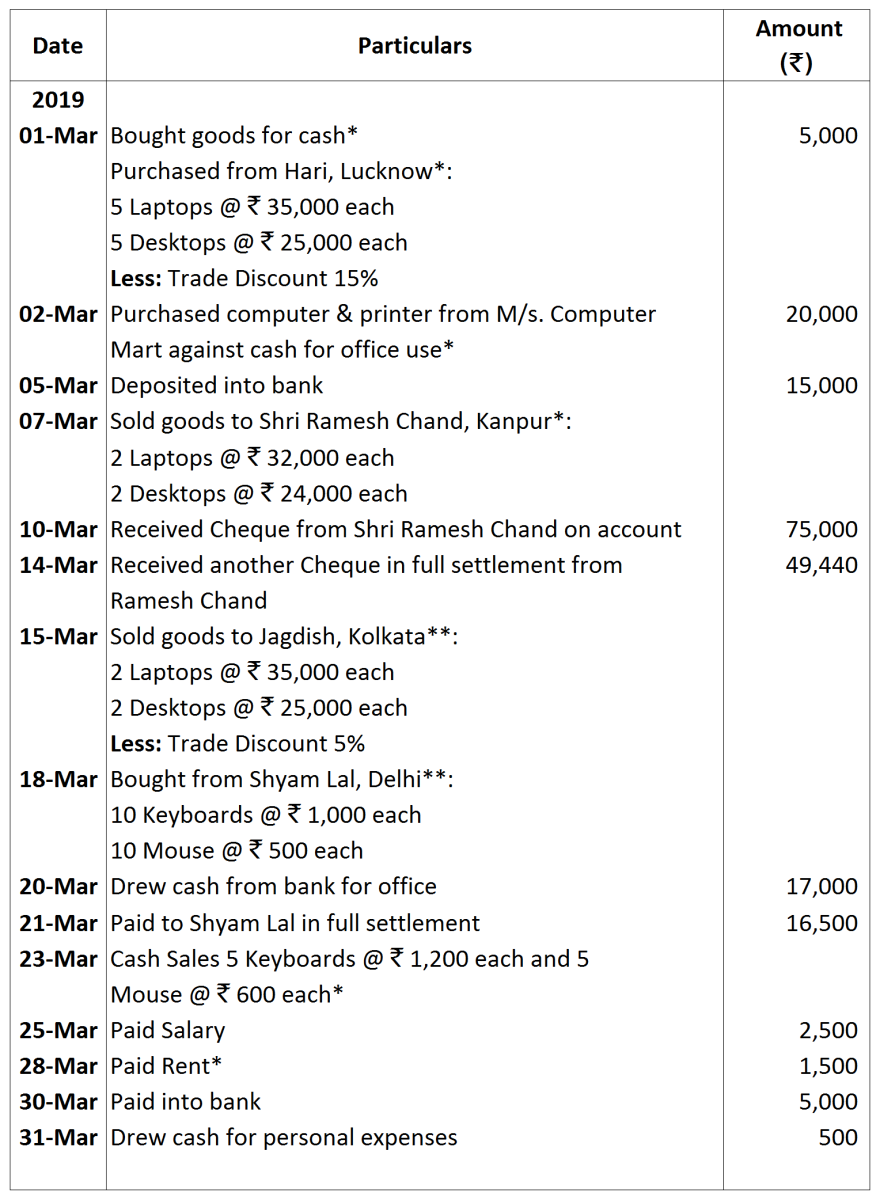
On 1st March, 2019, Shri Kailash Chand, Lucknow commenced business with cash ₹ 50,000. The following are his transactions for the month of March, 2019. Record them in proper books, post them to the Ledger and take out a Trial Balance:
Transactions marked with (*) are intra-state transactions subject to CGST and SGST @ 6% each. Transactions marked with (**) are inter-state transactions subject to IGST @ 12%.