c
$ \frac{x^2+x+2}{x^2+5 x+6}<0 $
$ \Rightarrow \frac{1}{(x+2)(x+3)}<0$
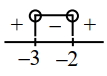
$Image$
$ \mathrm{x} \in(-3,-2) \ldots \ldots \ldots . .(1) $
$ \mathrm{f}(\mathrm{x})=1+\mathrm{x}\left(\lambda^2-\mathrm{x}^2\right)$
Finding local minima
$f^{\prime}(x)=\left(\lambda^2-x^2\right)+(-2 x) \cdot x$
Put $\mathrm{f}^{\prime}(\mathrm{x})=0$
$\Rightarrow \lambda^2=3 \mathrm{x}^2$
$\Rightarrow \mathrm{x}= \pm \frac{\lambda}{\sqrt{3}}$
$\frac{-+}{\frac{-\lambda}{\frac{-\lambda}{\sqrt{3}}} \frac{\lambda}{\sqrt{3}}}$
Local min Local max We want local min
$\Rightarrow \mathrm{x}=\frac{-\lambda}{\sqrt{3}}$
from ($1$)
$x \in(-3,-2)$
$ -3<\frac{-\lambda}{\sqrt{3}}<-2 $
$ 3 \sqrt{3}>\lambda>2 \sqrt{3} $
$ \alpha=2 \sqrt{3}, \beta=3 \sqrt{3} $
$ \alpha^2+\beta^2=12+27=39$