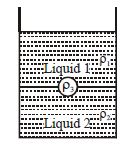
Diagram shows a jar filled with two non mixing liquids $1$ and $2$ having densities ${\rho _1}$ and ${\rho _2}$ respectively. A solid ball, made of a material of density ${\rho _3}$ , is dropped in the jar. It comes to equilibrium in the position shown in the figure. Which of the following is true for ${\rho _1}$ , ${\rho _2}$ and ${\rho _3}$ ?
Medium
Download our app for free and get started
${\rho _3} < {\rho _2}$ , ${\rho _3} > {\rho _1}$

Download our appand get started for free
Experience the future of education. Simply download our apps or reach out to us for more information. Let's shape the future of learning together!No signup needed.*
Similar Questions
- 1$10,000 $ small balls, each weighing $1\, gm$, strike one square cm of area per second with a velocity $100 \,m/s$ in a normal direction and rebound with the same velocity. The value of pressure on the surface will beView Solution
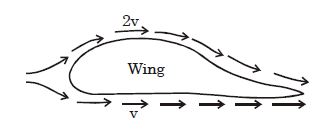
- 2The flow speeds of air on the lower and upper surfaces of the wing of an aeroplane are $v$ and $2v$ respectively. The density of air is $\rho $ and surface area of wing is $A$ . The dynamic lift on the wing isView Solution
- 3A square plate of $0.1 \;m$ side moves parallel to a second plate with a velocity of $ 0.1\; m/s$, both plates being immersed in water. If the viscous force is $0.002\; N$ and the coefficient of viscosity is $ 0.01 $ poise, distance between the plates in $m$ isView Solution
- 4A large vessel of height $H$, is filled with a liquid of density $\rho$, upto the brim. A small hole of radius $r$ is made at the side vertical face, close to the base. The horizontal force is required to stop the gushing of liquid is ...........View Solution
- 5A train with cross-sectional area $S _{ t }$ is moving with speed $v_t$ inside a long tunnel of cross-sectional area $S _0\left( S _0=4 S _{ t }\right)$. Assume that almost all the air (density $\rho$ ) in front of the train flows back between its sides and the walls of the tunnel. Also, the air flow with respect to the train is steady and laminar. Take the ambient pressure and that inside the train to be $p _0$. If the pressure in the region between the sides of the train and the tunnel walls is $p$, then $p _0- p =\frac{7}{2 N } \rho v_{ t }^2$. The value of $N$ is. . . . .View Solution
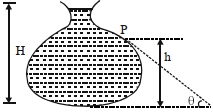
- 6Figure here shows the vertical cross section of a vessel filled with a liquid of density $\rho$. The normal thrust per unit area on the walls of the vessel at the point $P$, as shown, will beView Solution
- 7A small spherical ball of radius $0.1 \,mm$ and density $10^{4} \,kg m ^{-3}$ falls freely under gravity through a a distance $h$ before entering a tank of water. If after entering the water the velocity of ball does not change and it continue to fall with same constant velocity inside water, then the value of $h$ wil be $m$. (Given $g =10 \,ms ^{-2}$, viscosity of water $=1.0 \times 10^{-5} \,N - sm ^{-2}$ )View Solution
- 8Three liquids of densities $d,\,2d$ and $3d$ are mixed in equal volumes. Then the density of the mixture isView Solution
- 9Two drops of same radius are falling through air with steady velocity of $v $ $cm/s$. If the two drops coalesce, what would be the terminal velocity?View Solution
- 10Density of ice is $\rho $ and that of water is $\sigma $. What will be the decrease in volume when a mass $M$ of ice meltsView Solution