Three liquids of densities $d,\,2d$ and $3d$ are mixed in equal volumes. Then the density of the mixture is
Medium
Download our app for free and get started
(b) ${\rho _{mixture}}$= $\frac{{{m_1} + {m_2} + {m_3}}}{{3V}} = \frac{{V(d + 2d + 3d)}}{{3V}}$ $= 2d.$

Download our appand get started for free
Experience the future of education. Simply download our apps or reach out to us for more information. Let's shape the future of learning together!No signup needed.*
Similar Questions
- 1View SolutionAn ice block contains a glass ball when the ice melts within the water containing vessel, the level of water
- 2The total area of cross-section is $0.25\,m^2$. If the blood is flowing at the rate of $100\, cm^3/sec$, then the average velocity of flow of blood through the capillaries is ........ $mm/sec$View Solution
- 3A tank is filled with water of density $1\,g$ per $cm^3$ and oil of density $0.9\,g$ per $cm^3$ . The height of water layer is $100\,cm$ and of the oil layer is $400\,cm.$ If $g = 980\,cm/sec^2,$ then the velocity of efflux from an opening in the bottom of the tank isView Solution
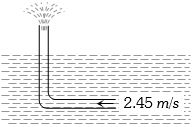
- 4An $ L-$ shaped tube with a small orifice is held in a water stream as shown in fig. The upper end of the tube is $ 10.6 cm$ above the surface of water. ....... $cm$ will be the height of the jet of water coming from the orifice ? Velocity of water stream is $2.45 m/s$View Solution
- 5Assume that, the drag force on a football depends only on the density of the air, velocity of the ball and the cross-sectional area of the ball. Balls of different sizes but the same density are dropped in an air column. The terminal velocity reached by balls of masses $250 \,g$ and $125 \,g$ are in the ratioView Solution
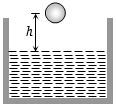
- 6A ball of radius $r $ and density $\rho$ falls freely under gravity through a distance $h$ before entering water. Velocity of ball does not change even on entering water. If viscosity of water is $\eta$, the value of $h$ is given byView Solution
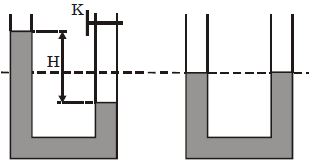
- 7A $U$ -tube of small and uniform cross section contains water of total length $4H$. The height difference between the water columns on the left and on the right is $H$ when the valve $K$ is closed. The valve is suddenly open, and water is flowing from left to right. Ignore friction. The speed of water when the heights of the left and the right water columns are the same, is :-View Solution
- 8The pressure at the bottom of a water tank is $4 P$. where $P$ is atmospheric pressure. If water is drawn out till the water level decreases by $\frac{3}{5}$ th, then pressure at the bottom of the tank is .........View Solution
- 9The Bhagirathi and the Alaknanda merge at Deoprayag to form the Ganga with their speeds in the ratio $1: 1: 5$. The cross-sectional areas of the Bhagirathi, the Alaknanda and the Ganga are in the ratio $1: 2: 3$. Assuming streamline flow, the ratio of the speed of Ganga to that of the Alaknanda isView Solution
- 10An air bubble of radius $r$ rises steadily through a liquid of density $\rho $ with velocity $v$ . The coefficient of viscosity of liquid isView Solution