Question
Differentiate between:

Afferent and Efferent Nerve.

Answer

Afferent (sensory) Nerve Efferent (motor) Nerve
It conducts nerve impulses from the periphery to the central nervous system. It conducts nerve impulses from the central nervous system (C.N.S.) to the periphery of the body.
It is generally made up of pseudo-unipolar neurons. It is generally made up of multipolar neurons.
Its dendrites are comparatively longer than the axon. Its axon is comparatively longer than dendrites.
Its axon enters into the C.N.S. Its axon emerges out from C.N.S.

Need a full question paper?

Generate a complete, print-ready paper with questions like this in minutes — across 16+ boards, with answer keys.
Start Generating Free

Similar questions

With respect to human eye explain:
(i) How is the image formed on the retina?
(ii) How is the amount of light entering the eye-controlled?
(iii) What type of lens is used for the correction of ‘Long sight’ defect?
(iv) With the help of a ray, diagram show the defect of the eye and then its correction after the use of a lens.
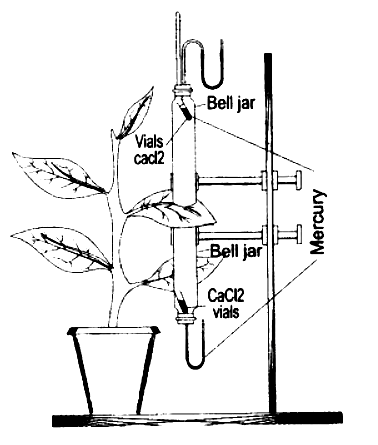
The apparatus shown here is Girreau’s poto-meter designed to demonstrate unequal transpiration from the two surfaces of a dorsiventral leaf. Before keeping the leaf in between the cups, anhydrous calcium chloride ($CaCl_2$) contained in two small vials were weighed and placed in both the cups. The ends of the cups were closed with corks through which two mercury manometers were connected. After a few hours, $CaCl_2$​​​​​​​ vials were taken out and weighed again.

(i) What is the purpose of keeping $CaCl_2$ vials inside the cup?
(ii) After a few hours, the $CaCl_2$ vials were taken out and weighed again. Will you expect any difference in weight? If so, give reasons.
(iii) What was the purpose of using a mano-meter?
(iv) What do you mean by transpiration?
What is the popular sign for the Family Planning and Welfare Centres in India?
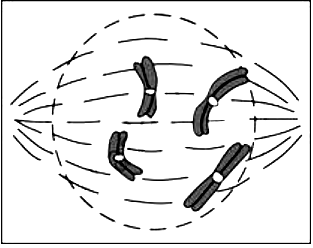
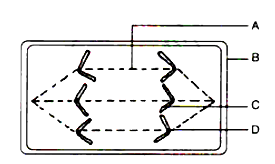
The diagram given alongside represents a stage in cell division.
Study the same and answer the questions that follow:

(i) Identify the stage of cell division.
(ii) Name the parts labeled A,B,C and D.
(iii) What is the unique feature observed in this stage?
(iv) Where does this type of cell division usually occur?
(v) How many daughter cells are formed from this type of cell division?
(vi) Is the dividing cell shown a plant or an animal cell?
Give a reason to support your answer.
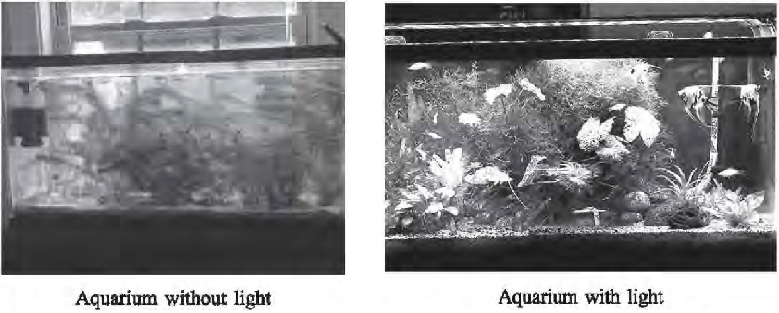
Given below is the diagram showing aquariums with light and without light. Read the information and fill in the blanks:

Image
A group of students conducted an experiment to understand the significance of photosynthesis in the ecosystem. They observed two aquariums, one with aquatic plants and the other without any plants, both exposed to light. Over time, they noticed that the aquarium with plants had clearer water, while the other became turbid. This experiment highlighted the role of photosynthesis in oxygen production and nutrient cycling, essential for maintaining aquatic ecosystems.
The presence of plants in the aquarium helped in (i) __________ the water by absorbing carbon dioxide. The unclear water in the aquarium without plants was due to the (ii) __________ of oxygen and the accumulation of waste. Photosynthesis is crucial for (iii) __________ as it produces oxygen and removes carbon dioxide. In the absence of photosynthesis, aquatic ecosystems would suffer from
(iv) __________ imbalance and poor water quality. The experiment demonstrated the importance of (v) __________ maintaining aquatic environments.
Explain the Term: Urinary bladder
Given below is a diagram representing a stage during mitotic cell division. Study it carefully and answer the question that follow.

How will you differentiate between mitosis and meiosis on the basis of the chromosome number in the daughter cells?
Draw a neat and labelled diagram of longitudinal section of kidney.
Give reason, why a matured mammalian erythrocyte lacks nucleus and mitochondria?