Question
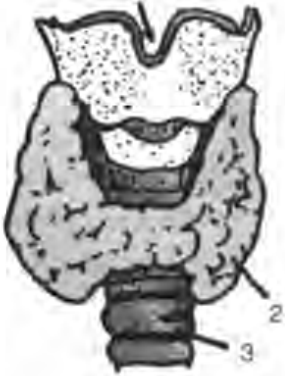
✓
Answer
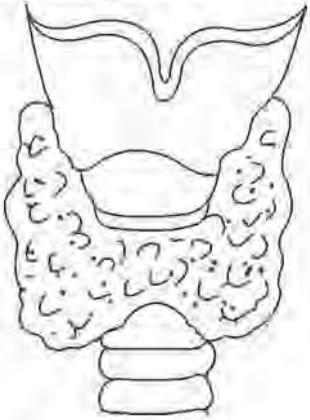
(i) In the neck
(ii) 1 - Larynx 2 - Thyroid gland 3 - Trachea
(iii) 1 - Production of sound 2 - Production of thyroxine hormone 3 - Helps in breathing
(ii) 1 - Larynx 2 - Thyroid gland 3 - Trachea
(iii) 1 - Production of sound 2 - Production of thyroxine hormone 3 - Helps in breathing
Need a full question paper?
Generate a complete, print-ready paper with questions like this in minutes — across 16+ boards, with answer keys.
Explore more
Similar questions
What is a monohybrid cross? How did Mendel perform this cross?
The beaker is divided into two chambers A and B. The big circle represents solute and the small circles solvent.
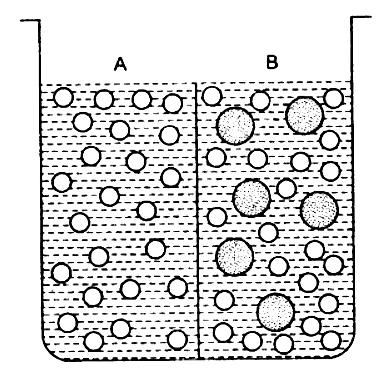
(i) What can you say about the size of the holes in the membrane, if it is to behave semi- permeably between these two?
(ii) Will the solvent molecules pass through the membrane from left to right, from right to left, in either direction or in both directions?
(iii) In which direction will there be a net movement of solvent molecules?
(i) What can you say about the size of the holes in the membrane, if it is to behave semi- permeably between these two?
(ii) Will the solvent molecules pass through the membrane from left to right, from right to left, in either direction or in both directions?
(iii) In which direction will there be a net movement of solvent molecules?
Given below is the diagram showing external view of human heart. Read the information and fill in the blanks:
The human heart, a vital organ, pumps blood throughout the body. It is conical in shape, encased in the pericardium. Made of cardiac muscle tissue, it contracts rhythmically to circulate blood. Valves inside regulate blood flow, ensuring unidirectional movement.
The heart is a muscular organ located slightly towards the (i) __________ side of the chest cavity. It is divided into four chambers: two upper chambers and two lower chambers called as $\qquad$ (ii) __________ . The right atrium receives deoxygenated blood from the body through the (iii) __________ The left atrium receives axygenated blood from the lungs through the (iv) __________ . Blood is pumped from the right ventricle to the lungs through the (v) __________ -
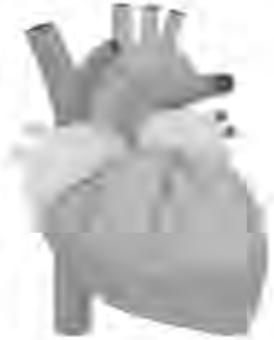
→The human heart, a vital organ, pumps blood throughout the body. It is conical in shape, encased in the pericardium. Made of cardiac muscle tissue, it contracts rhythmically to circulate blood. Valves inside regulate blood flow, ensuring unidirectional movement.
The heart is a muscular organ located slightly towards the (i) __________ side of the chest cavity. It is divided into four chambers: two upper chambers and two lower chambers called as $\qquad$ (ii) __________ . The right atrium receives deoxygenated blood from the body through the (iii) __________ The left atrium receives axygenated blood from the lungs through the (iv) __________ . Blood is pumped from the right ventricle to the lungs through the (v) __________ -
(i) Draw a neat labeled diagram to show the metaphase stage of mitosis in an animal cell having ‘6’ chromosome.
(ii) How many daughter cells are formed at the end of mitosis and at the end of meiosis?
(iii) With reference to cell division explain the following terms:
(Chromatid, Centromere, Haploid).
(iv) Name the type of cell division that occurs during:
1. Growth of shoot 2. Formation of pollen grains.
3. Repair of worn out tissues.
(ii) How many daughter cells are formed at the end of mitosis and at the end of meiosis?
(iii) With reference to cell division explain the following terms:
(Chromatid, Centromere, Haploid).
(iv) Name the type of cell division that occurs during:
1. Growth of shoot 2. Formation of pollen grains.
3. Repair of worn out tissues.
The figure given below is a diagramatic representation of a part of the cross section of the root in the root hair zone. Study the same and answer the questions that follow:
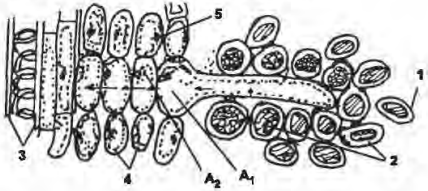
(i) Name the parts indicated by guidelines 1 to 5 .
(ii) Name the process responsible for the passage of water molecules from soil into $A_1$ and then into $A_2$.
(iii) How is this pressure set up?
→(i) Name the parts indicated by guidelines 1 to 5 .
(ii) Name the process responsible for the passage of water molecules from soil into $A_1$ and then into $A_2$.
(iii) How is this pressure set up?
Describe the structural differences between an artery and a vein.
Name the hormone produced by the following glands giving one function of each:
(i) Thyroid (ii) Pancreas (iii) Adrenal medulla
(i) Thyroid (ii) Pancreas (iii) Adrenal medulla
Elucidate "Law of independent Assortment". Explain how Mendel achieved it.
Differentiate between:
Thigmotropism and geotropism
Thigmotropism and geotropism