Question
Differentiate between: Bacteria and Yeast

Answer

BACTERIAYEAST
It belongs to the kingdom Monera.It belongs to the kingdom Fungi.
It is a prokaryotic organism.It is an eukaryotic organism
Its cell wall made is up of carbohydrates, proteins, muramic acid, etc.Its cell wall is made up of chitin
It shows the presence of slimy capsule onSlimy capsule is absent.

Need a full question paper?

Generate a complete, print-ready paper with questions like this in minutes — across 16+ boards, with answer keys.
Start Generating Free

Similar questions

Draw labelled diagrams showing the structure of the following seeds:
If you are provided with three slides, each containing one type of muscle fibre, how will you identify them?
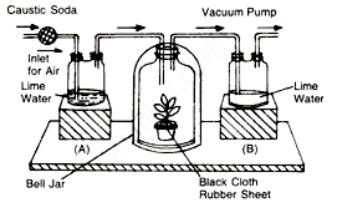
Given alongside is an experimental set up to demonstrate a phenomenon in a plant:
(a) What is the aim of this experiment?
(b) Why was the bell jar covered with a black cloth?
(c) What is the function of caustic soda in this experiment?
(d) Give an overall chemical equation of the process mentioned in (a) above. (e) Mention one precaution that should be taken to ensure more accurate results.
What change, if any, would you observe in the lime water in Flask A and B? In each case give a reason for your answer.
Image
Explain the methods of disposal of liquid wastes.
Complete the following table by filling the blanks:

Mineral

Function

Rich Source

Iodine

__________

___________

___________

Formation of haemoglobin

___________

Calcium

__________

___________

Potassium

__________

__________

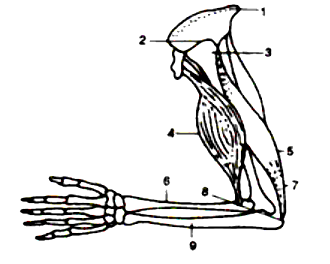
The diagram below represents the forelimb of man.
(a) Label the parts marked 1 to 9.
(b) Mention the antagonistic muscles.
(c) Which muscle will contract when the hand is bent?
(d} Name the main bone of pectoral girdle.
(e) Name the type of joint present in shoulder girdle.
Draw and describe the structure of a neuron.
Distinguish between the following
Nucleus and Nucleolus
Difference between
Bone and Cartilage
Match the items in Column A with those in Column B.

Column A

Column B

Cartilaginous

Epiglottis

Large surface area

Diaphragm

Breathing movements

Bronchi

Voice

Alveoli

Complemental air

Larynx

Swallowing

Extra inhalation