Question
Differentiate between guttation and bleeding in plants.
| Guttation | Bleeding |
| It is the removal of excess water from the plants because of excess water buildup in the plant. | It is the removal of water from the plant because of injury. |
| Water escapes from specialised structures called hydathodes. | Water escapes in the form of sap from the injured part of the plant. |
| It occurs from edges of leaves. | It occurs from cuts found in plants. |
| It happens due to the pressure presents in the xylem. | It happens due to pressure in sieve tubes. |
Generate a complete, print-ready paper with questions like this in minutes — across 16+ boards, with answer keys.
| Column 1 | Column 2 | ||
| i | Edward Janner | a | Alexander Flemming |
| ii | Pathogen | b | Pneumonia |
| iii | Streptomycin | c | Smallpox vaccine |
| iv | Penicillin | d | Diseases producing microbe |
| v | Antiseptic | e | Carbolic acid |
| vi | Disinfectant | f | Boric acid |
 c
c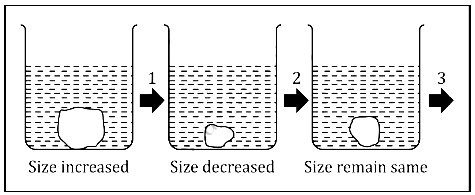 (i) Give the technical terms of the solutions used in beakers, 1, 2 and 3.
| Column I | Column II | ||
| (i) | Auditory canal | (a) | Channels pressure waves of air into the middle ear. |
| (ii) | Auditory (Eustachian tube) | (b) | Collects pressure waves of air. |
| (iii) | Auditory nerve | (c) | Converts pressure waves of air into vibrations of bone. |
| (iv) | Incus | (d) | Dissipates sound waves. |
| (v) | Malleus | (e) | Equalizes pressure between the middle ear and the atmosphere. |
| (vi) | Oval window | (f) | Provide information about the spatial orientation of the head. |
| (vii) | Pinna | (g) | Transfers vibrations from a bone to a fluid. |
| (viii) | Round window | (h) | Transfers vibrations from a bone to a membrane. |
| (ix) | Semi-circular canal | (i) | Transfers vibrations from a bone to a bone. |
| (x) | Stapes | (j) | Transfers vibrations from a membrane to a bone. |
| (xi) | Tympanic membrane | (k) | Transmits action potential to the auditory cortex. |