Question
Differentiate between interference and diffraction.

Answer

Difference between Interference and Diffraction
InterferenceDiffraction
1. Interference pattern is obtained by two coherent sources.Diffraction pattern is obtained by single source.
2. Interference is due to superposition of wavelets of different wave-fronts.Diffraction is due to super-position of wavelets of the same wavefront.
3. Alternate bright and dark bands of equal width are observed.Alternate bands of maximum and minimum brightness are observed. They are of unequal width. The width of central maxima is double of other subsidiary maximas.
4. The intensity of all the bright fringes, is the same.The intensity of central maxima is maximum while the intensity of secondary maxima decreases gradually.
5. Minimas of interference fringes are of zero intensity, hence they are perfectly dark.In diffraction fringes minimas are never perfectly dark.
6. No diffraction bands are observed in interference.Interference bands can be observed in diffraction.

Need a full question paper?

Generate a complete, print-ready paper with questions like this in minutes — across 16+ boards, with answer keys.
Start Generating Free

Similar questions

A block of mass M is kept on a rough horizontal surface. The coefficient of static friction between the block and the surface is $\mu.$ The block is to be pulled by applying a force to it. What minimum force is needed to slide the block? In which direction should this force act?
Explain the resolving power of an optical instrument. Write the formula for resolving power of telescope and microscope. Why is the resolving power of electron microscope more than that of optical microscope ?
Draw the complete I-V characteristic curve for an ideal P-N junction diode. Define the dynamic resistance in the forward bias state.
Consider the following very rough model of a beryllium atom. The nucleus has four protons and four neutrons confined to a small volume of radius $10^{-15}m$. The two $1s$ electrons make a spherical charge cloud at an average distance of $1.3 \times 10^{-11}m$ from the nucleus, whereas the two $2s$ electrons make another spherical cloud at an average distance of $5.2 \times 10^{-11}m$ from the nucleus. Find the electric field at:
  1. A point just inside the $1s$ cloud.
  2. A point just inside the $2s$ cloud.
$a$. Derive an expression for the energy stored in a parallel plate capacitor of capacitance $C$ when charged up to voltage $V$. How is this energy stored in the capacitor?
$b.$  A capacitor of capacitance $1 \mu F$ is charged by connecting a battery of negligible internal resistance and emf $10 V$ across it. Calculate the amount of charge supplied by the battery in charging the capacitor fully.
The plates of a parallel plate capacitor have an area of $90\ cm^2$ each and are separated by $2.5\ mm$. The capacitor is charged by connecting it to a $400V$ supply.
  1. How much electrostatic energy is stored by the capacitor?
  2. View this energy as stored in the electrostatic field between the plates, and obtain the energy per unit volume $u$. Hence arrive at a relation between $u$ and the magnitude of electric field $E$ between the plates.
  1. A point object is placed on the principal axis of a convex spherical surface of radius of curvature $R,$ which separates the two media of refractive indices $n_1$ and $n_{2 }(n_2 > n_1)$. Draw the ray diagram and deduce the relation between the object distance $(u),$ image distance $(v)$ and the radius of curvature $(R)$ for refraction to take place at the convex spherical surface from rarer to denser medium.
  2. A converging lens has a focal length of $20 \ cm$ in air. It is made of a material of refractive index $1.6$. If it is immersed in a liquid of refractive index $1.3,$ find its new focal length.
An electron of kinetic energy 100eV circulates in a path of radius 10cm in a magnetic field. Find the magnetic field and the number of revolutions per second made by the electron.
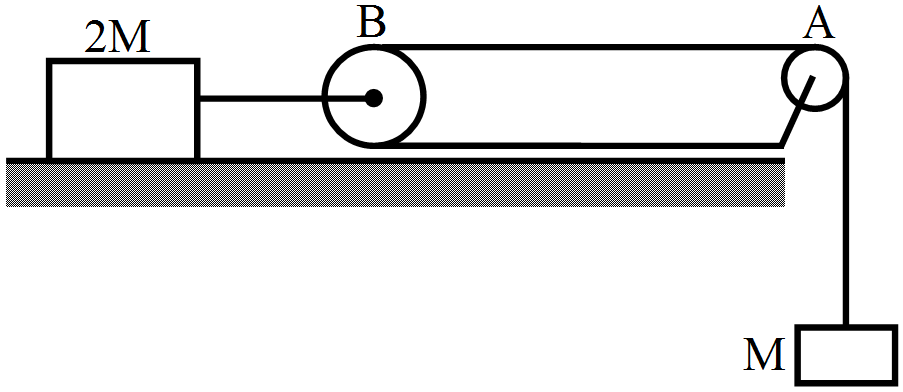
Consider the situation shown in figure. Both the pulleys and the string are light and all the surfaces are frictionless.
  1. Find the acceleration of the mass $M.$
  2. Find the tension in the string.
  3. Calculate the force exerted by the clamp on the pulley $A$ in the figure.
When a light ray passes from the atmosphere (a) through the combination of two mediums water (b) and glass (c), then find the relationship between the refractive indices of the three mediums.