Question
Explain the resolving power of an optical instrument. Write the formula for resolving power of telescope and microscope. Why is the resolving power of electron microscope more than that of optical microscope ?

Answer

Resolving Power of an optical instrument : If two objects are very close to each other, then their diffraction pattern will also be very close and will overlap each other. If the overlapping in the diffraction pattern is small than the objects are seen separate when seen by optical instrument. The optical instrument is able to resolve the objects. It however, the overlapping is large, then the objects will not be seen as separate; they will be seen as one. In other words, the optical instrument is not resolving them. The power of an optical instument to produce distinctly separate images of two close objects is called the 'resolving power' of that instrument.
But, an optical instrument has a limit to form separate images of two objects placed very close to each other. That minimum distance between two objects when they can be seen as separate by an optical instrument is called the 'limit of resolution' of that instrument. Smaller the limit of resolution of an optical instrument, greater is said to be its resolving power.
$\therefore \quad$ Resolving power $\propto \frac{1}{\text { Resolvinglimit }}$
Resolving power of telescope :
R.P. $=\frac{d}{1.22 \lambda}$
where d = aperture (diameter) of objective of telescope.
$\lambda=$ wavelength of light used.
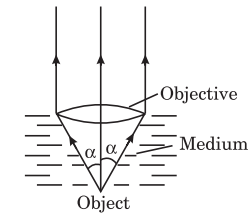
Resolving power of Microscope : The resolving power of a microscope is its ability to show two nearby closely lying objects as just distinguished and it is equal to the reciprocal of its limit of resolution.
Image
Resolving power of Electron Microscope :
Resolving power of a microscope is given by :
R.P $=\frac{2 n \sin \alpha}{1.22 \lambda}$.
From this formula it is obvious that it depends upon two factors, wavelength of light used $(\lambda)$ and numerical aperture $(n \sin \theta)$, the smaller the wavelength of light used the greater will be the resolving power. Now, when electrons are scattered or diffracted, they behave according to de-Broglie as light of wavelength given by :
$\lambda=h / m v$
where $h$ is Plank's constant, $m$ and $v$ are mass and velocity of electrons. The wavelength $\lambda$ as obtained above comes out to be about 5 x 10⁻¹⁰ cm. This is $10^5$ times smaller than that of visible light. Hence resolving power of electron microscope should be 100000 times greater than that of light microscope. But numerical aperture in electron microscope is usually smaller than that of the optical microscope on account of limitation set by lens aberration. This factor will therefore, reduce the resolving power. But even so the resolving power of electron microscope is far greater than that of optical microscope.

Need a full question paper?

Generate a complete, print-ready paper with questions like this in minutes — across 16+ boards, with answer keys.
Start Generating Free

Similar questions

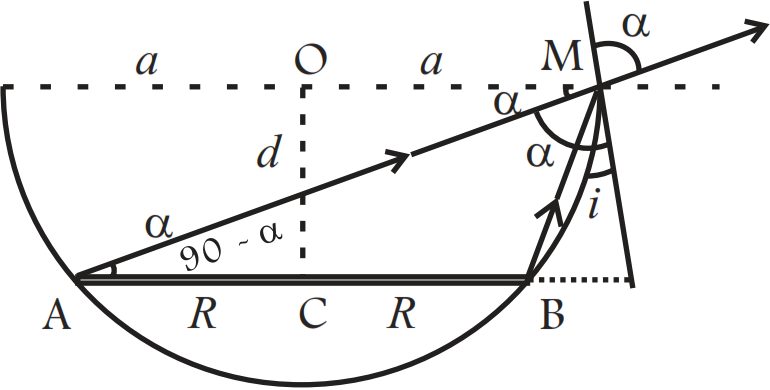
A circular disc of radius 'R' is placed co-axially and horizontally inside an opaque hemispherical bowl of radius 'a' (Fig). The far edge of the disc is just visible when viewed from the edge of the bowl. The bowl is filled with transparent liquid of refractive index μ and the near edge of the disc becomes just visible. How far below the top of the bowl is the disc placed?
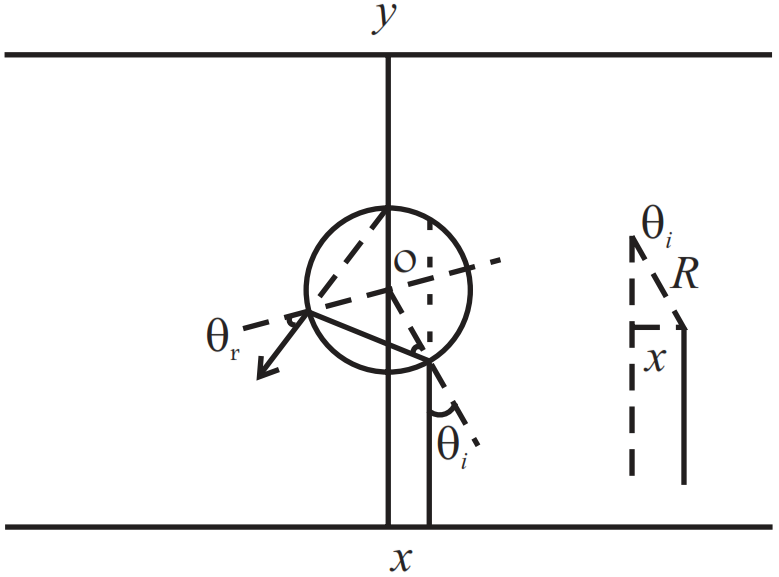
An infinitely long cylinder of radius R is made of an unusual exotic material with refractive index -1 (Fig). The cylinder is placed between two planes whose normals are along the y direction. The center of the cylinder O lies along the y-axis. A narrow laser beam is directed along the y direction from the lower plate. The laser source is at a horizontal distance x from the diameter in the y direction. Find the range of x such that light emitted from the lower plane does not reach the upper plane.
Calculate potential on the axis of a ring due to charge Q uniformly distributed along the ring of radius R.
A rod, when suspended in a magnetic field, stays in the east-west direction. Can we be sure that the field is in the east-west direction? Can it be in the north-south direction?
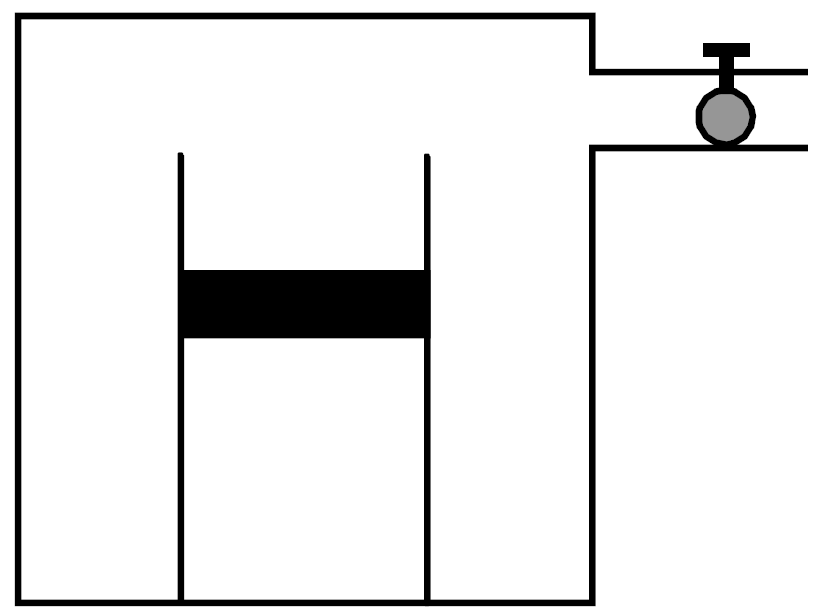
An ideal gas is kept in a long cylindrical vessel fitted with a frictionless piston of cross$-$sectional area $10\ cm^{2}$ and weight $1\ kg\ ($figure.$)$ The vessel itself is kept in a big chamber containing air at atmospheric pressure $100\ kPa$. The length of the gas column is $20\ cm$. If the chamber is now completely evacuated by an exhaust pump, what will be the length of the gas column? Assume the temperature to remain constant throughout the process.
Can reflection result in plane polarised light if the light is incident on the interface from the side with higher refractive index?
  1. Draw the circuit diagram of a fullwave rectifier using $p-n$ junction diode. Explain its working and show the output, input waveforms.
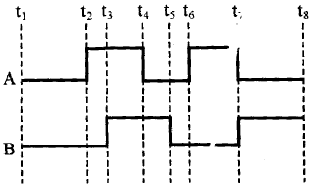
  2. Show the output waveforms $(Y)$ for the following inputs $A$ and $B$ of
    1. $OR$ gate.
    2. $\ce{NAND}$ gate.
Draw the labelled ray diagram for the formation of image by a compound microscope.Derive the expression for the total magnification of a compound microscope. Explain why both the objective and the eyepiece of a compound microscope must have short focal lengths.
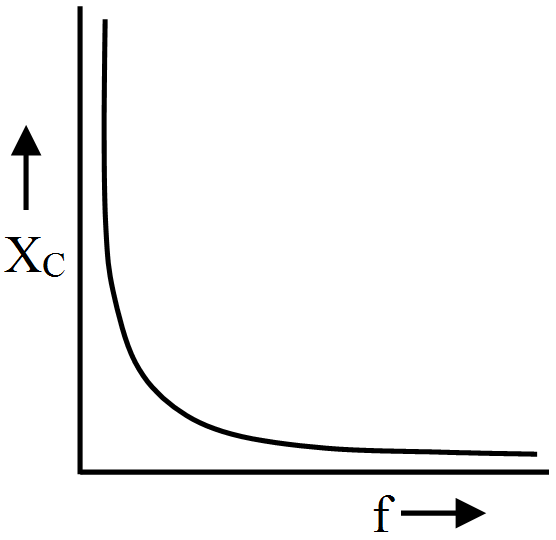
Define the term capacitive reactance. Show graphically the variation of capacitive reactance with frequency of applied alternating voltage. An ac voltage $\text{V = V}_0\sin\omega\text{t}$ is applied across a pure capacitor of capacitance $C.$ Find an expression for current flowing through it. Show mathematically the current flowing through it leads the applied voltage by angle $\frac{\pi}{2}.$
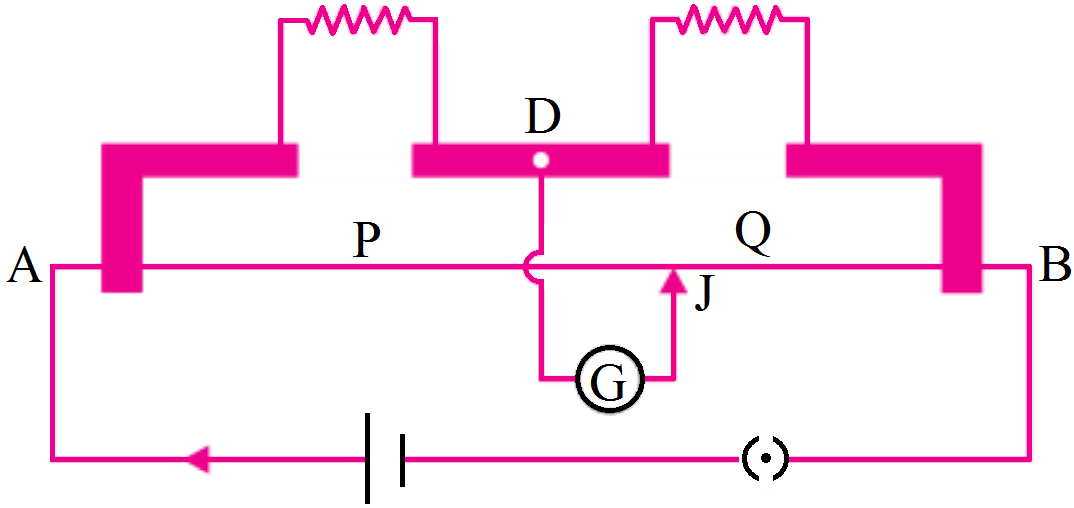
In a practical Wheatstone bridge circuit, wire $AB$ is $2\ m$ long. When resistance $Y = 2.0W$ and jockey is in position $J$ such that $AJ = 1.20\ m$, there is no current in galvanometer, find the value of unknown resistance $X$. The resistance per unit length of wire $AB = 0.01W/ cm$. Also calculate the current drawn by the cell of emf $4.0V$ and negligible internal resistance.