Question
$a$. Derive an expression for the energy stored in a parallel plate capacitor of capacitance $C$ when charged up to voltage $V$. How is this energy stored in the capacitor?
$b.$  A capacitor of capacitance $1 \mu F$ is charged by connecting a battery of negligible internal resistance and emf $10 V$ across it. Calculate the amount of charge supplied by the battery in charging the capacitor fully.
Answer

$a$. Work done in adding a charge $dq = dW$
$= Vdq$
$=\frac{q}{c} d q$
$\therefore$ Total Amount of work $(W)$ in charging a capacitor
$ W =\int d W=\frac{1}{C} \int_0^Q q d q$
$W=\frac{Q^2}{2 C}$
$=\frac{(C V)^2}{2 C}=\frac{1}{2} C V^2$
The electrostatic Energy/ potential energy is stored in the electric field between the plates.
$b. C =1 \mu F=1 \times 10^{-6} F ; V =10$ volt
$Q=C V$
$=1 \times 10^{-6} \times 10$
$=10^{-5}$ coulomb
hence, the amount of charge supplied by the battery in charging the capacitor fully is $10^{-5}$ coulomb.

Need a full question paper?

Generate a complete, print-ready paper with questions like this in minutes — across 16+ boards, with answer keys.

Start Generating Free

Similar questions

  1. An object is placed in front of a concave mirror. It is observed that a virtual image is formed. Draw the ray diagram to show the image formation and hence derive the mirror equation $\frac{1}{\text{f}}=\frac{1}{\text{u}}+\frac{1}{\text{v}}.$
  2. An object is placed 30cm in front of a plano-convex lens with its spherical surface of radius of curvature 20cm. If the refractive index of the material of the lens is 1.5, find the position and nature of the image formed.
An aeroplane has to go from a point A to another point B, 500km away due 30° east of north. A wind is blowing due north at a speed of 20m/s. The air-speed of the
plane is 150m/s.
  1. Find the direction in which the pilot should head the plane to reach the point B.
  2. Find the time taken by the plane to go from A to B.
Write the mathematical relation for the resistivity of a material in terms of relaxation time, number density, mass and charge of charge carriers in it. Explain using this relation, why the resistivity of a metal increases and that of a semiconductor decreases with rise in temperature.
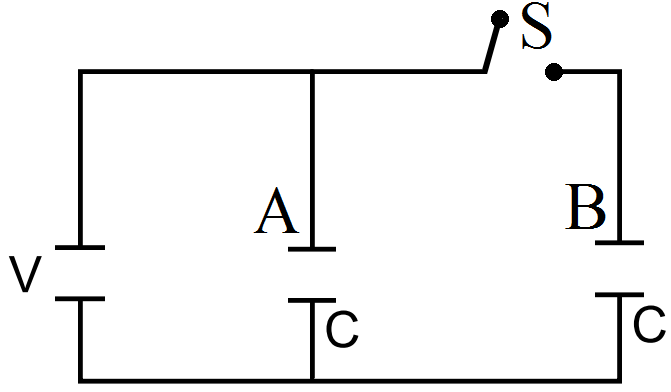
Figure shows two identical parallel plate capacitors connected to a battery through a switch S. Initially, the switch is closed so that the capacitors are completely charged. The switch is now opened and the free space between the plates of the capacitors is filled with a dielectric of dielectric constant 3. Find the ratio of the initial total energy stored in the capacitors to the final total energy stored.
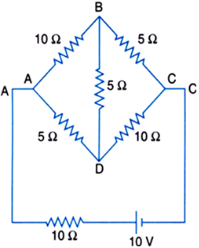
Determine the current in each branch of the network shown in Fig.:
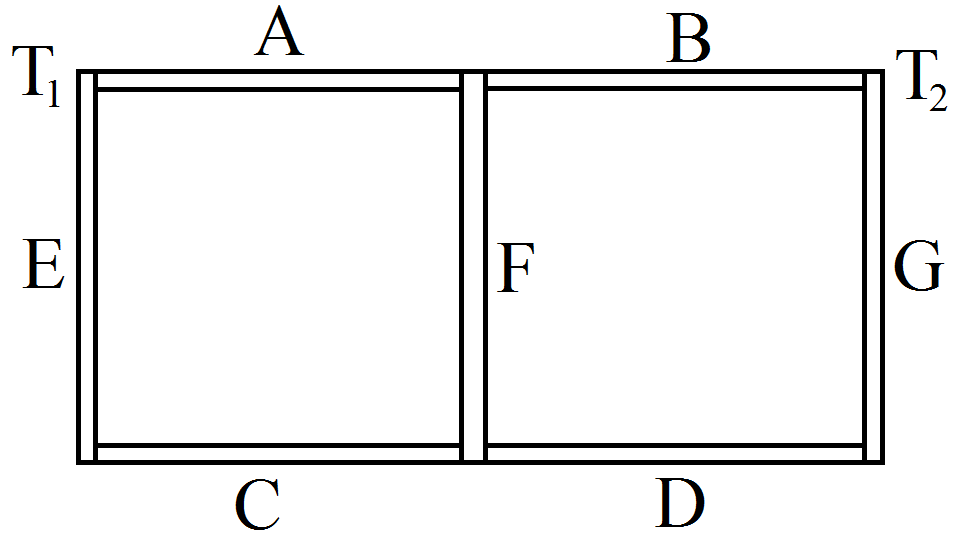
Seven rods $\ce{A, B, C, D, E, F}$ and $\ce{G}$ are joined as shown in figure. All the rods have equal cross$-$sectional area $A$ and length $l.$ The thermal conductivities of the rods are $\ce{K_A = K_c = K_0, K_B = K_D = 2K_0, K_{E }= 3K_{0,} K_F = 4K_0,}$ and $K_G = 5K_0.$ The rod $E$ is kept at a constant temperature $T_2$ and the rod $\ce{G}$ is kept at a constant temperature $\ce{T_2(T_2 > T_1).}$
  1. Show that the rod $\ce{F}$ has a uniform temperature $\text{T}=\frac{(\text{T}_1+2\text{T}_2)}{3}.$
  2. Find the rate of heat flowing from the source which maintains the temperature $\ce{T_2.}$
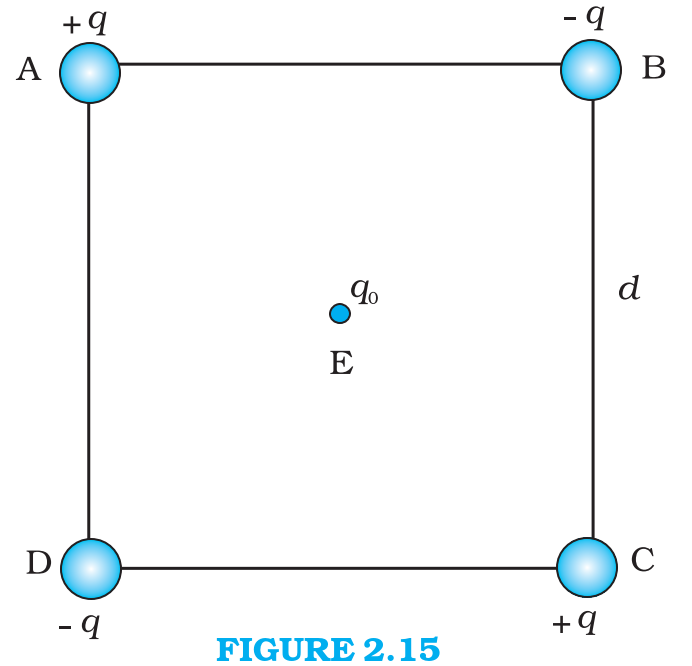
Four charges are arranged at the corners of a square $\text{ABCD}$ of side $d$, as shown in Fig. $2.15.(a)$ Find the work required to put together this arrangement. $(b)$ A charge $q_0$ is brought to the centre $E$ of the square, the four charges being held fixed at its corners. How much extra work is needed to do this?
Image
Draw a phasor diagram for series LCR circuit joined with ac voltage source and obtain an expression for impedance of the circuit.
A cubical metal block of edge 12cm floats in mercury with one fifth of the height inside the mercury. Water is poured till the surface of the block is just immersed in it. Find the height of the water column to be poured. Specific gravity of mercury = 13.6.
Prove : $n_{12}=\frac{1}{n_{21}}$