Question
Differentiate between Monohybrid & Dihybrid Cross.

Answer

Monohybrid cross Dihybrid cross
1Monohybrid cross is a genetic cross between two homozygous individuals to obtain progenies with a single contrasting character1Dihybrid corss is a cross between two pure plants to obtain progenies with two contrasting characters.
2Phenotypic ratio is 3: 1 in the F₂ generation.2Phenotypic ratio is 9:3:3:1 in the F₂ generation.
3It produces a genotypic ratio of 1:2:1 in F₂ generation.3It produces a genotypic ratio of 1:2:2:4:2: 1:2:1 in F₂ generation.
4A single pair of gene is involved.4Two pair of gene is involved.

Need a full question paper?

Generate a complete, print-ready paper with questions like this in minutes — across 16+ boards, with answer keys.

Start Generating Free

Similar questions

Read the following and answer any four questions from (i) to (v) given below:

Discovery of penicillin by Alexander Fleming in 1928 marked the beginning of the remarkable era in medical field. Penicillin was the first antibiotic extracted from Penicillium notatum. Antibiotics are used to treat bacterial diseases. These can be broad spectrum which can kill diverse group of disease causing bacteria and narrow spectrum which is effective only against one group of pathogenic strain. Antibiotics can act as bactericides or bacteriostatic. Bactericidal antibiotics kill bacteria by - disruption of cell wall synthesis (e.g., penicillin, cephalosporin, etc.), inhibition of SOS ribosome function (e.g.; erythromycin), inhibition of 30S ribosome function (e.g., streptomycin, neomycin), inhibition of amino acid-tRNA binding to ribosome (e.g., tetracyline). etc. Bacteriostatic antibiotics do not kill the bacteria rather they restrict the growth of bacteria. Penicillin belongs to $\beta$-lactum group of antibiotics and it inhibits bacterial cell wall synthesis by binding and inactivating protein. It inhibits transpeptidation of reaction and blocks cross-linking of the cell wall. It is used to treat tonsilitis, sore throat, gonorrhoea, rheumatic fever and some pneumonia types.

  1. The first antibiotic was extracted from a:
  1. Lichen.
  2. Fungus.
  3. Eubacteria.
  4. Acti-nomycetes.
  1. Which of the following kills bacteria by interfering SOS ribosome function?
  1. Cephalosporin.
  2. Erythromycin.
  3. Streptomycin.
  4. Neomycin.
  1. $\beta$-lactum group of antibiotics kill the bacterial pathogen by:
  1. Disruption of plasma membrane.
  2. Inhibition of translation of mRNA.
  3. Inhibition of translation of mRNA
  4. Inhibition of transcription of mRNA.
  1. Penicillin is not used to treat.
  1. Pneumonia.
  2. Tonsilitis.
  3. Rheumatic fever.
  4. Candidiasis.
  1. Assertion: Cephalosporins act by disruption of bacterial cell wall synthesis mechanism.

Reason: Cephalosporins are bacteriostatic antibiotics.
  1. Both assertion and reason are true and reason is the correct explanation of assertion.
  2. Both assertion and reason are true but reason is not the correct explanation of assertion.
  3. Assertion is true but reason is false.
  4. Both assertion and reason are false.
Read the following and answer any four questions from (i) to (v) given below:

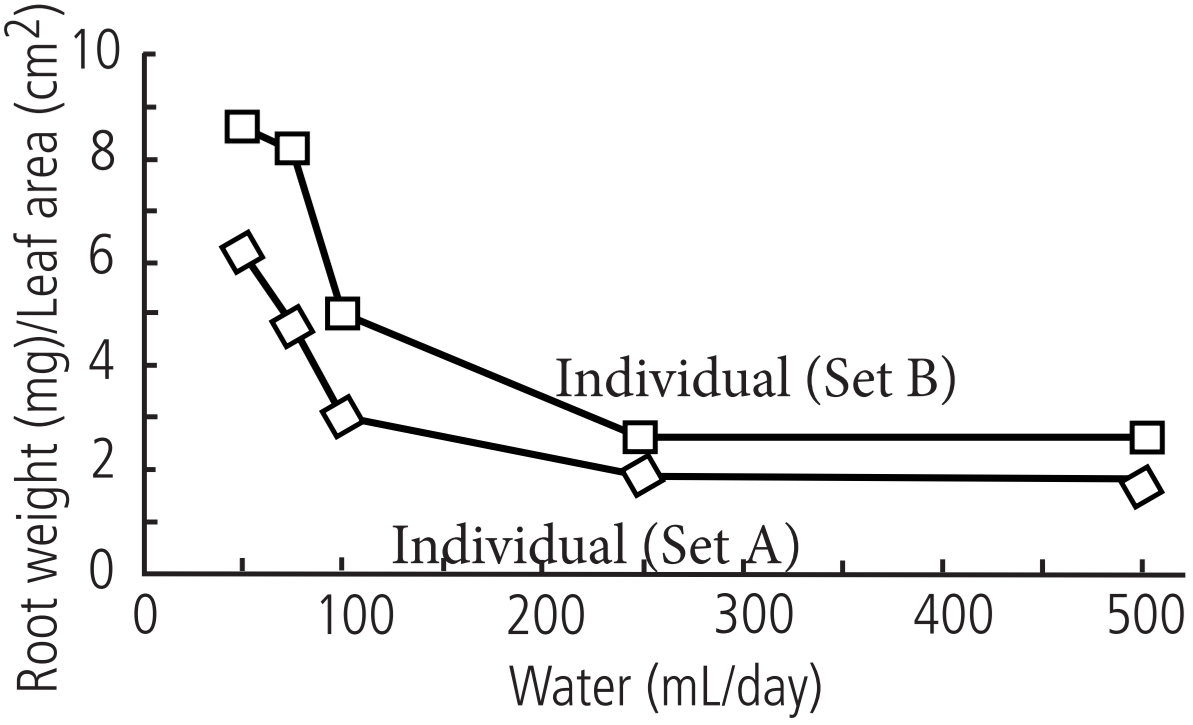
Ananya is a biologist, her research guide assigned project, i.e., to determine the effect ofin tra-specific competition on the growth of sapling of Eucalyptus. For this, she designed an experiment in which two sets of pots were used. ln the first set (set A) only I sapling was planted per pot and in the other set (set B) 16 saplings were planted per pot. To check for the effect of intra-specific competition on allocation of resources, a decreasing amount of water was added to each set. The results have been graphically indicated. Which of the following conclusions can indicated as follows:

  1. Which of the following statements can be concluded from the given study?
  1. More resources are allocated to the root during low water conditions.
  2. Competition for water among individuals of a population causes more root growth as compared to individuals who are growing alone.
  3. Lesser leaves are formed under low water conditions.
  4. Root growth is higher in individual grown singly as compared to individuals in populations.
  1. Which of the following associations is an example of competitions?
  1. Cuscuta and hedge plant.
  2. Balanus and Cathamalus.
  3. Cactus and moth.
  4. Orchid and mango.
  1. If '+' sign is assigned to beneficial interaction, '-' sign to detrimental and O sign to neutral interaction, then the population interaction of competition refers to:
  1. +, +
  2. -, -
  3. +, -
  4. +, 0
  1. lntraspecific competition is more severe due to:
  1. similar needs.
  2. similar adaptations.
  3. common resources.
  4. all of these.
  1. Assertion: Two members of a competing species may co-exist.

Reason: Different individuals of a species have different resource requirements.

  1. Both assertion and reason are true and reason is the correct explanation of assertion.
  2. Both assertion and reason are true but reason is not the correct explanation of assertion.
  3. Assertion is true but reason is false.
  4. Both assertion and reason are false.
Read the following and answer any four questions from (i) to (v) given below:

Rohan, a 13 year old school student, has been diagnosed with AIDS. He often complains of fever, nausea, headache and lethargy. Doctor advised some drugs to prolong his life.

  1. What could be the most likely mode of transmission of disease to Rohan?
  1. Artificial insemination.
  2. Sexual intercourse with infected partner.
  3. Sexual intercourse with infected partner.
  4. Use of contaminated blade.
  1. Name the drug prescribed for treatment of this disease.
  1. Zidovudine.
  2. Taxol.
  3. Vinblastine.
  4. Both (a) and (c).
  1. Assertion: AIDS is an incurable STD.

Reason: AIDS virus attacks helper T-lymphocytes.
  1. Both assertion and reason are true, and reason is the correct explanation of assertion.
  2. Both assertion and reason are true, but reason is not the correct explanation of assertion.
  3. Assertion is true, but reason is false.
  4. Both assertion and reason are false.
  1. AIDS cannot be diagnosed by:
  1. ELISA.
  2. PCR.
  3. Western blotting.
  4. VDRL.
  1. AIDS can be transmitted by:
  1. Sharing towels.
  2. Kissing.
  3. Sharing contaminated needles.
  4. All of these.
Loss of habitat and fragmentation leads to loss in biodiversity. Explain with example.
For food related services, granting patent for transgenic organisms is becoming complicated. Explain with example.
Give a brief account of evolution of vertebrates.
Microbes are useful in household products. Explain this with suitable examples
Read the following and answer any four questions from (i) to (v) given below:
Enzymes are best known for their ability to catalise biochemical reactions without undergoing any change. A large number of enzymes are being used in biotechnological industry. Most of them are obtained from microbes. Proteases degrade proteins and polypeptides. Most of the commercially applicable proteases are alkaline and are biosynthesised mainly by bacteria such as Pseudomonas, Bacillus and some fungi like, Aspergillus. These enzymes are used in clearing beer, softening of bread and meat, degumming of silk, etc. Alkaline serine proteases have the largest applications in bio-industry. Alkaline proteases have shown their capability to work under high pH, temperature and in presence of inhibitory compounds. Another important group of enzymes is amylases. Amylolytic enzymes act on starch. These are obtained from Aspergillus, Rhizopus and Bacillus sp. These are used in softening and sweetening of bread, production of alcoholic beverages from starchy materials, clearing of turbidity in juices caused by starch, etc.
  1. Polypeptides are degraded by:
  1. Amylases.
  2. Proteases.
  3. Pectinases.
  4. Lipases.
  1. Amylolytic enzymes are not obtained from:
  1. Aspergillus.
  2. Aspergillus.
  3. Mucor.
  4. Bacillus.
  1. Clearing of turbidity in juices caused by starch is achieved by:
  1. Amylases.
  2. Proteases.
  3. Rennet.
  4. Both (a) and (b).
  1. Select the incorrect option from the following.
  1. Enzymes are proteinaceous substances.
  2. Enzymes are substrate specific.
  3. Enzymes are large sized molecules.
  4. Microbial enzymes can work only in normal temperature and pH.
  1. A farmer harvests corns and prepares corn starch. He wants to prepare some corn syrup from this. for the conversion he needs to use enzyme ______.
  1. Amylase.
  2. Glucoamylases.
  3. Glucoisomerases.
  4. All of these.
Read the following and answer any four questions from (i) to (v) given below:
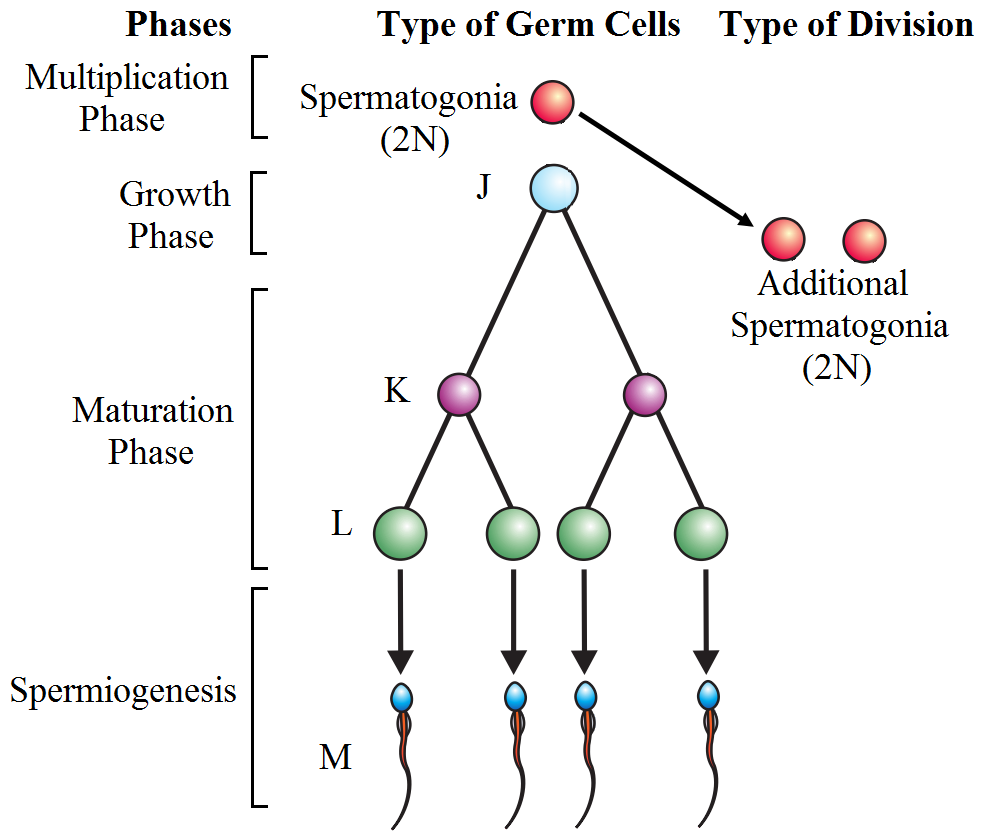
In testis, the immature male germ cells produce sperms by spermatogenesis that begins at puberty. It occurs in the seminiferous tubules of the testes. Seminiferous tubules are lined by germinal epithelium. Study the schematic representation of spermatogenesis and answer the following questions.

  1. Which cell division occurs during multiplication phase?
  1. Mitosis.
  2. Meiosis I.
  3. Meiosis II.
  4. Both (b) and (c).
  1. How many chromosomes are present in secondary spermatocyte and spermatid, respectively?
  1. 46, 23
  2. 46, 46
  3. 23, 23
  4. 23, XY
  1. Transformation of L into M is known as:
  1. Spermiation.
  2. Spermateliosis.
  3. Spermatogenesis.
  4. None of these.
  1. Select the correct option.
  1. Type A spermatogonia grows to larger primary spermatocyte.
  2. One spermatogonium forms two spermatids.
  3. Spenniation is the release of sperms from seminiferous tubules.
  4. Primary spermatocyte undergoes mitosis to form secondary spermatocytes.
  1. Which hormone acts on spermatogonia to stimulate sperm production?
  1. LH.
  2. GnRH.
  3. ABP.
  4. FSH.
Read the following and answer any four questions from (i) to (v) given below:

Study the given table and answer the questions based on it.

 
Hormone
Source
Function
(A)
Oxytocin
W
Ejection of milk
(B)
X
Anterior lobe of pituitary gland
Stimulates secretion of ABP from Sertoli cells
(C)
Y
Placenta
Maintains corpus luteum to secrete progesterone
(D)
Relaxin
Ovary
Z
  1. Identify the hormones X and Y, respectively.
  1. Testosterone, FSH.
  2. LH, hPL.
  3. FSH, hCG.
  4. ICSH, hCG.
  1. W in the given table is:
  1. Hypothalamus.
  2. Posterior lobe of pituitary.
  3. Placenta.
  4. Ovary.
  1. Which of the following is correct for Z?
  1. Dilation of uterine cervix during labour pains.
  2. Stimulates the growth of the mammary glands during pregnancy.
  3. Supports the fetal growth and prevents desiccation.
  4. Forms protective plug in cervix of uterus during pregnancy.
  1. Which set of hormones is secreted only during pregnancy?
  1. Human chorionic gonadotropin, relax in and human placental lactogen.
  2. Human placental lactogen, estrogen and chorionic thyrotropin.
  3. Human chorionic gonadotropin, human placental lactogen and progesterone.
  4. Chorionic thyrotropin, chorionic gonadotropin and estrogen.
  1. Assertion: Follicle stimulating hormone controls the maintenance and functions of male reproductive organs.

Reason: FSH acts directly on spermatogonia to stimulate sperm production.

  1. Both assertion and reason are true, and reason is the correct explanation of assertion.
  2. Both assertion and reason are true, but reason is not the correct explanation of assertion.
  3. Assertion is true, but reason is false.
  4. Both assertion and reason are false.