Questions

3 Marks Question

Take a timed test

8 questions · self-marked practice — reveal the answer and mark yourself.

Question 13 Marks
The pressure excess inside a soap bubble is equal to 0.8 cm column of water. Radius of bubble is 0.35 cm . Find the surface tension of soap solution.
Answer
Given : $h=0.8 cm=8 \times 10^{-3} m$
Density of water $\rho=1 \times 10^3 kg / m ^3$ and
$r=0.35 cm=35 \times 10^{-4} m$
Pressure of water column
$\begin{aligned}P & =h \rho g \\& =8 \times 10^{-3} \times 1 \times 10^3 \times 9.8 \\P & =78.4 N / m^2\end{aligned}$
Pressure excess in bubble
$\begin{aligned}P & =\frac{4 T}{r} \\or~~~T & =\frac{\operatorname{Pr}}{4} \\T & =\frac{78.4 \times 35 \times 10^{-4}}{4} \\T & =\frac{2744 \times 10^{-4}}{4} \\T & =686 \times 10^{-4} N / m \\T & =68.6 \times 10^{-3} N / m\end{aligned}$
View full question & answer
Question 23 Marks
Two soap bubbles have radii 2 cm and 3 cm respectively. What would be the radius of curvature of the surface formed at the contact surface when the two bubbles are brought near each other?
Answer
The value of pressure excess at common surface will be equal to the differene in pressure excess of the two bubbles
$\begin{aligned}i.e. ~\frac{4 T}{r} & =\frac{4 T}{r_1}-\frac{4 T}{r_2} \\\frac{1}{r} & =\frac{1}{r_1}-\frac{1}{r_2} \\\frac{1}{r} & =\frac{r_2-r_1}{r_1 r_2} \\r & =\frac{r_1-r_2}{r_2-r_1}\end{aligned}$
where $r$ is the radius of curvature of the common surface.
$\text { Hence, } \quad r=\frac{2 \times 3}{3-2}=6 cm$
View full question & answer
Question 33 Marks
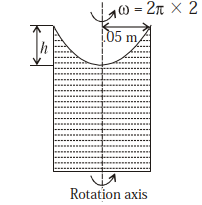
A liquid is kept in a cylindrical container which is being rotated around its axis. The support of the walls will rise higher. If the radius of the container is 0.05 m and speed of rotation is 2 revolutions per second then find the difference in height of the container between the center and the side of the container.
View full question & answer
Question 43 Marks
A tank is filled with water up to a height of H meter and there is a hole in it at a height from the bottom. Find the volume of water coming out of that hole and how far from the tank will it fall on the ground?
Answer
The water tank is filled to a height of H meter.
The hole from the bottom is at a height of $h$ $m $.
Height from water surface to surface
$=( H - h)$ $m$
Velocity of water coming out of that hole
$\begin{aligned}v & =\sqrt{2 g \times(H-h)} \\v & =\sqrt{2 g(H-h)}\end{aligned}$
Let the distance from tank is $x ~ m$ and the time of fall is $t ~\text sec$.
$\begin{aligned}h & =u t+\frac{1}{2} g t^2 \\h & =0+\frac{1}{2} g t^2 \\t^2 & =2 h / g \\t & =\sqrt{\frac{2 h}{g}}\end{aligned}$
The horizontal distance covered by the velocity $v$ in the same time will be
$\begin{aligned}x & =v t \\& =\sqrt{2 g(H-h)} \times \sqrt{\frac{2 h}{g}} \\x & =2 \sqrt{h(H-h)}\end{aligned}$
Hence, it will fall at a distance of $2 \sqrt{( H - h)}$ from the tank.
View full question & answer
Question 53 Marks
Two horizontal pipes of radius 1 cm and 2 cm are joined to each other. The velocity of water in first pipe is $8 m / sec$ and pressure is $1 \times 10^5 N / m ^2$. Calculate the velocity and pressure of water in second pipe.
Answer
Given :
$\begin{aligned}r_1 & =1 cm \\r_2 & =2 cm \\v_1 & =8 m / sec \\P_1 & =1 \times 10^5 N / m^2\end{aligned}$
Let the velocity of water in second pipe $\left( v _2\right)=$ ?
Let the pressure of water in second pipe $\left( P _2\right)=$ ?
Formula :
$\begin{aligned} A _1 v _1 & = A _2 v _2 \\ \pi r_1^2 v _1 & =\pi r_2^2 v _2 \\ r_1^2 v _1 & =r_2^2 v _2 \\ (1)^2 \times 8 & =(2)^2 \times v _2 \\ v _2 & =8 / 4=2 m / sec .\end{aligned}$
From Bernoulli's equation
$\begin{array}{c}P_1+\frac{1}{2} 1 v_1^2=P_2+\frac{1}{2} 1 v_2^2 \\1 \times 10^5+\frac{1}{2} \times 10^3 \times(8)^2=P_2+\frac{1}{2} \times 10^3 \times(2)^2\end{array}$
Since density of water is $10^3 kg / m ^3$
$\begin{aligned}\Rightarrow10^5+32 \times 10^3 & =P_2+2 \times 10^3 \\\Rightarrow10^5+32 \times 10^3 & =2 \times 10^3=P_2 \\\Rightarrow10^5+30 \times 10^3 & =P_2 \\P_2 & =10^5+0.30 \times 10^5=10^5(1+0.30) \\P_2 & =1.30 \times 10^5 N / m^2\end{aligned}$
Hence, pressure in second pipe $=1.30 \times 10^5 N / m ^2$
View full question & answer
Question 63 Marks
The weight of an empty boat is 500 kg. When it floats 1/3 part of its sink in water. Find out what is the maximum weight can be loaded on the boat?
Answer
Let the rolume of the boat be $V m ^3$ and the density of water be $\rho$.
Since boat is empty V/3 part is sink in water. Hence, the weight of water removed by the submerged part
$=\frac{V}{3} \times \rho \times g$ of the boat.
From principle of floating
Weight of boat = Weight of water removed by the boat
$\begin{array}{l}\Rightarrow \quad 500 \times g=\frac{V \rho g}{3} \\\Rightarrow \quad 1500 g=V \rho g\ldots\ldots (1)\end{array}$
Let the maximum weight can be loaded on the boat be W kg . Then weight of water removed by the boat is equal to the total weight of the boat.
i.e. the volume of water removed will be equal to the total volume of the boat.
Hence, $( W +500) g = V \rho g\dots\ldots (2)$
Compare eq. (1) and (2)
$\begin{aligned}(W+500) g & =1500 g \\W & =1500-500=1000 kg\end{aligned}$
Therefore maximum weight on the boat is 1000 kg can be loaded.
View full question & answer
Question 73 Marks
What are the energies involved in streamline flow of ideal liquid? Explain briefly.
Answer
There are three types of energies in the stream line flow of an ideal liquid.
(i) Pressure energy : If the pressure on area A of a flowing liquid is $p$ and the liquid is displaced by a distance $I$ due to this pressure then,
Pressure energy of the liquid $=$ Force $\times$ distance
$=$ Pressure $\times$ area $\times$ distance
$= P \times A \times l$
Volume of liquid $=$ Area $\times$ distance $= A \times l$
Pressure energy of unit volume of liquid $=\frac{ P \times A \times l}{A \times I}= P$
(ii) Kinetic energy : If a liquid of mass M is flowing with velocity. V in a streamline flow then kinetic energy is $1 / 2 mv ^2$.
$\therefore$ Kinetic energy of unit volume of liquid
$ =\frac{1}{2} \frac{m}{V} v^2=\frac{1}{2} \rho v^2 $
where $\rho$ is the density of liquid.
(iii) Potential energy : If the mass of flowing liquid is m , its height from the earth's surface is $h$ then its potential energy is $m g h$. $ \begin{array}{l} \therefore \text { Potential energy of unit volume of liquid }=\frac{M}{V} g h \\ =\rho g h \end{array} $
View full question & answer
Question 83 Marks
Differentiate between streamline flow and turbulent flow.
Answer
Stream line flowTurbulent flow
(1) It is the systematic and regular flow of liquidThis is a disorganized and irregular flow of liquid
(2) In streamline flow the velocity of liquid is less than the critical velocityIn this flow the velocity of liquid is more than the critical velocity
(3) The direction of velocity of particles passing through a point remains constantIn this flow, the direction of velocity of particles passing through a point keeps changing.
(4) In this flow, eddy currents do not produce inside the liquidIn this flow, eddy currents produce inside the liquid
View full question & answer