Question
Differentiate between the following (with examples)
  1. Open and closed system.
  2. Adiabatic and isothermal process.
  3. State function and path function.

Answer

  1. Open system: Open system is a system which can exchange both matter as well as energy e.g. a cup of tea.

Closed system: Closed system is a system which can exchange energy but not matter e.g. tea placed in closed kettle.

  1. Adiabatic process: Adiabatic process is a process in which no exchange of heat takes place with the surrounding e.g. carrying out reaction in a isolated system. The conductor should have non-conducting walls.

Isothermal process: Isothermal process is a process in which no change in temperature takes place e.g. thermostat maintains constant temperature by exchanging heat with the surroundings.

  1. State function: It depends upon initial and final state of the system and not on path e.g. $\Delta\text{U}$ (internal energy change)

Path function: It depends upon path e.g. work.

Need a full question paper?

Generate a complete, print-ready paper with questions like this in minutes — across 16+ boards, with answer keys.

Start Generating Free

Similar questions

Calculate the work done when 11.2g of iron dissolves in hydrochloric acid in:
  1. A closed vessel.
  2. An open beaker at 25°C (Atomic mass of Fe = 56u).
Write the important conditions required for the linear combination of atomic orbitals to form molecular orbitals.
How many litres of oxygen are required for complete combustion of 6.0 gram of ethane at standard temperature and pressure.
(i) Write the electronic configurations of the following ions : (a) $H ^{-}$(b) $Na ^{+}$(c) $O ^{2-}$ (d) $F ^{-}$
(ii) What are the atomic numbers of elements whose outermost electrons are represented by (a) $3 s^1$ (b) $2 p^3$ and (c) $3 p^5$ ?
(iii) Which atoms are indicated by the following configurations?
(a) $[ He ] 2 s^1$
(b) $[ Ne ] 3 s^2 3 p ^3$
(c) $[ Ar ] 4 s^2 3 d^1$.
Find

  1. The total number and.
  2. The total mass of protons in 34mg of NH3 at STP.

Will the answer change if the temperature and pressure are changed?
Compare the relative stability of the following species on the basis of molecular orbital theory and indicate their magnetic properties:
$\text{O}^+_2,\text{O}^-_2,\text{O}_2^{-2}$
The increasing order of reactivity among group 1 elements is Li < Na < K < Rb <Cs, whereas that among group 17 elements is F > CI > Br > I. Explain.
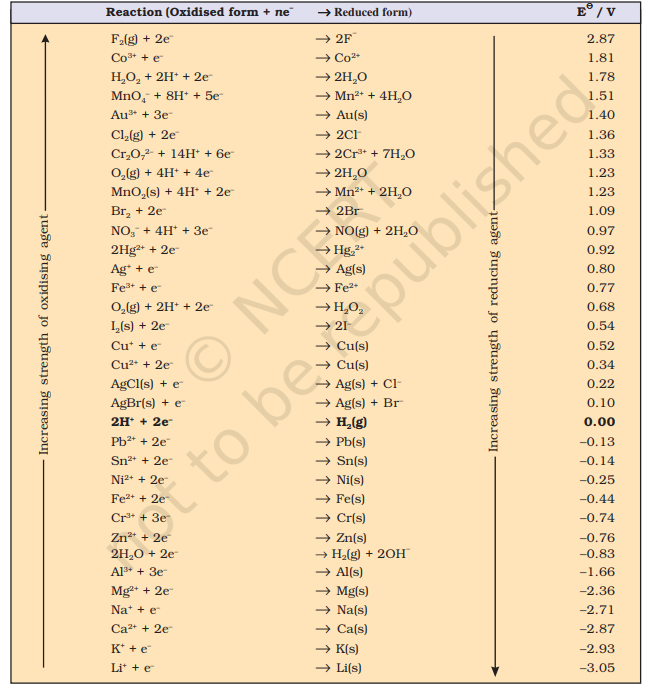
Using the standard electrode potentials given in the Table, predict if the reaction between the following is feasible:

Ag+(aq) and Cu(s).

Calculate the pH of a solution containing 0.1M acetic acid and 0.1M benzoic acid, Ka for CH3COOH and C6H5COOH are 1.8 × 10⁻⁵ and 6.5 × 10⁻⁵ respectively.
Discuss the concept of hybridisation. What are the different types of hybridization that carbon can exhibit?