Question
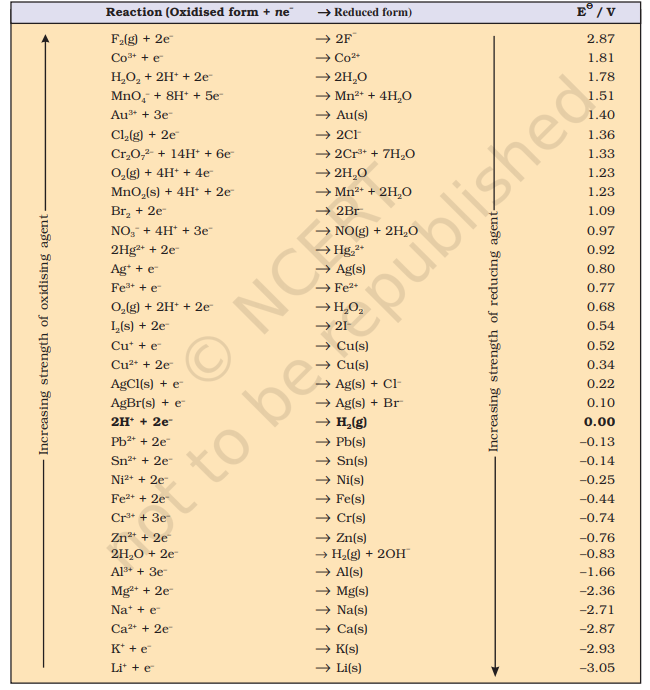
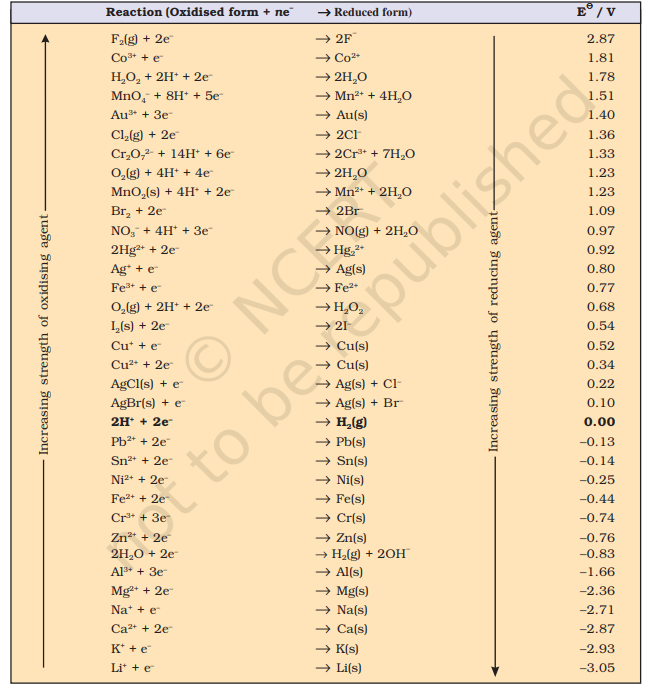
Using the standard electrode potentials given in the Table, predict if the reaction between the following is feasible:
Ag+(aq) and Cu(s).

Answer

The possible reaction between Ag+(aq) + Cu(s) is given by,

$2\text{Ag}^+_{(\text{aq})}+\text{Cu}_{(\text{s})}\rightarrow2\text{Ag}_{(\text{s})}+\text{Cu}^{2+}_{(\text{aq})}$

$\text{Oxidation half equation:}\ \ \ \ \ \ \ \ \text{Cu}_{(\text{s})}\xrightarrow{\ \ \ \ \ }\text{Cu}^{2+}_{(\text{aq})}+2\text{e}^-;\ \ \text{E}^\circ=-0.34\text{V}\\\text{Reduction half equation:}\ \ [\text{Ag}^+_{(\text{aq})}+\text{e}^-\xrightarrow{\ \ \ \ \ }\text{Ag}_{(\text{s})}]\times2;\ \ \ \text{E}^\circ=+0.80\text{V}\\\overline{\ \ \ \ \ \ \ \ \ \ \ \ \ \ \ \ \ \ \ \ \ \ \ \ \ \ \ \ \ \ \ \ \ \ \ \ \ \ \ \ \ \ \ \ \ \ \ \ \ \ \ \ \ \ \ \ \ \ \ \ \ \ \ \ \ \ \ \ \ \ \ \ \ \ \ \ \ \ \ \ \ \ \ \ \ \ \ \ \ \ \ \ \ \ \ \ \ \ \ \ \ \ \ \ \ \ \ \ \ \ \ \ \ \ \ \ \ \ }\\\ \ \ \ \ \ \ \ \ \ \ \ \ \ \ \ \ \ \ \ \ \ \ \ \ \ \ \ \ \ \ \ 2\text{Ag}^+_{(\text{aq})}+\text{Cu}_{(\text{s})}\xrightarrow{\ \ \ \ \ }2\text{Ag}_{(\text{s})}+\text{Cu}^{2+};\ \ \ \text{E}^\circ=+0.46\text{V}$

E° positive for the overall reaction is positive. Hence, the reaction between Ag+(aq) and Cu(s) is feasible.

Need a full question paper?

Generate a complete, print-ready paper with questions like this in minutes — across 16+ boards, with answer keys.
Start Generating Free

Similar questions

1. The fact that the enthalpy is a state function forms the basis of a very useful law. Name the law.
2. Two liters of an ideal gas at a pressure of 10 atm expands isothermally at $25^{\circ} C$ into a vacuum until its total volume is 10 liters. How much heat is absorbed and how much work is done in the expansion?
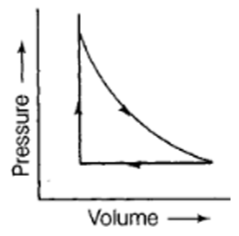
3. A sample of 1.0 mole of a monoatomic ideal gas is taken through a cyclic process of expansion and compression as shown in the figure. What will be the value of $\Delta H$ for the cycle as a whole?
Image
Calculate the wavenumber for the longest wavelength transition in the Balmer series of atomic hydrogen.
Assuming the water vapor to be a perfect gas, calculate the internal energy change when 1 mol of water at $100^{\circ} C$ and 1 bar pressure is converted to the ice at $0^{\circ} C$. Given the enthalpy of fusion of ice is 6.00 kJ mol 1 heat capacity of water is $4.2 J / g ^{\circ} C$.
The water level in a metric measuring cup is 0.75L before the addition of a pebble weighing 150g. The water level after submerging the pebble is 0.82L. Determine the density of the pebble.
What is hybrid state of each carbon in:
  1. $\text{CH}_2=\text{C}=\text{CH}_2$
  2. $\ \ \ \ \ \ \ {\text{O}}\\\ \ \ \ \ \ \ \ \|\\\text{H}-\text{C}-\text{H}?$
Choose the correct answer.
A reaction, A + B → C + D + q is found to have a positive entropy change. The reaction will be:
  1. Possible at high temperature.
  2. Possible only at low temperature.
  3. Not possible at any temperature.
  4. Possible at any temperature.
If 4g of NaOH dissolves in 36g of H2O, calculate the mole fraction of each component in the solution. Also, determine the molarity of solution (specific gravity of solution is 1g mL–1).
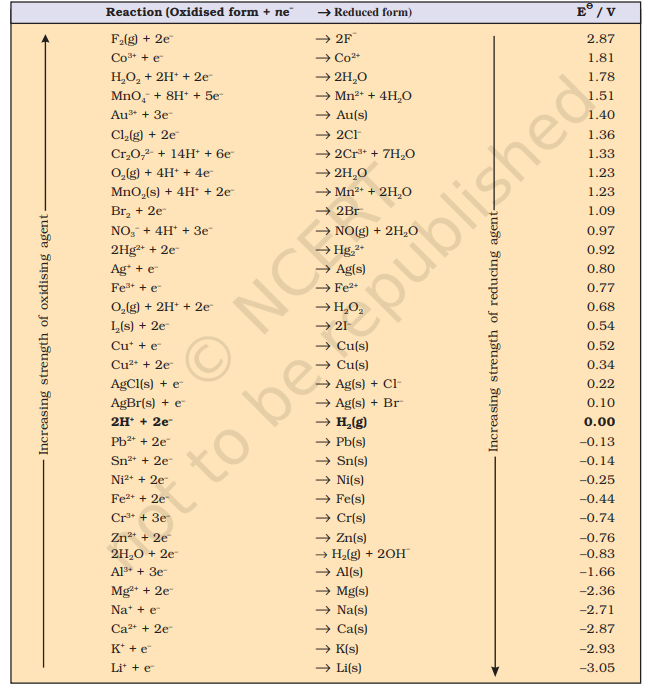
Using the standard electrode potentials given in the Table, predict if the reaction between the following is feasible:

Ag(s) and Fe3+(aq).
Compute the mass of one molecule and the molecular mass of C6H6 (benzene) (At. mass of C = 12, H = 1u).
Using the standard electrode potentials given in the Table, predict if the reaction between the following is feasible:

Fe3+(aq) and Cu(s).