Questions

3 Marks Question

Take a timed test

54 questions · self-marked practice — reveal the answer and mark yourself.

Question 13 Marks
Calculate the lattice enthalpy of MgBr2, given that
Enthalpy of formation of MgBr2 = -524kJ mol-1
Sublimation energy of Mg = 148kJ mol-1
Ionization energy of Mg = 2187kJ mol-1
Vaporisation energy of Br2(l) = 31kJ mol-1
Dissociation energy of Br2(g) = 193kJ mol-1
Electron gain enthalpy of Br2(g) = 331kJ mol-1
Answer
$\Delta_\text{f}\text{H}=\Delta\text{H}_\text{sub}+\Delta\text{H}_\text{ion}+\Delta\text{H}_\text{EA}+\Delta\text{H}_\text{D}\\+\Delta\text{H}_\text{Lattice}+\Delta\text{H}_\text{vap}$

$-524=148+2187-331+193\\+31+\Delta\text{H}_\text{Lattice}$

$\Delta\text{H}_\text{Lattice}=-524-2228=-2752\text{kJ mol}^{-1}$
View full question & answer
Question 23 Marks
Although heat is a path function but heat absorbed by the system under certain specific conditions is independent of path. What are those conditions? Explain.
Answer

Heat is independent of path under two conditions :

  1.  At constant volume

By first law of thermodynamics,

$\text{q}=\Delta\text{U}+(-\text{w})$

and, $(-\text{w})=\text{P}\Delta\text{V}$

Therefore, $\text{q}=\Delta\text{U}+\text{P}\Delta\text{V}$ 

By first law of thermodynamics $\Delta\text{V}=0$

or, $\text{qV}=\Delta\text{U}+0$

or, $\text{qV}=\Delta\text{U}=$ change in internal energy

  1.  At constant pressure

$\text{q}_\text{p}=\Delta\text{U}+\text{P}\Delta\text{V}$

 But, $\Delta\text{U}+\text{P}\Delta\text{V}=\Delta\text{H}$

Therefore, $\text{q}_\text{p}=\Delta\text{H}=$ change in enthalpy

So, at constant volume and at constant pressure heat change is a state function because it is equal to change in internal energy and change in enthalpy respectively which are state functions.

View full question & answer
Question 33 Marks
Justify the following statements.
  1. Reactions with $\Delta\text{G}<0$ always have an equilibrium constant greater than 1.
  2. Many thermodynamically feasible reactions do not occur under ordinary conditions.
  3. At low temperatures, enthalpy change dominates the $\Delta\text{G}$ expression and at high temperatures, it is the entropy which dominates the value of $\Delta\text{G}.$
Answer
  1. $\Delta\text{G}=-2.303\text{RT}\log\text{K}.$ Thus, when $\Delta\text{G}^\circ<0,$ K > 1).
  2. Under ordinary conditions, the average energy of the reactants may be less than threshold energy. They require some activation energy to initiate the reaction.
  3. $\Delta\text{G}=​​\Delta\text{H}-\text{T}\Delta\text{S}.$ At low temperature, $\text{T}\Delta\text{S}$ is small. Hence, $\Delta\text{H}$ dominates. At high temperature, $\text{T}\Delta\text{S}$ is large, i.e. $\Delta\text{S}$ dominates the value of $\Delta\text{G}.$
View full question & answer
Question 43 Marks
Differentiate between the following (with examples)
  1. Open and closed system.
  2. Adiabatic and isothermal process.
  3. State function and path function.
Answer
  1. Open system: Open system is a system which can exchange both matter as well as energy e.g. a cup of tea.

Closed system: Closed system is a system which can exchange energy but not matter e.g. tea placed in closed kettle.

  1. Adiabatic process: Adiabatic process is a process in which no exchange of heat takes place with the surrounding e.g. carrying out reaction in a isolated system. The conductor should have non-conducting walls.

Isothermal process: Isothermal process is a process in which no change in temperature takes place e.g. thermostat maintains constant temperature by exchanging heat with the surroundings.

  1. State function: It depends upon initial and final state of the system and not on path e.g. $\Delta\text{U}$ (internal energy change)

Path function: It depends upon path e.g. work.

View full question & answer
Question 53 Marks
Use the following data to calculate the $\Delta\text{G}^{\circ}$ for the reaction in which PF5(g) forms from PF3(g) and F2(g) at 298K.

PF3(g) + F2(g) → PF5(g)

$\begin{matrix}\Delta \text{H}^{\circ}_{f} & -919 \text{kJ mol}^{-1} & 0 & -1577 \text{kJ} \text{ K}^{-1} \text{mol}^{-1} \ \\\text{S}^{\circ}& 273 & 203 & 301 \end{matrix}$

Answer
$\Delta \text{H}^{\circ}= \sum\Delta \text{H}^{\circ}_f \text{(products)} - \sum\Delta \text{H}^{\circ}_f \text{(reactants)}$

$= -1577 - (919)$

$= -658 \text{kJ}$

$\Delta \text{H}^{\circ}= \sum\text{S}^{\circ}_\text{products} - \sum \text{S}^{\circ}_\text{reactants}$

$= 301 - 273 - 203 = 175 \text{JK}^{-1}$

$= -0.175 \text{kJ} \text{ K}^{-1}$

$\Delta \text{G}^{\circ} = \Delta \text{H}^{\circ} - \text{T}\Delta \text{S}^{\circ}$

$= -658 \text{kJ} - 298 \times 0.175 \text{kJ}$

$= -606 \text{kJ}$

View full question & answer
Question 63 Marks
Give the appropriate reason.
  1. It is preferable to determine the change in enthalpy rather than the change in internal energy.
  2. It is necessary to define the 'standard state'.
  3. It is necessary to specify the phases of the reactants and products in a thermochemical equation.
Answer
  1. Because it is easier to make measurement under constant pressure than under constant volume conditions.
  2. Enthalpy change depends upon the conditions in which a reaction is carried out. For making the comparison of results obtained by different people meaningful, the reaction conditions must be well-defined.
  3. Because enthalpy depends upon the phase of reactants and products.
View full question & answer
Question 73 Marks
Calculate the entropy change in surroundings when 1.00 mol of H2O(l) is formed under standard conditions. $ \Delta_{\text{f}}\text{H}^\ominus=-286\text{kJ} \ \text{mol}^{-1}.$
Answer
It is given that 286kJ mol–1 of heat is evolved on the formation of 1 mol of H2O(l). Thus, an equal amount of heat will be absorbed by the surroundings.

qsurr = +286kJ mol–1

Entropy change $\Delta\text{S}_{\text{surr}}$ for the surroundings $=\frac{\text{q}_{\text{surr}}}{7}$

$=\frac{286\text{kJ} \ \text{mol}^{-1}}{298\text{k}}$

$\therefore\Delta\text{S}_{\text{surr}}=959.73\text{J} \ \text{mol}^{-1} \ \text{k}^{-1}$

View full question & answer
Question 83 Marks
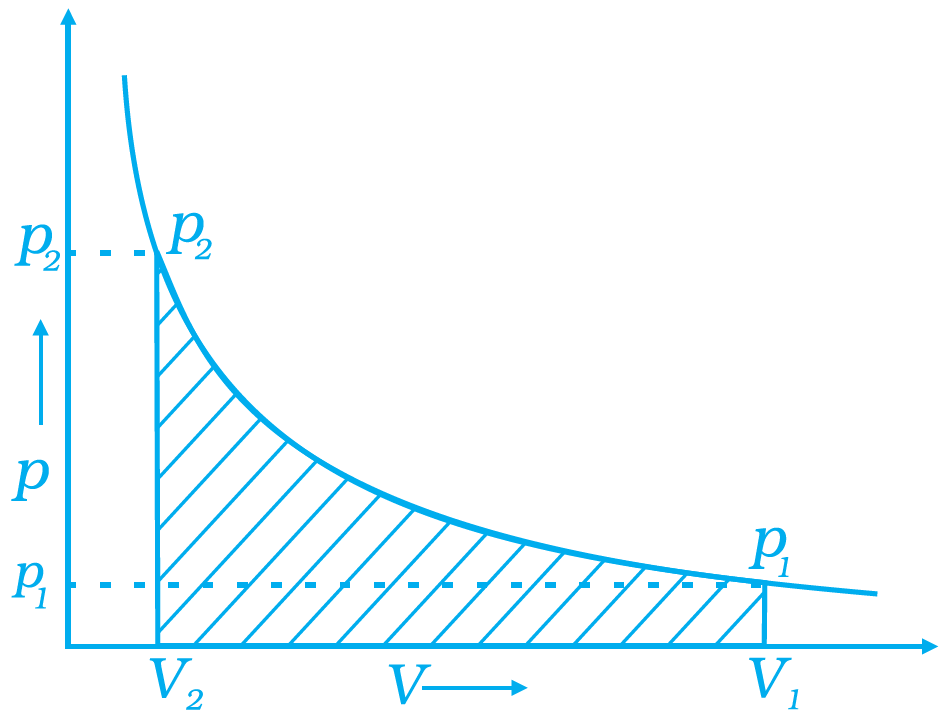
1 mole of an ideal gas undergoes reversible isothermal expansion from an initial volume of V1 to a final volume of 10V1 and does 10kJ of work. The initial pressure was 1 × 107Pa.
  1. Calculate V1.
  2. If there were 2 moles of gas, what must its temperature have been?
Answer
  1. We know that $\text{W}=-2.303\text{nRT}\log\frac{\text{V}_2}{\text{V}_1}$

$10\times10^3\text{J}=2.303\times1\times8.314\\\times\text{T}\times\log\frac{10\text{V}_1}{\text{V}_1}$

T = 522.3K

For initial conditions, p1V1 = n1RT,

i.e., (107Pa)V1 = 1 × 8.314 × 522.3

V1 = 4.342 × 10-4m3

= 4.342 × 102cm3

= 434.2cm3

We cannot apply the formula $-\text{W}=\text{p}\Delta\text{V}$ because expansion is not against constant pressure.

  1. If there were 2 moles of the gas, applying p1V1 = n1RT, we get (107Pa)(4.342 × 10-4m3) = 2 × 8.314T or T = 261.1K, i.e. half of the first value.
View full question & answer
Question 93 Marks
Enthalpy of combustion of carbon to CO2 is –393.5kJ mol–1. Calculate the heat released upon formation of 35.2g of CO2 from carbon and dioxygen gas.
Answer
Formation of CO2 from carbon and dioxygen gas can be represented as:

$\text{C}_{(\text{s})}+\text{O}_{{2(\text{g})}}\xrightarrow[]{\ \ \ \ \ \ \ }\text{CO}_{2(\text{g})} \ \Delta_{\text{f}}\text{H}=-393.5\text{kJ} \ \text{mol}^{-1}$

Heat released on formation of 44g CO2 = –393.5kJ mol–1

Heat released on formation of 35.2g CO2

$=\frac{-393.5\text{kJ} \ \text{mol}^{-1}}{44\text{g}}\times35.2\text{g}$

$= –314.8\text{kJ} \ \text{mol}^{–1} $

View full question & answer
Question 113 Marks
Choose the correct answer.
A reaction, A + B → C + D + q is found to have a positive entropy change. The reaction will be:
  1. Possible at high temperature.
  2. Possible only at low temperature.
  3. Not possible at any temperature.
  4. Possible at any temperature.
Answer
  1. Possible at any temperature

Explanation:

For a reaction to be spontaneous, $\Delta\text{G} $ should be negative.

$\Delta\text{G} = \Delta\text{H} – \text{T}\Delta\text{S}$

According to the question, for the given reaction,

$\Delta\text{S} = \text{positive} $

$\Delta\text{H} = \text{negative}$ (since heat is evolved)

$\Delta\text{G} = \text{negative}$

Therefore, the reaction is spontaneous at any temperature.

View full question & answer
Question 123 Marks
10g of argon is compressed isothermally and reversibly at a temperature of 27°C from 10L to 5L. Calculate q, W, $\Delta\text{U}$ and $\Delta\text{H}$ for this process. R = 2.0cal K-1 mol-1, log2 = 0.30, atomic weight, of Ar = 40.
Answer
$\text{q}=2.303\text{nRT}\log\frac{\text{V}_2}{\text{V}_1}$

$=2.303\times\frac{10}{40}\times300\times\log\frac{5}{10}$

$=-103.635\text{cal}$

For isothermal expansion, $\Delta\text{U}=0$

$\text{W}=\Delta\text{U}-\text{q}=0-(-103.635)$

$=+103.635\text{cal}$

Also, when temperature is constant,

p1V1 = p2V2 or pV = constant

$\Delta\text{H}=\Delta\text{E}+\Delta(\text{pV})=0+0=0$

View full question & answer
Question 133 Marks
10 moles of an ideal gas expand isothermally and reversibly from a pressure of 5atm to 1atm at 300K. What is the largest mass that can be lifted through a height of 1m by this expansion?
Answer
$\text{W}_\text{exp}=-2.303\text{nRT}\log\frac{\text{p}_1}{\text{p}_2}$

$=-2.303(10)\times(8.314)(300)\log\frac{5}{1}$

$=-40.15\times10^3\text{J}$

If M is the mass that can be lifted by this work through a height of 1m, then work done = Mgh

$40.15\times10^3\text{J}=\text{M}\times9.81\times\text{ms}^{-1}\times1\text{m}$

$\text{M}=\frac{40.15\times10^3\text{kg m}^2\text{s}^{-2}}{9.81\text{m s}^{-2}\times1\text{m}}$ $\big(\because\text{J}=\text{kg m}^2\text{s}^{-2}\big)$

$=4092.76\text{kg}$

View full question & answer
Question 143 Marks
It has been found that 221.4J is needed to heat 30g of ethanol from 15° to 18°. Calculate:
  1. specific heat capacity.
  2. molar heat capacity of ethanol.
Answer
  1. $\text{q} = \text{m} \times \text{specific heat} \times (\text{T}_{2} - \text{T}_{1})$

$\text{T}_{1} = 15 ^\circ\text{C} + 273 = 288 \text{K}$

$\text{T}_{2} = 18 ^\circ\text{C} + 273 = 291 \text{K}$

$221.4\text{J} = 30 \text{g} \times \text{specific heat} \times (291 \text{K} - 288 \text{K})$

$\text{Specific heat} = \frac{221.4}{30 \times 3} = 2.46\text{J} \text{ g}^{-1} \text{K}^{-1}$

  1. Molar heat capacity = specific heat × Molar mass of C2H5OH

$= 2.46\text{J} \text{ g}^{-1} \text{K}^{-1} \times 46 \text{g} \text{ mol}^{-1}$

$= 113.16 \text{J K}^{-1} \text{mol}^{-1}$

View full question & answer
Question 153 Marks
What is the value of equilibrium constant for the following reaction at 400K?

$2\text{NOCl(g)}\rightleftharpoons2\text{NO(g)}+\text{Cl}_2(\text{g})$

$\Delta\text{H}^\circ=77.5\text{kJ mol}^{-1},$ $\text{R}=8.314\text{J mol}^{-1}\text{K}^{-1},$ $\Delta\text{S}=135\text{J K}^{-1}\text{mol}^{-1}.$

Answer
$\Delta\text{G}=\Delta\text{H}-\text{T}\Delta\text{S}$

$\Delta\text{G}=77.5\times1000\text{ J}-400\text{K}\times135\text{J K}^{-1}$

$=77500\text{J}-54000\text{J}=23500\text{J}$

$\Delta\text{G}=-2.303\text{RT}\log\text{K}$

$23500\text{J}=-2.303\times8.314\times400\text{K}\log\text{K}$

$\log\text{K}=\frac{-23500}{19.147\times400\text{K}}=\frac{-235}{76.588}$

$=-3.068+1-1=\bar{4}.932$

$\text{K}=\bar{4}.932,\text{ Antilog}=8.551\times10^{-4}$

$\text{Antilog }0.932=8.551$

$\text{Antilog }\bar{4}.932=8.551\times10^{-4}$

View full question & answer
Question 163 Marks
For the reaction,
2Cl(g) → Cl2(g), what are the signs of $\Delta\text{H}$ and $\Delta\text{S}?$
Answer
$\Delta\text{H}$ and $\Delta\text{S}$ are negative

The given reaction represents the formation of chlorine molecule from chlorine atoms. Here, bond formation is taking place. Therefore, energy is being released. Hence, $\Delta\text{H}$ is negative.

Also, two moles of atoms have more randomness than one mole of a molecule. Since spontaneity is decreased, $\Delta\text{S}$ is negative for the given reaction.

View full question & answer
Question 173 Marks
How is the third law of thermodynamics useful in calculation of the absolute entropies? Calculate the value of $\Delta\text{S}^\circ$ for the following reaction at 400K:
2NOCl(g) → 2NO(g) + Cl2(g)
If the value of equilibrium constant for the reaction at 400K is 1.958 × 10⁻⁴ and $\Delta\text{H}^\circ=77.2\text{kJ mol}^{-1}$ (R = 8.314J K-1mol-1).
Answer
$\Delta\text{S}=\text{S}_\text{T}-\text{S}_0$

Where ST is entropy at temperature TK

But from third law, S0 = 0

Where S0 is entropy at 0K

$\therefore\text{S}_\text{T}=\Delta\text{S}$

If we measure the energy required to raise the temperature of a crystalline substance from 0K to 298K, we can determine entropy change. The entropy ST at 298K is called absolute entropy.

$\Delta\text{G}^\circ=-2.303\text{RT}\log\text{K}$

$=-2.303\times8.314\text{JK}^{-1}\text{mol}^{-1}\\\times400\text{K}\log1.958\times10^{-4}$

$=(-19.147\times400\log1.958\times10^{-4})\text{J mol}^{-1}$

$=[-7658.8\times(\log1.958+\log10^{-4})]\text{J mol}^{-1}$

$=[-7658.8\times(0.2917-4.0000)]\text{J mol}^{-1}$

$\Delta\text{G}^\circ=-7658.8\times-3.7183=+28477.72\text{J mol}^{-1}$

$=28.48\text{kJ mol}^{-1}$

$\Delta\text{G}^\circ=\Delta\text{H}^\circ-\text{T}\Delta\text{S}^\circ$

$28.48\text{kJ mol}^{-1}=77.20\text{kJ mol}^{-1}-400\Delta\text{S}^\circ$

$-400\Delta\text{S}^\circ=-48.73\text{kJ mol}^{-1}$

$\Delta\text{S}^\circ=\frac{48.73\times1000\text{J mol}^{-1}}{400\text{K}}=\frac{487.3}{4}$

$=121.82\text{JK}^{-1}\text{mol}^{-1}$

View full question & answer
Question 183 Marks
Calculate the maximum work obtained when 0.75mol of an ideal gas expands isothermally and reversibly at 27°C from a volume of 15L to 25L.
Answer
$\text{w}=-2.303\text{nRT}\log\frac{\text{V}_2}{\text{V}_1}$

$\text{n}=0.75\text{mol},\ \text{R}=8.314\text{JK}^{-1}\text{mol}^{-1}\text{T}$

$\text{T}=27^\circ\text{C}+273=300\text{K}$

$\text{w}=-2.303\times0.75\times8.314\\\times300\text{K}\log\frac{25\text{L}}{15\text{L}}$

$\text{w}=-19.147\times\frac{3}{4}\times300[\log5-\log3]$

$\text{w}=\frac{-19.147\times900}{4}\times[0.6990-0.4771]$

$\text{w}=\frac{-19.147\times900\times0.2219}{4}$

$=\frac{-3823.84}{4}$

$=-955.96\text{J}$

View full question & answer
Question 193 Marks
The heat of combustion of C2H6 is -368.4kcal. Calculate heat of combustion of C2H4, heat of combustion of H2 is 68.32kcal mol-1. $\Delta\text{H}$ for the following reaction is -37.1kcal.

$\text{C}_2\text{H}_4(\text{g})+\text{H}_2(\text{g})\overrightarrow{\ \ \ \ \ \ }\ \text{C}_2\text{H}_6(\text{g})$

Answer
$\text{C}_2\text{H}_4(\text{g})+\text{H}_2(\text{g})\overrightarrow{\ \ \ \ \ \ }\ \text{C}_2\text{H}_6(\text{g});$

$\Delta\text{H}=-37.1\text{kcal}$

$\Delta_\text{c}\text{H}^{\ominus}\text{C}_2\text{H}_6=-368.4\text{kcal},$ $\Delta_\text{c}\text{H}^\ominus\text{C}_2\text{H}_4=?$

$\Delta_\text{c}\text{H}^\ominus\text{H}_2(\text{g})=-68.32\text{kcal}$

$\Delta\text{H}=\sum\Delta_\text{c}\text{H}^\ominus(\text{reactants})-\sum\Delta_\text{c}\text{H}^\ominus(\text{products})$

$\Delta\text{H}=\Delta_\text{c}\text{H}^\ominus\text{C}_2\text{H}_4+\Delta_\text{c}\text{H}^\ominus\text{H}_2(\text{g})\\-\Delta_\text{c}\text{H}^\ominus\text{C}_2\text{H}_6(\text{g})$

$-37.1\text{kcal}=\Delta_\text{c}\text{H}^\ominus\text{C}_2\text{H}_4-68.32-(-368.4)$

$\Delta_\text{c}\text{H}^\ominus\text{C}_2\text{H}_4=-337.18\text{kcal}$

View full question & answer
Question 203 Marks
Starting with the thermodynamic relationship G = H - TS, derive the following relationship: $\Delta\text{G}=-\text{T}\Delta\text{S}_\text{Total}$
Answer
$\text{G}=\text{H}-\text{TS},$ $\text{G}_1=\text{H}_1-\text{TS}_1,$ $\text{G}_2=\text{H}_2-\text{TS}_2$

$\text{G}_2-\text{G}_1=\text{H}_2-\text{H}_1-\text{T}(\text{S}_2-\text{S}_1)$

$\Delta\text{G}=\text{H}_2-\text{H}_1-\text{T}(\text{S}_2-\text{S}_1)$

$\Delta\text{G}=\Delta\text{H}-\text{T}\Delta\text{S}$

$\Delta\text{S}_\text{Total}=\Delta\text{S}_\text{sys}+\Delta\text{S}_\text{surr}$

$\Rightarrow\Delta\text{S}_\text{Total}=\Delta\text{S}_\text{sys}-\frac{\text{q}}{\text{T}}$

$\Delta\text{S}_\text{sys}=\frac{+\text{q}}{\text{T}},\Delta\text{S}_\text{surr}=\frac{-\text{q}}{\text{T}}$

$\Rightarrow\text{T}\Delta\text{S}_\text{Total}=\text{T}\Delta\text{S}_\text{sys}-\text{q}=\text{T}\Delta\text{S}_\text{sys}-\Delta\text{H}$

$\text{T}\Delta\text{S}_\text{Total}=-\Delta\text{G}$

$\Rightarrow\Delta\text{G}=-\text{T}\Delta\text{S}_\text{Total}$

View full question & answer
Question 213 Marks
$\text{X(g)}+3\text{Y(g)}\rightleftharpoons2\text{Z(g)};$ $\Delta\text{H}=-40\text{kJ}$ and so of X, Y and Z are 60, 40 and 50kJ-1 mol-1 respectively. Calculate the temperature above or below which reaction become feasible?
Answer
$\Delta\text{S}^\circ=\sum\text{S}^\circ_\text{products}-\sum\text{S}^\circ_\text{reactants}$

$=2\times50-60-3\times40$

$=100-60-120$

$=-80\text{Jk}^{-1}\text{mol}^{-1}$

$\Delta\text{G}^\circ=\Delta\text{H}^\circ-\text{T}\Delta\text{S}$

$0=-40000\text{J}-\text{T}\times(-80)$

$80\text{T}=40000$

$\text{T}=500\text{K}$

Below 500K, reaction will be spontaneous.

$\therefore\Delta\text{G}$ will be -ve because both $\Delta\text{H}$ and $\Delta\text{S}$ are - ve.

$\therefore\Delta\text{H}>\text{T}\Delta\text{S}$

View full question & answer
Question 223 Marks
Using the data (all values are in kilocalories per mole at 25°C) given below, calculate the bond energy of C-C and C-H bonds.

$\Delta\text{H}^\circ$ combustion (ethane) = -372.0

$\Delta\text{H}^\circ$ combustion (propane) = -530.0

$\Delta\text{H}^\circ$ for C(graphite) → C(g)= 172.0

Bond energy of H-H = 104.0

$\Delta_\text{f}\text{H}^\circ$ of H2O(l) = -68.0

$\Delta\text{H}^\circ$ for CO2(g) = -94.0

Answer
We are given,

  1. $\text{C}_2\text{H}_6(\text{g})+\frac{7}{2}\text{O}_2(\text{g})\overrightarrow{\ \ \ \ \ }\ 2\text{CO}_2(\text{g})+\text{H}_2\text{O};$ $\Delta\text{H}^\circ=-372.0\text{kcal}$

  2. $\text{C}_3\text{H}_8(\text{g})+5\text{O}_2(\text{g})\overrightarrow{\ \ \ \ \ \ }\ 3\text{CO}_2(\text{g})+4\text{H}_2\text{O};$ $\Delta\text{H}^\circ=-530.0\text{kcal}$

  3. $\text{C(s)}\overrightarrow{\ \ \ \ \ }\ \text{C(g)};$ $\Delta\text{H}^\circ=172.0\text{kcal}$

  4. $\text{H}_2(\text{g})\overrightarrow{\ \ \ \ \ }\ 2\text{H(g)};$ $\Delta\text{H}^\circ=104.0\text{kcal}$

  5. $\text{H}_2(\text{g})+\frac{1}{2}\text{O}_2(\text{g})\overrightarrow{\ \ \ \ \ \ }\ \text{H}_2\text{O(l)};$ $\Delta\text{H}^\circ=-68.0\text{kcal}$

  6. $\text{C(g)}+\text{C}_2(\text{g})\overrightarrow{\ \ \ \ \ }\ \text{CO}_2(\text{g});$ $\Delta\text{H}^\circ=-94.0\text{kcal}$

Suppose the bond energy of C-C bond = xkcal mol-1 and that of C-H bond = ykcal mol-1. Then for C2H6 (g),

$\ \ \ \ \ \ \ \ \text{H} \ \ \ \ \ \text{H}\\ \ \ \ \ \ \ \ \ \ |\ \ \ \ \ \ |\\\text{H}-\text{C}-\text{C}-\text{H}\overrightarrow{\ \ \ \ \ }\ 2\text{C(g)}+6\text{H};\\ \ \ \ \ \ \ \ \ \ |\ \ \ \ \ \ |\\ \ \ \ \ \ \ \ \ \text{H}\ \ \ \ \text{H}$ $\Delta\text{H}=\text{x}+6\text{y}\dots(\text{vii})$

and for C3H8(g); i.e.,

$\ \ \ \ \ \ \ \ \text{H} \ \ \ \ \ \text{H} \ \ \ \ \ \text{H}\\ \ \ \ \ \ \ \ \ \ |\ \ \ \ \ \ \ |\ \ \ \ \ \ |\\\text{H}-\text{C}-\text{C}-\text{C}-\text{H}\overrightarrow{\ \ \ \ \ }\ 3\text{C(g)}+8\text{H(g)};\\ \ \ \ \ \ \ \ \ \ |\ \ \ \ \ \ \ |\ \ \ \ \ \ |\\ \ \ \ \ \ \ \ \ \text{H} \ \ \ \ \ \text{H}\ \ \ \ \text{H}$ $\Delta\text{H}=2\text{x}+8\text{y}\dots(\text{viii})$

To get eq. (vii), operate eq. (i) + 2 × eq. (iii) + 3 × eq. (iv) - 3 × eq. (v) - 2 × eq. (vi).

It gives $\Delta\text{H}=676\text{kcal}$

It get eq. (viii) operate eq. (ii) + eq. (iii) + 4 × eq. (iv) - 4 × eq. (v) - 3 × eq. (vi)

It gives $\Delta\text{H}=956\text{kcal}$

Thus, x + 6y = 676, 2x + 8y = 956

On solving these equations, we get x = 82, y = 99

Hence, C-C bond energy = 82kcal mol-1 and C-H bond energy = 99kcal mol-1.

View full question & answer
Question 233 Marks
Calculate bond energy of C-H bond if $\Delta_\text{c}\text{H}$ of CH4, is -891kJ mol-1, $\Delta_\text{c}\text{H}$ of C(s) is -394kJ mol-1, $\Delta_\text{c}\text{H}$ of H2(g) is -286kJ mol-1, heat of sublimation of C(s) is 717kJ mol-1, heat of dissociation of H2 is 436kJ mol-1.
Answer
$\text{CH}_4(\text{g})+2\text{O}_2(\text{g})\overrightarrow{\ \ \ \ \ \ }\ \text{CO}_2(\text{g})+2\text{H}_2\text{O(l)}$

$\Delta\text{H}=-891\text{kJ mol}^{-1}\dots(\text{i})$

$\text{C(s)}+\text{O}_2(\text{g})\overrightarrow{\ \ \ \ \ \ }\ \text{CO}_2(\text{g})$

$\Delta\text{H}=-394\text{kJ mol}^{-1}\dots(\text{ii})$

$\text{H}_2(\text{g})+\frac{1}{2}\text{O}_2(\text{g})\overrightarrow{\ \ \ \ \ \ \ }\ \text{H}_2\text{O(l)}$

$\Delta\text{H}=-286\text{kJ mol}^{-1}\dots(\text{iii})$

$\text{C(s)}\overrightarrow{\ \ \ \ \ \ }\ \text{C(g)}$

$\Delta\text{H}=+717\text{kJ mol}^{-1}\dots(\text{iv})$

$\text{H}_2(\text{g})\overrightarrow{\ \ \ \ \ \ \ }\ 2\text{H(g)}$

$\Delta\text{H}=+436\text{kJ mol}^{-1}\dots(\text{v})$

Target equation in $\ \ \ \ \ \ \ \ \text{H}\\ \ \ \ \ \ \ \ \ \ |\\\text{H}-\text{C}-\text{H}\overrightarrow{\ \ \ \ \ \ \ \ }\ \text{C(g)}+4\text{H(g)}\\ \ \ \ \ \ \ \ \ \ |\\ \ \ \ \ \ \ \ \ \text{H}$

Reversing (ii), Multiplying (iii) by 2 and reversing and Multiplying (v) by 2 and then adding all together we get:

$\text{CH}_4\overrightarrow{\ \ \ \ \ }\ \text{C(g)}+4\text{H(g)}$

$\Delta\text{H}=-891+394+572+717+872$

$\Delta\text{H}=1664\text{kJ}$

Now, energy required to break 4 C-H bond = 1664kJ.

Therefore, energy required to break 1 C-H bond $=\frac{1664}{4}=416\text{kJ mol}^{-1}.$

View full question & answer
Question 243 Marks
Use the following data to calculate $\Delta_\text{lattice}\text{H}^\ominus$ for NaBr

$\Delta_\text{sub}\text{H}^\ominus$ for sodium metal = 108.4kJ mol–1

Ionization enthalpy of sodium = 496kJ mol–1

Electron gain enthalpy of bromine = –325kJ mol–1

Bond dissociation enthalpy of bromine = 192kJ mol–1

$\Delta_\text{f}\text{H}^\ominus$ for NaBr (s) = – 360.1kJ mol–1

Answer
$\text{Na}(\text{s})\rightarrow\text{Na}(\text{g}),\Delta_\text{sub}\text{H}^\circ=108.4\text{kJ }\text{mol}^{-1}$

$\text{Na}\rightarrow\text{Na}^{+}+\text{e}^-,\Delta_\text{i}\text{H}^\circ=496\text{kJ }\text{mol}^{-1}$

$\frac{1}{2}\text{Br}_2\rightarrow\text{Br},\frac{1}{2}\Delta_\text{diss}\text{H}^\circ=\frac{192}{2}=96\text{kJ }\text{mol}^{-1}$

$\text{Br}+\text{e}^-\rightarrow\text{Br}^-,\Delta_\text{eg}\text{H}^\circ=-325\text{kJ }\text{mol}^{-1}$

$\Delta_\text{f}\text{H}^\circ\ \text{for}\ \text{NaBr}=-360.1\text{kJ }\text{mol}^{-1}$

Enthalpies in diffrent steps involved in the formation of NaBr(s) are,

$\Delta_\text{f}\text{H}^\circ=\Delta_\text{sub}\text{H}^\circ+\frac{1}{2}\Delta\text{diss}\text{H}^\circ+\Delta_\text{i}\text{H}^\circ+\Delta_\text{eg}\text{H}^\circ+\Delta_\text{lattice}\text{H}^\circ$

$\therefore\ \Delta_\text{lattice}\text{H}^\circ=-360.1-108.4-96-496+325$

$=-735.5\text{kJ }\text{mol}^{-1}$

View full question & answer
Question 253 Marks
Calculate $\Delta_\text{f}\text{H}^\circ$ of HCl if bond energy of H-H bond is 437kJ mol-1, Cl-Cl bond is 244kJ mol-1 and H-Cl is 433kJ mol-1.
Answer
$\frac{1}{2}\text{H}_2(\text{g})+\frac{1}{2}\text{Cl}_2(\text{g})\overrightarrow{\ \ \ \ \ \ } \ \text{HCl(g)}$

$\Delta_\text{f}\text{H}^\circ=\sum$ Bond enthalpy of reactants $-\sum$ Bond enthalpy of products.

$=\frac{1}{2}\text{B}_{\text{H}-\text{H}}+\frac{1}{2}\text{B}_{\text{Cl}-\text{Cl}}-\text{B}_{\text{H}-\text{Cl}}$

$=218.5+122-433$

$=-92.5\text{kJ mol}^{-1}$

View full question & answer
Question 263 Marks
Reaction $\text{X} → \text{Y}\Delta\text{H}= \text{+ve}$ is spontaneous at temperature ‘T'. Determine:
  1. Sign of AS for this reaction.
  2. Sign of AG for ‘Y' to 'X'
  3. Sign of AG at temperature < T.
Answer
  1. $\Delta \text{S} = +\text{ve}$ for this reaction

$\because\Delta \text{G} = -\text{ve} \text{ only if} \ \Delta \text{S} $

$= + \text{ve} \text{ as }\Delta \text{H} = +\text{ve}$

  1. $\Delta \text{G} = +\text{ve} \text{ for } '\text{y}' \text{ to } '\text{x}' $

because $ \Delta\text{G} = - \text{ve}$ from

'X' to 'Y' as it is spontaneous

  1. $\Delta \text{G}^{\circ} = \Delta \text{H}^{\circ} - \text{T}\Delta \text{S}^{\circ}$

Since $\Delta \text{H}^{\circ} = + \text{ve}, \Delta \text{S} = + \text{ve}$

At temp T, $\Delta \text{G} = -\text{ve,}$ reaction is spontaneous Below temp T, $\Delta \text{G} = +\text{ve,}$reaction will be non-spontaneous.

View full question & answer
Question 273 Marks
The enthalpy of vaporisation of liquid diethyl ether (C2H5)2O is 26.0kJ mol-1 at its boiling point (35.0°C). Calculate $\Delta\text{S}^\circ$ for the conversion of:
  1. Liquid to vapour.
  2. Vapour to liquid at 35°C.
Answer
  1. For vaporisation of diethyl ether,

$\therefore\Delta_\text{vap}\text{S}^\circ=\frac{\Delta_\text{vap}\text{H}^\circ}{\text{T}}$

$\Delta_\text{vap}\text{H}^\circ=26.0\text{kJ mol}^{-1},$

$\text{T}=273+35=308\text{K}$

$​​\Delta_\text{vap}\text{S}^\circ=\frac{26.0\times10^3\text{J mol}^{-1}}{308\text{K}}$

$=84.4\text{JK}^{-1}\text{mol}^{-1}$

  1. The conversion of vapour into liquid is condensation. The enthalpy of condensation is negative of enthalpy of vaporisation.

$\therefore$ For condensation of diethyl ether (i.e., conversion of vapour to liquid)

$\Delta_\text{cond}\text{S}^\circ=\frac{\Delta_\text{cond}\text{H}^\circ}{\text{T}}$

$=\frac{-26.0\times10^3\text{mol}^{-1}}{308}$

$=-84.4\text{JK}^{-1}\text{mol}^{-1}$

View full question & answer
Question 283 Marks
Calculate the standard Gibbs energy change for the formation of propane at 298K.

$3\text{C(graphite)}+4\text{H}_2\text{O}\overrightarrow{\ \ \ \ \ \ \ }\ \text{C}_3\text{H}_8(\text{g})$

$\Delta_\text{f}\text{H}^\circ$ for propane, C3H8(g) is -103.8kJ mol-1

Given: $\text{S}^\circ_\text{m}\text{C}_3\text{H}_8(\text{g})=270.2\text{JK}^{-1}\text{mol}^{-1},$ $\text{S}^\circ_\text{m}\text{C}_{(\text{graphite})}=5.70\text{JK}^{-1}\text{mol}^{-1}$ and $\text{S}^\circ_\text{m}\text{H}_2(\text{g})=130.7\text{JK}^{-1}\text{mol}^{-1}$

Answer
$3\text{C}_\text{(graphite)}+4\text{H}_2\text{O}\overrightarrow{\ \ \ \ \ \ \ }\ \text{C}_3\text{H}_8(\text{g})$

$\Delta_\text{r}\text{S}^\circ=\sum\text{S}^\circ_\text{m}(\text{products})-\text{S}^\circ_\text{m}(\text{reactants})$

$\Delta_\text{r}\text{S}^\circ=\text{S}^\circ_\text{m}[\text{C}_3\text{H}_8(\text{g})]-3\text{S}^\circ_\text{m}[\text{C(graphite)}]\\-4\text{S}^\circ_\text{m}[\text{H}_2]$

$=(270.2-3\times5.70-4\times130.7)\text{JK}^{-1}\text{mol}^{-1}$

$=(270.2-17.10-522.80)\text{JK}^{-1}\text{mol}^{-1}$

$=(270.2-539.90)=-269.7\text{JK}^{-1}\text{mol}^{-1}$

$\Delta_\text{r}\text{H}^\circ=\Delta_\text{f}\text{H}^\circ_\text{products}-\Delta_\text{f}\text{H}^\circ_\text{reactants}$

$\Delta_\text{r}\text{H}^\circ=\Delta_\text{f}\text{H}^\circ(\text{C}_3\text{H}_8)-4\Delta_\text{f}\text{H}^\circ[\text{H}_2(\text{g})]\\-3\Delta_\text{f}\text{H}^\circ[\text{C(graphipte)}]$

$\Delta_\text{r}\text{H}^\circ=-103.8\text{kJ mol}^{-1}$

$\Delta_\text{r}\text{G}^\circ=\Delta_\text{r}\text{H}^\circ-\text{T}\Delta_\text{r}\text{S}^\circ$

$=-103.8-\Big(\frac{298\times(-269.7)}{1000}\Big)\text{kJ mol}^{-1}$

$=(-103.80+80.370)\text{kJ mol}^{-1}$

$=-23.43\text{kJ mol}^{-1}$

View full question & answer
Question 293 Marks
  1. Why entropy of steam is more than that of water at its boiling point?
  2. Out of diamond and graphite which has higher entropy?
  3. Standard heat of formation of hydrazine [N2H4(l), hydrogen peroxide [H2O2(l)] and water [H2O(l)] are -50.4, -193.2 and -242.7 kJ/ mole respectively. Calculate the standard heat of formation for the following reaction:

$\text{N}_2\text{H}_4\text{(l)}+2\text{H}_2\text{O}_2(\text{l})\overrightarrow{\ \ \ \ \ \ \ }\ \text{N}_2(\text{g})+4\text{H}_2\text{O(l)}$​​​​​​​

Answer
  1. Steam has more disorder or randomness as compared to liquid water, therefore, has more entropy.
  2. Graphite has more entropy than diamond because force of attraction between layers is less in graphite than diamond.
  3. $\text{N}_2\text{H}_4\text{(l)}+2\text{H}_2\text{O}_2(\text{l})\overrightarrow{\ \ \ \ \ \ \ }\ \text{N}_2(\text{g})+4\text{H}_2\text{O(l)}$

$\Delta_\text{r}\text{H}=\Delta_\text{f}\text{H}(\text{N}_2)+4\Delta_\text{f}\text{H}(\text{H}_2\text{O})\\-\Delta_\text{f}\text{H}(\text{N}_2\text{H}_4)-2\Delta_\text{f}\text{H}(\text{H}_2\text{O})$

$=0+4\times[-242.7-(-50.4)-2(-193.2)]$

$=(-970.8+50.4+386.4)\text{kJ mol}^{-1}$

$\Delta_\text{r}\text{H}=-534\text{kJ mol}^{-1}$

View full question & answer
Question 303 Marks
  1. State Hess's Law of constant heat summation. How does it follow from the first law of thermodynamics.
  2. Determine $\Delta_\text{r}\text{H}^\circ,$ at 298K for reaction:

$\text{C(graphite)}+2\text{H}_2(\text{g})\overrightarrow{\ \ \ \ \ \ \ \ }\ \text{CH}_4(\text{g});\ \Delta_\text{r}\text{H}^\circ=?$

You are given:

  1. $\text{C(graphite)}+\text{O}_2(\text{g})\overrightarrow{\ \ \ \ \ \ \ }\ \text{CO}_2(\text{g});$ $\Delta_\text{r}\text{H}^\circ=-393.51\text{kJ/ mol}$

  2. $\text{H}_2\text{(g)}+\frac{1}{2}\text{O}_2(\text{g})\overrightarrow{ \ \ \ \ \ \ \ }\ \text{H}_2\text{O(l)};$ $\Delta_\text{r}\text{H}^\circ=-285.8\text{kJ/ mol}$

  3. $\text{CO}_2(\text{g})+2\text{H}_2\text{O(l)}\overrightarrow{\ \ \ \ \ \ \ \ \ }\ \text{CH}_4(\text{g})+2\text{O}_2(\text{g});$ $\Delta_\text{r}\text{H}=+890.3\text{kJ/ mol}$

Answer
  1. Hess's law states enthalpy change remains the same whether the reaction takes place in one step or in several steps.

It follows from Ist law of thermodynamics that energy can neither be created nor be destroyed. It can change from one form to another. The total energy of universe remains constant.

  1. $\text{CO}_2(\text{g})+2\text{H}_2\text{O(l)}\overrightarrow{ \ \ \ \ \ \ }\ \text{CH}_4(\text{g})+2\text{O}_2(\text{g})$

$\Delta_\text{r}\text{H}=\Delta_\text{f}\text{H}(\text{CH}_4)+2\Delta_\text{f}\text{H}(\text{O}_2)-\Delta_\text{f}\text{H}(\text{CO}_2)\\-2\Delta_\text{f}\text{H}[\text{H}_2\text{O(l)}]$

$+890.3\text{kJ mol}^{-1}=\Delta_\text{f}\text{HCH}_4+2\times0-\\-(-393.51\text{kJ mol}^{-1})-2\times(-285.8\text{kJ mol}^{-1})$

$\Delta_\text{f}\text{H}(\text{CH}_4)=(+890.3-393.51\text{kJ}\\-571.6)\text{kJ mol}^{-1}$

$\Delta_\text{f}\text{H}(\text{CH}_4)=-74.8\text{kJ mol}^{-1}$

View full question & answer
Question 313 Marks
  1. Using the data given below, calculate the value of equilibrium constant for the reaction at 298K.

$3\text{CH}\equiv\text{CH}(\text{g})\rightleftharpoons\text{C}_6\text{H}_6(\text{g})$ assuming ideal gas behaviour, $\Delta_\text{f}\text{G}^\circ[\text{HC}\equiv\text{CH(g)}]=2.09\times10^5\text{J mol}^{-1},$ $\Delta_\text{f}\text{G}^\circ[\text{C}_6\text{H}_6(\text{g})]=1.24\times10^5\text{J mol}^{-1},$ R = 8.314JK-1 mol-1.

  1. Based on your calculated value, comment whether this process can be recommended as a practical method for making benzene.
Answer
  1. $\Delta\text{G}^\circ=\Delta_\text{f}\text{G}^\circ[\text{C}_6\text{H}_6(\text{g})]-3\Delta_\text{f}\text{G}^\circ[\text{CH}\equiv\text{CH(g)}]$

$=1.24\times10^5\text{J mol}^{-1}-3\times2.09\times10^5\text{J mol}^{-1}$

$=1.24\times10^5\text{J mol}^{-1}-6.27\times10^5\text{J mol}^{-1}$

$=-5.03\times10^5\text{J mol}^{-1}$

$-5.03\times10^5=-2.303\times8.314\times298\log\text{K}$

$\Rightarrow\log\text{K}=\frac{5.03\times10^5\text{J}}{5705.8\text{J}}=+88.1559$

$\Rightarrow\text{K}=1.432\times10^{88}$

  1. Yes, this process can be recommended as a practical method for making benzene as value of K is very high.
View full question & answer
Question 323 Marks
100mL of a liquid is contained in awn insulated container at a pressure of 1bar. The pressure is steeply increased to 100bar. The volume of the liquid is decreased by 1mL at this constant pressure. Find $\Delta\text{H}$ and $\Delta\text{U}.$
Answer
p1 = 1bar, p2 = 100bar, V1 = 100mL, V2 = 99mL

For adiabatic process, q = 0, $\Delta\text{U}=\text{q}+\text{W}$

$\Delta\text{U}=\text{W}$

$\text{W}=-\text{p}\Delta\text{V}$

$=-100(99-100)=100\text{bar mL}$

$\Delta\text{H}=\Delta\text{U}+\Delta\text{pV}$

$=100+\text{p}_2\text{V}_2-\text{p}_1\text{V}_1$

$=100+(100\times99)-(1\times100)$

$=100+9900-100=9900\text{bar mL}$

View full question & answer
Question 333 Marks
Given

$\text{N}_2(\text{g}) + 3\text{H}_2(\text{g}) \xrightarrow{ \ \ \ \ \ \ }2\text{NH}_3(\text{g}) ; \Delta_{\text{r}}\text{H}^\ominus= –92.4\text{kJ} \ \text{mol}^{–1}$

What is the standard enthalpy of formation of NH3 gas?

Answer
Standard enthalpy of formation of a compound is the change in enthalpy that takes place during the formation of 1 mole of a substance in its standard form from its constituent elements in their standard state.

Re-writing the given equation for 1 mole of NH3(g),

$\frac{1}{2}\text{N}_{2(\text{g})} + \frac{3}{2}\text{H}_{2(\text{g})} \xrightarrow{ \ \ \ \ \ \ } \text{NH}_{3(\text{g})}$

$\therefore$ Standard enthalpy of formation of NH3(g)

$=\frac{1}{2}\Delta_{\text{r}}\text{H}^\ominus$

$=\frac{1}{2}(-92.4\text{kJ}) \ \text{mol}^{-1}$

$=-46.2\text{kJ} \ \text{mol}^{-1}$

View full question & answer
Question 343 Marks
For the reaction at 298K,

2A + B → C

$\Delta\text{H} = 400\text{kJ} \ \text{mol}^{–1} \text{and} \Delta\text{S} = 0.2\text{kJ} \ \text{K}^{–1} \ \text{mol}^{–1} $

At what temperature will the reaction become spontaneous considering $\Delta\text{H}$ and $\Delta\text{S}$ to be constant over the temperature range.

Answer
From the expression,

$\Delta\text{G} = \Delta\text{H} – \text{T}\Delta\text{S}$

Assuming the reaction at equilibrium, $\Delta\text{T}$ for the reaction would be:

$\text{T} =( \Delta\text{H} –\Delta\text{G})\frac{1}{\Delta\text{S}}$

$=\frac{\Delta\text{H}}{\Delta\text{S}}$

$=\frac{400\text{kJ} \ \text{mol}^{-1}}{0.2\text{kJ} \ \text{mol}^{-1}}$

$\text{T} = 20000\text{K}$

For the reaction to be spontaneous, $\Delta\text{G}$ must be negative. Hence, for the given reaction to be spontaneous, T should be greater than 2000K.

View full question & answer
Question 353 Marks
State the law of thermodynamics that was first formulated by Nernst in 1906. What is the utility of this law? The equilibrium constant for the reaction $\text{A}\rightleftharpoons\text{B}$ is 1.8 × 10-7 at 298K. Calculate the value of $\Delta\text{G}^\circ$ for the reaction (R = 8.314JK-1mol-1). Predict the feasibility of the reaction under standard states.
Answer
According to Nernst, at absolute zero, the entropy of a perfectly crystalline substance is taken as zero at zero kelvin. This is also known as third law of thermodynamics.

It helps us to calculate the absolute entropies of pure substances at different temperatures.

K = 1.8 × 10-7, T = 298K, $\Delta\text{G}^\circ=?,$ R = 8.314JK-1 mol-1

$\Delta\text{G}^\circ=-2.303\text{RT}\log\text{K}$

$\Delta\text{G}^\circ=-2.303\times8.314\times298\log1.8\times10^{-7}$

$=-19.147\times298\log1.8\times10^{-7}$

$=-5705.8[\log1.8+\log10^{-7}]$

$=-5705.8[0.2552-7.0000]$

$=-5705.8\times(-6.7448)=+38484.47\text{J}$

$=38.484\text{kJ mol}^{-1}$

Since $\Delta\text{G}^\circ$ is +ve, therefore, reaction is not feasible at this temperature, i.e., reaction is non-spontaneous.

View full question & answer
Question 363 Marks
Why is the entropy of a substance taken as zero at 0K?

Calculate the standard Gibbs free energy change for the reaction:

$\text{N}_2(\text{g})+3\text{H}_2(\text{g})\rightleftharpoons2\text{NH}_3(\text{g})$ at 298K

The value of equilibrium constant for the above reaction is 6.6 × 10⁵. [R = 8.314J K-1mol-1]

Answer
The entropy of all substances at absolute zero (0K) is taken as zero because of complete order in the system, i.e. the atoms or molecule do not move at all in the perfectly crystalline state.

$\Delta\text{G}^\circ=-2.303\text{RT}\log\text{K}$

$=-2.303\times8.314\text{JK}^{-1}\text{mol}^{-1}\\\times298\text{K}\log6.6\times10^5$

$=-19.147\text{J}\times298\log6.6\times10^5$

$=-5705.8[\log6.6+\log10^5]$

$=-5705.8[0.8195+5.0000]$

$=-5705.8\times5.8195\text{J}=-33204.903\text{J}$

$\Delta\text{G}^\circ=-33.205\text{kJ mol}^{-1}$

View full question & answer
Question 373 Marks
Explain the term 'standard molar free energy of formation’ of a compound. Calculate the equilibrium constant for the reaction:

$2\text{SO}_2(\text{g})+\text{O}_2(\text{g})\rightleftharpoons2\text{SO}_3(\text{g})$ at 25°C.

Given: $\Delta_\text{f}\text{G}^\circ\text{SO}_3(\text{g})=-371.1\text{kJ mol}^{-1},$ $\Delta_\text{f}\text{G}^\circ\text{SO}_2(\text{g})=-300.2\text{kJ mol}^{-1},$ R = 8.31JK-1 mol-1.

Answer
Standard free energy of formation of compound is defined as free energy change when a compound is formed from its constituting elements at 298K and 1atm pressure.

$2\text{SO}_2(\text{g})+\text{O}_2(\text{g})\rightleftharpoons2\text{SO}_3(\text{g})$

$\Delta\text{G}^\circ=\sum\Delta_\text{f}\text{G}^\circ(\text{products})-\sum\Delta_\text{f}\text{G}^\circ(\text{reactants})$

$=2\Delta_\text{f}\text{G}^\circ(\text{SO}_3)-2\Delta_\text{f}\text{G}^\circ(\text{SO}_2)-\Delta_\text{f}\text{G}^\circ(\text{O}_2)$

$=2\times(-371.1)-2\times(-300.2)-0$

$=-742.2+600.4=-141.8$

$\Delta\text{G}^\circ=-2.303\text{RT}\log\text{K}$

$-141.8\times1000\text{J}=-2.303\times8.314\times298\log\text{K}$

$\log\text{K}=\frac{1,41,800}{5705.8}=24.8519$

$\Rightarrow\text{K}=7.114\times10^{24}$

[Antilog of 0.8519 = 7.114]

[Antilog of 24.8519 = 7.114 × 1024]

View full question & answer
Question 383 Marks
Calculate the equilibrium constant for the following reaction at 298K and 1atm pressure $\text{NO(g)}+\frac{1}{2}\text{O}_2(\text{g})\rightleftharpoons\text{NO}_2(\text{g})$
Given $\Delta\text{H}^\circ_\text{f}$ at 298K are NO(g) = 90.4kJ mol-1 and NO2(g) = 33.8kJ mol-1, $\Delta\text{S}^\circ$ at 298K for the reaction = -70.0JK-1mol-1, R = 8.31JK-1mol-1.
Answer
Enthalpy change for the reaction, $\Delta\text{H}^\circ=\sum\Delta_\text{f}\text{H}^\circ_{(\text{products})}-\sum\Delta_\text{f}\text{H}^\circ_{(\text{reactants})}$

$\big[\Delta_\text{f}\text{H}^\circ\text{NO}_2(\text{g})\big]-\Big[\Delta_\text{f}\text{H}^\circ\text{NO(g)}+\frac{1}{2}\Delta_\text{f}\text{H}^\circ\text{O}_2(\text{g})\Big]$

$=[33.8]-\Big[90.4+\frac{1}{2}\times0\Big]$

$=-56.6\text{kJ mol}^{-1}$

$\Delta\text{S}^\circ=-70\text{JK}^{-1}\text{mol}^{-1}$

Now, $\Delta\text{G}^\circ=\Delta\text{H}^\circ-\text{T}\Delta\text{S}^\circ,\ \text{T}=298\text{K}$

$\therefore\Delta\text{G}^\circ=-56600-298\times(-70)$

$=-35740\text{J mol}^{-1}$

$\log\text{K}=-\frac{\Delta\text{G}}{2.303\text{RT}}$

$\log\text{K}=-\frac{-35740}{2.303\times8.31\times298}=6.267$

$\therefore\text{K}=\text{anti}\log(6.267)=1.85\times10^6$

View full question & answer
Question 393 Marks
Calculate the standard Gibbs energy change for the formation of propane at 298K.

3C(graphite) + 4H2(g) → C3H8(g)

$\Delta_\text{f}\text{H}^\circ$ for propane, C3H8(g) is -103.8kJ mol-1

Given, $\text{S}^\circ_\text{m}\text{C}_3\text{H}_8(\text{g})=270.2\text{JK}^{-1}\text{mol}^{-1}$

$\text{S}^\circ_\text{m}\text{C(graphite)}=5.70\text{JK}^{-1}\text{mol}^{-1}$ and $\text{S}^\circ_\text{m}\text{H}_2(\text{g})=130.7\text{JK}^{-1}\text{mol}^{-1}$

Answer
3C(graphite) + 4H2(g) → C3H8(g)

$\Delta_\text{r}\text{S}=\sum\text{S}^\circ_\text{m}(\text{products})-\text{S}^\circ_\text{m}(\text{reactants})$

$\Delta_\text{r}\text{S}=\text{S}^\circ_\text{m}[\text{C}_3\text{H}_8(\text{g})-3\text{S}^\circ_\text{m}[\text{C(graphite)}]\\+4\text{S}^\circ_\text{m}[\text{H}_2]]$

$=(270.2-3\times5.70-4\times130.7)\text{JK}^{-1}\text{mol}^{-1}$

$=(270.2-17.10-522.80)\text{JK}^{-1}\text{mol}^{-1}$

$=(270.2-539.90)=-269.7\text{JK}^{-1}\text{mol}^{-1}$

$\Delta_\text{r}\text{H}^\circ=\Delta_\text{f}\text{H}^\circ\text{products}-\Delta_\text{f}\text{H}^\circ\text{reactants}$

$\Delta_\text{r}\text{H}^\circ=\Delta_\text{f}\text{H}^\circ(\text{C}_3\text{H}_8)-4\Delta_\text{f}\text{H}^\circ[\text{H}_2(\text{g})]\\-3\Delta_\text{f}\text{H}^\circ[\text{C(graphite)}]$

$\Delta_\text{r}\text{H}^\circ=-103.8\text{kJ mol}^{-1};\ \Delta_\text{r}\text{G}^\circ=\Delta_\text{r}\text{H}^\circ-\text{T}\Delta_\text{r}\text{S}^\circ$

$=\Big(-103.8-\frac{298\times(-269.7)}{1000}\Big)\text{kJ mol}^{-1}$

$=(-103.80+80.370)\text{kJ mol}^{-1}$

$=-23.43\text{kJ mol}^{-1}$

View full question & answer
Question 403 Marks
What is meant by entropy? Predict the sign of entropy change in each of the following:
  1. H2 (at 298K, 1atm) → H(at 298K, 10atm)
  2. H2O (at 298K, 1atm) → H­2O (at 330K, 1atm)
  3. 2NH4NO3(s) → 2N2(g) + 4H2O(g) + O2(8)
  4. Crystallization of copper sulphate from its saturated solution.
  5. $2\text{SO}_2(\text{g})+\text{O}_2(\text{g})\rightleftharpoons2\text{SO}_3(\text{g}).$
Answer
Entropy is defined as the degree of randomness or disorder.

  1. $\Delta\text{S}=-\text{ve}$

  2. $\Delta\text{S}=+\text{ve}$

  3. $\Delta\text{S}=+\text{ve}$

  4. $\Delta\text{S}=-\text{ve}$

  5. $\Delta\text{S}=-\text{ve}$

View full question & answer
Question 413 Marks
Standard molar enthalpy of formation, $\Delta_\text{f}\text{H}^\ominus$ is just a special case of enthalpy of reaction, $\Delta_\text{r}\text{H}^\ominus$. Is the $\Delta_\text{r}\text{H}^\ominus$ for the following reaction same as $\Delta_\text{f}\text{H}^\ominus$? Give reason for your answer.

$\text{CaO}(\text{s})+\text{CO}_2(\text{g})\rightarrow\text{CaCO}_3(\text{s});$ $\Delta_\text{f}\text{H}^\ominus=-178.3\text{kJ}\ \text{mol}^{-1}$

The value of $\Delta_\text{f}\text{H}^\ominus$ for NH3 is -91.8kJ mol-1 . Calculate enthalpy change for the following reaction:

$2\text{NH}_3(\text{g})\rightarrow\text{N}_2(\text{g})+3\text{H}_2(\text{g})$

Answer
No, standard molar enthalpy of formation is the enthalpy of the reaction when 1mole of compound from its consituent elements.

$\text{Ca}(\text{s})+\text{C}(\text{s})+\frac{3}{2}\text{O}_2(\text{g})\rightarrow\text{CaCO}_3(\text{s});$ $\Delta_\text{f}\text{H}^\circ$

AS the close reaction is different from the given reaction,

$\therefore\ \Delta_\text{r}\text{H}^\circ\neq\Delta_\text{f}\text{H}^\circ$

View full question & answer
Question 423 Marks
The combustion of one mole of benzene takes place at 298K and 1atm. After combustion, CO2(g) and H2O(l) are produced and 3267.0kJ of heat is liberated. Calculate the standard enthalpy of formation of benzene $(\Delta_\text{f}\text{H}^\circ).$

$\Delta_\text{f}\text{H}^\circ\text{CO}_2(\text{g})=-393\text{kJ mol}^{-1}$ and $\Delta_\text{f}\text{H}^\circ\text{H}_2\text{O(l})=-285.83\text{kJ mol}^{-1}.$

Answer
Combustion of 1 mole of benzene takes place as follows:

$\text{C}_6\text{H}_6(\text{l})+\frac{15}{2}\text{O}_2\text{(g)}\overrightarrow{\ \ \ \ \ \ \ }\ 6\text{CO}_2\text{(g)}+3\text{H}_2\text{O(l)}$

$\Delta_\text{c}\text{H}^\circ=-3267.0\text{kJ mol}^{-1}$

$\Delta_\text{r}\text{H}^\circ=\Delta_\text{r}\text{H}^\circ$

$=\sum[\Delta_\text{f}\text{H}^\circ(\text{products})]-\sum[\Delta_\text{f}\text{H}^\circ(\text{reactants})]$

$\text{or} -3267.0\text{kJ mol}^{-1}$

$ -3267.0\text{kJ mol}^{-1}=6[\Delta_\text{f}\text{H}^\circ\text{CO}_2(\text{g})]\\+3[\Delta_\text{f}\text{H}^\circ\text{H}_2\text{O(l)}]-1[\Delta_\text{f}\text{H}^\circ\text{C}_6\text{H}_6(\text{l})]\\-\frac{15}{2}[\Delta_\text{f}\text{H}^\circ\text{C}_2(\text{g})]$

$ -3267.0\text{kJ}=(6)(-393.5\text{kJ mol}^{-1})\\+(3)(-285.83\text{kJ mol}^{-1})-(1)[\Delta_\text{f}\text{H}^\circ\text{C}_6\text{H}_6(\text{l})]-0$

$\Delta_\text{f}\text{H}^\circ\text{C}_6\text{H}_6(\text{l})=[6(-393.5)\\+3(-285.83)+3267]\text{kJ mol}^{-1}$

$=[-2361.0-857.49+3267.0]\text{kJ mol}^{-1}$

$=48.51\text{kJ mol}^{-1}$

View full question & answer
Question 433 Marks
Two moles of an ideal gas initially at 27°C and one atmospheric pressure are compressed isothermally and reversibly till the final pressure of the gas is 10atm. Calculate q, W and $\Delta\text{U}$ for the process.
Answer
Here, n = 2 moles, T = 27°C = 300K, P1 = 1atm, P2 = 10atm

$\text{W}=2.303\text{nRT}\log\frac{\text{p}_2}{\text{p}_1}$

$=2.303\times2\times8.314\text{JK}^{-1}\text{mol}^{-1}\times300\text{K}\\\times\log\frac{10}{1}=11488.28\text{J}$

For isothermal compression of ideal gas, $\Delta\text{U}=0$

Further, $\Delta\text{U}=\text{q}+\text{W}$

$\therefore\text{q}=-\text{W}=-11488\text{J}$

View full question & answer
Question 443 Marks
  1. Classify the following processes as reversible or irreversible:
  1. Dissolution of sodium chloride.
  2. Evaporation of water at 373K and 1atm pressure.
  3. Mixing of two gases by diffusion.
  4. Melting of ice without rise in temperature.
  1. When an ideal gas expands in vacuum, there is neither absorption nor evolution of heat. Why?
Answer
  1.  
  1. Reversible.
  2. Irreversible.
  3. Irreversible.
  4. Reversible.
  1. It is because no work is done.

i.e., w = 0

$\because\text{w}=-\text{P}_\text{ext}\times\Delta\text{V}=0\times\Delta\text{V}=0$

$\Delta\text{U}=\text{q}+\text{w}$

q = 0 because gas chamber is insulated

$\therefore\Delta\text{U}=0+0=0$​​​​​​​

View full question & answer
Question 453 Marks
  1. State first law of thermodynamics.
  2. Heat (q) and work function (w) individually are not state functions but their sum is always a state function. Why?
  3. Define extensive property with example.
Answer
  1. First law of thermodynamics: It states energy can neither be created, nor be destroyed. It can change from one from to another. The total energy of universe remains constant.

$\Delta\text{U}=\text{q}+\text{w}$

  1. 'q' and 'w' depend upon path, therefore, these are path function.

$\text{q}+\text{w}=\Delta\text{U}$

$\Delta\text{U}$ is internal energy change which is state function because it depends upon initial and final state of the system and not on path, therefore, 'q + w' is state function.

  1. Extensive property: The property which depends upon amount of substance is called extensive property, e.g., mass, volume are extensive properties.
View full question & answer
Question 463 Marks
A man takes a diet equivalent to 10000kJ per day and does work, in expending his energy in all forms equivalent to 12500kJ per day. What is change in internal energy per day? If the energy lost was stored as sucrose (1632kJ per 100g), how many days should it take to lose 2kg of his weight? (Ignore water loss)
Answer
Energy taken by a man = 10000kJ

Change in internal energy per day = 12500 - 10000 = 2500kJ The energy is lost by the man as he expends more energy than he takes. Now 100g of sugar corresponds to energy = 1632kJ loss in energy.

2000g of sugar corresponds to energy $=\frac{1632\times2000}{100}$

= 32640kJ

$\therefore$ Number of days required to lose 2000g of weight or 32640kJ of energy $=\frac{32640}{2500}=13\text{days}$

View full question & answer
Question 473 Marks
If the combustion of 1g of graphite produces 20.7kJ of heat, what will be molar enthalpy change? Give the significance of sign also.
Answer
Heat capacity of the calorimeter, Cv =20.7KJ/ mol

The temperature change is not mentioned in the question,

so we assume it to be, $\Delta\text{T}=1\text{K}$

Thus

heat absorbed by the calorimeter

$\text{Cv}\times\Delta\text{T}$

$=20.7\times1=20.7\text{KJ}$

This is the heat evolved in combustion of 1g graphite

So, heat evolved in combustion of 1mole of graphite i.e 12g of graphite = 20.7 × 12 = 284.4KJ

Since heat is evolved and vessel is closed enthalpy change of reaction = -284.4KJ/ mol

−ve sign signifies heat evolved.

View full question & answer
Question 483 Marks
Comment on the thermodynamic stability of NO(g), given

$\frac{1}{2}\text{N}_2(\text{g}) + \frac{1}{2}\text{O}_2(\text{g})\xrightarrow{ \ \ \ \ \ \ } \text{NO}_{(\text{g})} \ ; \ \Delta_{\text{r}}\text{H}^\ominus=90\text{kJ} \ \text{mol}^{-1}$

$\text{NO}_2(\text{g}) + \frac{1}{2}\text{O}_2(\text{g})\xrightarrow{ \ \ \ \ \ \ } \text{NO}_2(\text{g}) \ ; \ \Delta_{\text{r}}\text{H}^\ominus=-74\text{kJ} \ \text{mol}^{-1}$

Answer
The positive value of $\Delta_\text{r}\text{H}$ indicates that heat is absorbed during the formation of NO(g). This means that NO(g)has higher energy than the reactants (N2 and O2). Hence, NO(g) is unstable.
The negative value of $\Delta_\text{r}\text{H}$ indicates that heat is evolved during the formation of NO2(g) from NO(g) and O2(g). The product, NO2(g) is stabilized with minimum energy.
Hence, unstable NO(g) changes to stable NO2(g).
View full question & answer
Question 493 Marks
Calculate the work done when 11.2g of iron dissolves in hydrochloric acid in:
  1. A closed vessel.
  2. An open beaker at 25°C (Atomic mass of Fe = 56u).
Answer
Iron reacts with hydrochloric acid to produce H, gas as

Fe(s) + 2HCl (aq) → FeCl2(aq) + H2(g)

Thus, 1 mole of Fe, i.e. 56g Fe produces H2 gas = 1mol.

$\therefore$ 11.2g Fe will produce H2 gas $=\frac{1}{56}\times11.2=0.2\text{mol}$

  1. If the reaction is carried out in closed vessel, $\Delta\text{V}=0$

$\therefore\text{W}=-\text{p}_\text{ext}\Delta\text{V}=0$

  1. If the reaction is carried out in open beaker (external pressure being 1atm)

Initial volume = 0 (because no gas is present)

Final volume occupied by 0.2 mole of H2 at 25°C and 1atm pressure can be calculated as follows pV = nRT

$\therefore\text{V}=\frac{\text{nRT}}{\text{p}}$

$=\frac{0.2\text{mol}\times0.0821\text{L atm K}^{-1}\text{mol}^{-1}\times298\text{K}}{1\text{atm}}$

$=4.89\text{L}$

$\therefore\Delta\text{V}=\text{V}_\text{final}-\text{V}_\text{initial}=4.89\text{L}$

$\text{W}=-\text{p}_\text{ext}\Delta\text{V}=-1\text{atm}\times4.89\text{L}$

$=-4.89\text{L atm}=-4.89\times101.3\text{J}$

$=-495.4\text{J}$

View full question & answer
Question 503 Marks
An ideal gas is allowed to expand against a constant pressure of 2 bar from 10L to 50L in one step. Calculate the amount of work done by the gas. If the same expansion were carried out reversibly, will the work done be higher or lower than the earlier case? (Given that 1L bar = 100J)
Answer
Work done in the process can be calculated as

$\text{w}=-\text{P}_\text{ex}\big(\text{V}_\text{f}-\text{V}_\text{t}\big)=-2\times40=-80\text{bar}=-8\text{kJ}$

The negative sign shows that work is done by the system on the surroundings. Work done will be more in the reversible expansion because internal pressure and external pressure are almost same at every step.

View full question & answer
Question 513 Marks
6.72dm3 of an unknown gas at STP requires 113.35J of heat to raise its temperature by 15°C at constant volume. Calculate CV, Cp, and atomicity of the gas.
Answer
22.4dm3 of a gas at STP = 1mol

$\therefore$ 5.6dm3 of the gas at STP $=\frac{1}{22.4}\times6.72=0.3\text{mol}$

Thus, for 15° rise, 0.3mol of the gas at constant volume require heat = 113.35J

$\therefore$ For 1° rise, 1 mole of the gas at constant volume will require heat $=\frac{113.35}{15\times0.3}\text{J}=25.19\text{J}$

$\therefore\text{C}_\text{V}=25.19\text{JK}^{-1}\text{mol}^{-1}$

Now, $\text{C}_\text{p}=\text{C}_\text{V}+\text{R}$

$=25.19\text{JK}^{-1}\text{mol}^{-1}+8.314\text{JK}^{-1}\text{mol}^{-1}$

$=33.5\text{JK}^{-1}\text{mol}^{-1};$

$\therefore\gamma=\frac{\text{C}_\text{p}}{\text{C}_\text{V}}=\frac{33.5}{25.19}=1.33$

View full question & answer
Question 523 Marks
In a process, 701J of heat is absorbed by a system and 394J of work is done by the system. What is the change in internal energy for the process?
Answer
According to the first law of thermodynamics,

$\Delta\text{U} = \text{q} + \text{W} (\text{i})$

Where,

$\Delta\text{U} =$ change in internal energy for a process

q = heat

W = work

Given,

q = +701J (Since heat is absorbed)

W = –394J (Since work is done by the system)

Substituting the values in expression (i), we get

$\Delta\text{U} = 701\text{J} + (–394\text{J}) $

$\Delta\text{U} = 307\text{J}$

Hence, the change in internal energy for the given process is 307J.

View full question & answer
Question 533 Marks
Calculate the number of kJ of heat necessary to raise the temperature of 60.0g of aluminium from 35°C to 55°C. Molar heat capacity of Al is 24J mol–1 K–1 .
Answer
Mass of Al = 60g

Rise in temperature,$ \Delta\text{T} = 55 – 35 = 20°\text{C}$

Molar heat capacity of Al $= 24\text{J mol}^{-1} \text{K}^{-1}$

Specific heat capacity of Al $=\frac{24}{27}\text{Jg}^{-1} \ \text{K}^{-1}$

$\therefore$ Energy required $ \text{m} \times \text{c} \times \Delta{\text{T}}$

$60\times\frac{24}{27}\times20=\frac{28800}{27}=1066.67 \text{J}$

$= 1.068\text{kJ or 1.07kJ}$

View full question & answer
Question 543 Marks
Choose the correct answer.

$\Delta\text{U}^\ominus$of combustion of methane is – X kJ mol–1. The value of $\Delta\text{H}^\ominus$ is:

  1. $=\Delta\text{U}^\ominus$

  2. $>\Delta\text{U}^\ominus$

  3. $<\Delta\text{U}^\ominus$

  4. $=0$

Answer
  1. $<\Delta\text{U}^\ominus$

Explanation:

The balanced chemical equation fir the combustion reaction is:

$\text{CH}_{4(\text{g})}+2\text{O}_{{2(\text{g})}\xrightarrow[]{\ \ \ \ \ \ \ \ \ \ \ \ \ }\text{CO}_2(\text{g})}+2\text{H}_2\text{O}(\text{l})$

$\Delta_{\text{ng}}=1-3=-2$

$\Delta\text{H}^\ominus=\Delta\text{U}^\ominus+\Delta_\text{ng}\text{RT}=\Delta\text{U}^\ominus-2\text{RT}$

$\therefore \Delta\text{H}^\ominus<\Delta\text{U}^\ominus$

View full question & answer