Question
Differentiate: Nervous control and Hormonal control.

Answer

Nervous ControlHormonal Control
The information is sent in the form of electric signals.The information is sent in the form of chemical signals.
The signals travel through nerve fibres to specific target cells like muscle fibres and glands.The signals travel through blood stream to cells in different organs.
Nervous system causes muscles to contract or relax, glands to secrete more or less. But it cannot bring about growth.Endocrine system brings about changes in metabolic activities of all body tissues. It affects growth.
Action is immediate (within few milliseconds.)Action is slow (can take hours or days to produce response).
Effect lasts for a sliort time.Effect is more lasting and permanent.

Need a full question paper?

Generate a complete, print-ready paper with questions like this in minutes — across 16+ boards, with answer keys.
Start Generating Free

Similar questions

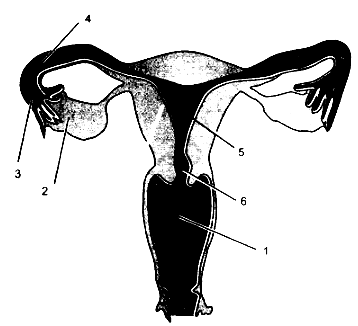
Given below is a diagram of the female reproductive system of a human being

(i) Name the parts numbered 1 to 6.
(ii) Normally after how many days does an ovary release an egg?
(iii) Where are the sperms released during coitus?
(iv) What do the sperms do after being released?
(v) What is the function of the organ numbered 5?
(vi) How many days does it normally take from the fertilization of the egg up to the birth of the baby?
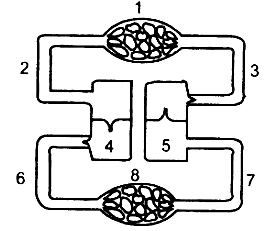
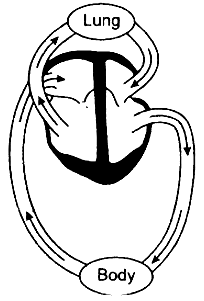
The diagram represents the ‘closed system’ or ‘double circulation’ of blood in mammals.

Justify the above statement.
State two structural and two functional differences between the arteries and veins.
State the changes in the composition of blood as it passes through the following organs:
(a) Lungs (b) Gut (c) Liver (d) Kidneys.
What do you mean by endocrine system?
Name and explain the various stages of the cell cycle.
Given below is a simple diagram of the circulation of blood in a mammal showing the main blood vessels, the heart, lungs, and body tissues. The blood vessel labeled 6 contains deoxygenated blood and 2 the valve leading to it has three semi-lunar pockets.

(i) Name the blood vessels of organs marked by numbers 1 to 8.
(ii) What do you mean by the term ‘double circulation’ of blood in mammals?
(iii) What is diastole?
Write a short note on sex determination in man.
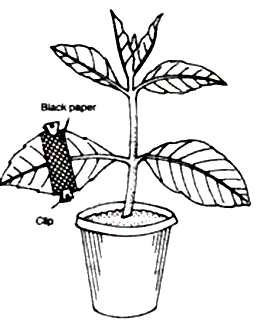
The diagram alongside represents an experiment conducted to prove the importance of a factor in photosynthesis.

Study the same and then answer the questions that follow:
(i) Name the factor being studied in his experiment.
(ii) Why was the plant kept in a dark room before conducting the experiment?
(iii}Why was the experimental leaf then kept in
1. boiling water 2. methylated spirit?
(iv) Name the solution used to test for the presence of starch in the leaf.
(v) What will we observe in the experimental leaf at the end of the starch test?
(vi) Give a balanced chemical equation to represent the process of photosynthesis.
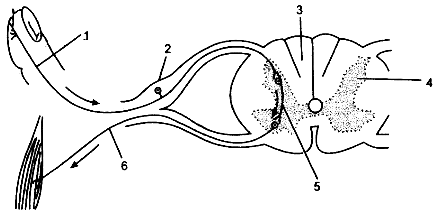
The diagram given below is a representation of a certain phenomenon pertaining to the nervous system. Study the diagram and answer the following questions:

(i) Name the phenomenon which is being depicted.
(ii) Give the technical term for the point of contact between the two nerve cells.
(iii) Name the parts 1, 2, 3, and 4.
(iv) Write the functions of parts 5 and 6
(v) How does the arrangement of neurons in the spinal cord differ from that of the brain?
Differentiate between:
Red blood cells and White blood cells
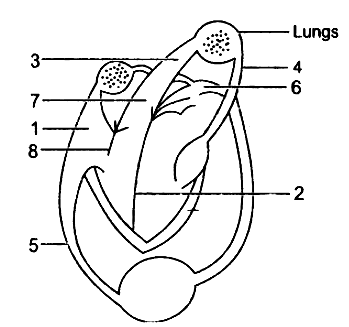
The figure below represents the internal structure of a mammalian heart and the associated blood vessels.

(i) (a) Name each of the structures labeled 1, 2, 3, 4, 5, 6, 7 and 8.
(b) State the function of each of the structures 5, 6, 7, and 8.
(ii) (a) State the function of the heart as an entire organ.
(b) Why are the walls of the left ventricle more muscular than the right?