Questions

[5 Mark Question Answer]

🎯

Test yourself on this topic

5 questions · timed · auto-graded

Question 15 Marks
Complete the following:
Gland/OrganHormoneFunction
(i) Stomach____________________
(ii) Parathyroid____________________
(iii) ____________________Lowers blood sugar level.
(iv) Adrenal medulla____________________
(v) Pancreas (Alpha cells)____________________
(vi) Testes____________________
Answer
Gland/OrganHormoneFunction
(i) StomachGastrinStimulates secretion of gastric juices.
(ii) ParathyroidParathormoneRegulates calcium metabolism.
(iii) Pancreas (Beta cells)InsulinLowers blood sugar level.
(iv) Adrenal medullaAdrenalineHelps body to adapt stress and other extreme conditions.
(v) Pancreas (Alpha cells)GlucagonRaise blood sugar level.
(vi) TestesTestosteroneDevelopment of primary and secondary sex characters in males.
View full question & answer
Question 25 Marks
What do you mean by endocrine system?
Answer
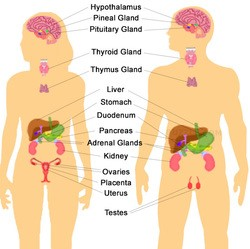
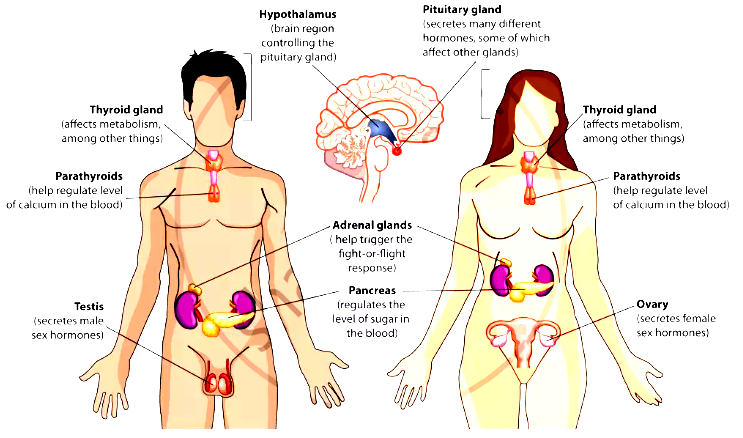
In human body there are two types of glands - exocrine and endocrine. The exocrine glands have ducts and discharge their secretions through them, e.g., salivary glands, liver, etc. The endocrine glands are those which do not possess any duct and discharge their secretion (hormones) directly into the blood stream to send them to the various parts of the body. The endocrine glands and their secretion (hormones) constitute the endocrine system which along with nervous system coordinates the activity of various parts of the body. Image
View full question & answer
Question 35 Marks
Column ‘II’ is a list of items related to ideas in Column ‘I’. Match the term in Column ‘II’ with a suitable idea given in Column ‘I’.
Column AColumn B
(i) Pituitary(a) produces male sex characteristics
(ii) Ovaries(b) decreases blood sugar level
(iii) Thyroid(c) increases heart and breathing rate raises blood pressure
(iv) Thymus(d) produces female sex characteristics
(v) Adrenals(e) is known as emergency hormone
(vi) Hypothalamus(f) regulates the level of calcium and phosphorus
(vii) Pancreas(g) increases the rate of metabolism
(viii) Testes(h) maintains the level of calcium
(ix) Parathyroidregulates the amount of water excreted in the urine.
(x) Cretinism(j) simulates skeletal growth
(xi) Diabetes mellitus(k) regulates the activities of other glands
(xii) Insulin shock(l) stimulates the development of male and female sex organs
(xiii) Gigantism(m) Shortage of glucose in the blood.
(xiv) Enlargement of breasts in adult males(n) Over-secretion of growth hormone
(xv) Exophthalmic goiter(o) Excess of glucose in the blood
(xvi) Acromegaly(p) Over-secretion of thyroxin
(xvii) Addison’s disease(q) Dwarfism and mental retardation
(xviii)Cretinism(r) Over-secretion of cortical hormones
(xix) Dwarfism(s) Under-secretion of the adrenal cortex
(xx) Adrenalin(t) Under-secretion of thyroxin in children
(xxi) Vasopressin(u) Over-secretion of growth hormones in adults
Answer
Column AColumn B
(i) Pituitary(j) simulates skeletal growth
(ii) Ovaries(d) produces female sex characteristics
(iii) Thyroid(g) increases the rate of metabolism
(iv) Thymus(l) stimulates the development of male and female sex organs
(v) Adrenals(c) increases heart and breathing rate raises blood pressure
(vi) Hypothalamus(k) regulates the activities of other glands
(vii) Pancreas(b) decreases blood sugar level
(viii) Testes(a) produces male sex characteristics
(ix) Parathyroid(f) regulates the level of calcium and phosphorus
(x) Cretinism(q) Dwarfism and mental retardation
(xi) Diabetes mellitus(o) Excess of glucose in the blood
(xii) Insulin shock(m) Shortage of glucose in the blood.
(xiii) Gigantism(n) Over-secretion of growth hormone
(xiv) Enlargement of breasts in adult males(r) Over-secretion of cortical hormones
(xv) Exophthalmic goiter(p) Over-secretion of thyroxin
(xvi) Acromegaly(u) Over-secretion of growth hormones in adults
(xvii) Addison’s disease(s) Under-secretion of the adrenal cortex
(xviii)Cretinism(t) Under-secretion of thyroxin in children
(xix) Dwarfism(s) Under-secretion of the adrenal cortex
(xx) Adrenalin(e) is known as emergency hormone
(xxi) Vasopressin(l) stimulates the development of male and female sex organs
View full question & answer
Question 45 Marks
Differentiate: Nervous control and Hormonal control.
Answer
Nervous ControlHormonal Control
The information is sent in the form of electric signals.The information is sent in the form of chemical signals.
The signals travel through nerve fibres to specific target cells like muscle fibres and glands.The signals travel through blood stream to cells in different organs.
Nervous system causes muscles to contract or relax, glands to secrete more or less. But it cannot bring about growth.Endocrine system brings about changes in metabolic activities of all body tissues. It affects growth.
Action is immediate (within few milliseconds.)Action is slow (can take hours or days to produce response).
Effect lasts for a sliort time.Effect is more lasting and permanent.
View full question & answer
Question 55 Marks
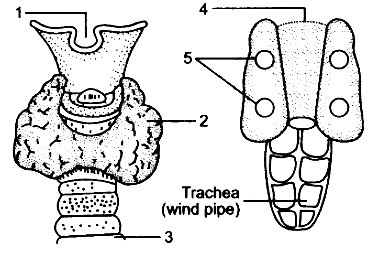
Given alongside are the diagrammatic sketches of some endocrine glands. Observe the figures and answer the following questions:
(i) Label the parts numbered 1 to 5.
(ii) Name the hormones secreted by (2) and (5).
(iii) Which chemicals in our body are greatly affected by hormones?
(iv) What is the chemical nature of hormones?
(v) Name the elements related to the functioning of hormones secreted by the structure (2) and (5).
Answer
(i)
1. Larynx.
2. Left lobe of the thyroid gland.
3. Trachea (windpipe).
4. Oesophagus.
5. Parathyroid glands.
(ii) Structure (2) secretes thyroxin hormone and structure (5) secretes parathormone.
(iii) Enzymes; which constitute the enzyme system of the body.
(iv) Hormones may be proteins, amino acids or steroids.
(v) Iodine is related to the functioning of glands (2) calcium, phosphorus is related to the functioning of the gland (5).
View full question & answer
[5 Mark Question Answer] - Biology STD 10 Questions - Vidyadip