Question
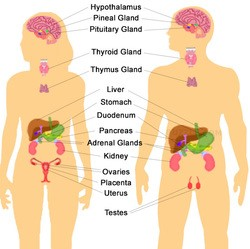
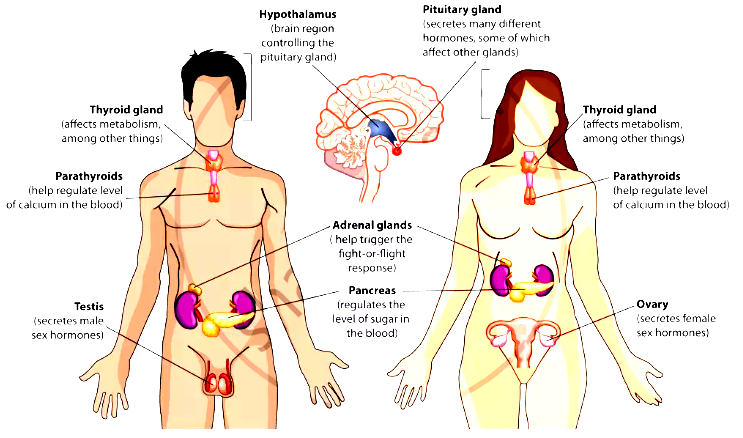
What do you mean by endocrine system?
Answer

In human body there are two types of glands - exocrine and endocrine. The exocrine glands have ducts and discharge their secretions through them, e.g., salivary glands, liver, etc. The endocrine glands are those which do not possess any duct and discharge their secretion (hormones) directly into the blood stream to send them to the various parts of the body. The endocrine glands and their secretion (hormones) constitute the endocrine system which along with nervous system coordinates the activity of various parts of the body. Image

Need a full question paper?

Generate a complete, print-ready paper with questions like this in minutes — across 16+ boards, with answer keys.

Start Generating Free

Similar questions

Differentiate between:
Red blood cells and White blood cells
Column 2 is a list of items related to ideas in Column 1. Match the term in Column 2 with the suitable idea given in Column 1.
Column 1Column 2
iEdward JanneraAlexander Flemming
iiPathogenbPneumonia
iiiStreptomycincSmallpox vaccine
ivPenicillindDiseases producing microbe
vAntisepticeCarbolic acid
viDisinfectantfBoric acid
Describe an experiment to prove that sunlight is necessary for photosynthesis.
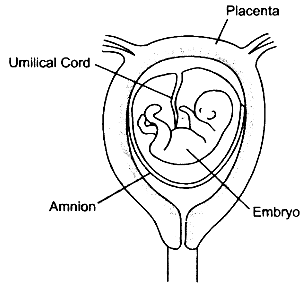
The below diagram is of a developing embryo is a mother’s womb:

(i) Write the functions of the placenta, amnion, and umbilical cord.
(ii) How are the waste products of a fetus removed?
(iii) What is the gestation period?
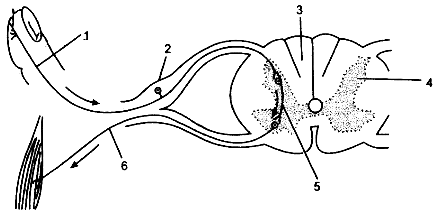
The diagram given below is a representation of a certain phenomenon pertaining to the nervous system. Study the diagram and answer the following questions:

(i) Name the phenomenon which is being depicted.
(ii) Give the technical term for the point of contact between the two nerve cells.
(iii) Name the parts 1, 2, 3, and 4.
(iv) Write the functions of parts 5 and 6
(v) How does the arrangement of neurons in the spinal cord differ from that of the brain?
Column ‘II’ is a list of items related to ideas in Column ‘I’. Match the term in Column ‘II’ with a suitable idea given in Column ‘I’.
Column AColumn B
(i) Pituitary(a) produces male sex characteristics
(ii) Ovaries(b) decreases blood sugar level
(iii) Thyroid(c) increases heart and breathing rate raises blood pressure
(iv) Thymus(d) produces female sex characteristics
(v) Adrenals(e) is known as emergency hormone
(vi) Hypothalamus(f) regulates the level of calcium and phosphorus
(vii) Pancreas(g) increases the rate of metabolism
(viii) Testes(h) maintains the level of calcium
(ix) Parathyroidregulates the amount of water excreted in the urine.
(x) Cretinism(j) simulates skeletal growth
(xi) Diabetes mellitus(k) regulates the activities of other glands
(xii) Insulin shock(l) stimulates the development of male and female sex organs
(xiii) Gigantism(m) Shortage of glucose in the blood.
(xiv) Enlargement of breasts in adult males(n) Over-secretion of growth hormone
(xv) Exophthalmic goiter(o) Excess of glucose in the blood
(xvi) Acromegaly(p) Over-secretion of thyroxin
(xvii) Addison’s disease(q) Dwarfism and mental retardation
(xviii)Cretinism(r) Over-secretion of cortical hormones
(xix) Dwarfism(s) Under-secretion of the adrenal cortex
(xx) Adrenalin(t) Under-secretion of thyroxin in children
(xxi) Vasopressin(u) Over-secretion of growth hormones in adults
How is root hair adapted for the absorption of water from the soil?
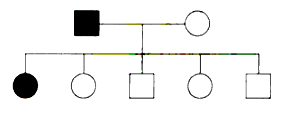
A family consists of two parents and their five children and the pedigree chart below shows the inheritance of the trait colour blindness .

(i) Who is colour blind in parents - Father or Mother?
(ii) How many daughters and sons have beeen born in the family?
(iii) What does the child 1 indicate about this trait?
(iv) Complete the depiction of all probabilities of the trait among the children 2-5 in the chart.
(v) On which chromosome is the gene of this trait located?
(vi) Name one other trait in humans which follows the similar mode of inheritance.
Explain the divisions of the nervous system.
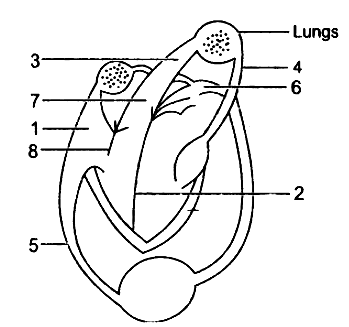
The figure below represents the internal structure of a mammalian heart and the associated blood vessels.

(i) (a) Name each of the structures labeled 1, 2, 3, 4, 5, 6, 7 and 8.
(b) State the function of each of the structures 5, 6, 7, and 8.
(ii) (a) State the function of the heart as an entire organ.
(b) Why are the walls of the left ventricle more muscular than the right?