MCQ
Diffusion current in a p-n junction is greater than the drift current in magnitude:
- AIf the junction is forward-biased.
- BIf the junction is reverse-biased.
- CIf the junction is unbiased.
- DIn no case.
Explanation:
In the forward biassing of a p−n junction, the positive terminal of the battery is connected to the p side of the p−n junction and the negative terminal of the battery is connected to the n side of the p−n junction. As a result, electrons in the n side of the p−n junction are repelled by the negative terminal of the battery and move to the p side, where the positive terminal of the battery attracts the electrons. Similarly, holes from the p side of the p−n junction are repelled by the positive terminal of the battery and move to the nside, where the negative terminal of the battery attracts the holes. Thus, they give diffusion current across the p−n junction.
In case of reverse biassing, no conduction takes place across the junction because of the diffusion of majority carriers. Hence, there is no diffusion current.
If the junction is unbiased, then diffusion current is initially maximum. But at equilibrium, diffusion current becomes equal to drift current.
Generate a complete, print-ready paper with questions like this in minutes — across 16+ boards, with answer keys.
If in the circuit, power dissipation is 150 W, then R is
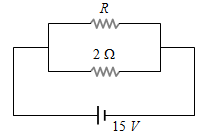
|
(a) 2 W |
(b) 6 W |
(c) 5 W |
(d) 4 W |
Two electric bulbs whose resistances are in the ratio of 1 : 2 are connected in series. The powers dissipated in them have the ratio
|
(a) 1 : 2 |
(b) 2 : 1 |
(c) 1 : 1 |
(d) 1 : 4 |
If a hole is made at the centre of a bar magnet, then its magnetic moment will
| (a) Increase | (b) Decrease | (c) Not change | (d) None of these |
The reason of current flow in P-N junction in forward bias is
|
(a) Drifting of charge carriers |
(b) Minority charge carriers |
|
(c) Diffusion of charge carriers |
(d) All of these |
Can a metal be used as a medium for dielectric
|
(a) Yes |
(b) No |
(c) Depends on its shape |
(d) Depends on dielectric |