Question
Dimension of $\frac{1}{\mu_0 \varepsilon_0}$ should be equal to

Answer

$\frac{1}{\mu_0 \epsilon_0}=c^2 \Rightarrow\left[\frac{1}{\mu_0 \in_0}\right]=\left[ c ^2\right]=\left[ L ^2 T ^{-2}\right]$

Need a full question paper?

Generate a complete, print-ready paper with questions like this in minutes — across 16+ boards, with answer keys.
Start Generating Free

Similar questions

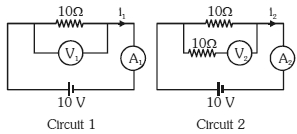
In the circuits shown below, the readings of the voltmeters and the ammeters will be
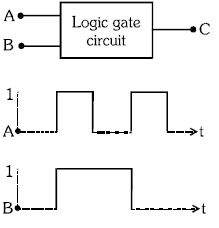
The following figure shows a $AND$ logic gate circuit with two inputs $A$ and $B$ and the output $C$. The voltage waveforms of $C$ will be
An $e.m.f.$ of $100$ $millivolts$ is induced in a coil when the current in another nearby coil becomes $10$ $ampere$ from zero in $0.1$ $second.$ The coefficient of mutual induction between the two coils will be....$millihenry$
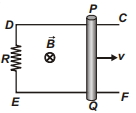
A frame $C D E F$ is placed in a region where a magnetic field $\vec{B}$ is present. A rod of length one metre moves with constant velocity $20 \,m / s$ and strength of magnetic field is one tesla. The power spent in the process is .............. $kW$ (take $R=$ $0.2 \,\Omega$ and all other wires and rod have zero resistance)
The magnetic field in a plane electromagnetic wave is given by, $B_{y}=2 \times 10^{-7} \sin \left(\pi \times 10^{3} x+3 \pi \times 10^{11} t\right) \;T$ Calculate the wavelength.
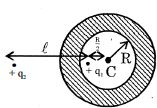
A solid conducting sphere has cavity, as shown in figure. A charge $+ {q_1}$ is situated away from the centre. A charge $+q_2$ is situated outside the sphere then true statement is
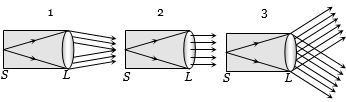
The slit of a collimator is illuminated by a source as shown in the adjoining figures. The distance between the slit $S$ and the collimating lens $L$ is equal to the focal length of the lens. The correct direction of the emergent beam will be as shown in figure
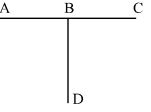
Three conducting rods of same material and cross-section are shown in figure. Temperatures of$ A, D$ and $C$ are maintained at $20^o C, 90^o C$ and $0^o C$. The ratio of lengths of $BD$ and $BC$ if there is no heat flow in $AB$ is:
An object is projected horizontally with speed $\frac{1}{2} \sqrt{\frac{G M}{R}}$, from a point at height $3 R$ [where $R$ is radius and $M$ is mass of earth, then object will] 
The filament of a light bulb has surface area $64 mm ^2$. The filament can be considered as a black body at temperature $2500 K$ emitting radiation like a point source when viewed from far. At night the light bulb is observed from a distance of $100 m$. Assume the pupil of the eyes of the observer to be circular with radius $3 mm$. Then

(Take Stefan-Boltzmann constant $=5.67 \times 10^{-8} Wm ^{-2} K ^{-4}$, Wien's displacement constant $=2.90 \times 10^{-3} m - K$, Planck's constant $=6.63 \times 10^{-34} Js$, speed of light in vacuum $=3.00 \times 10^8 ms ^{-1}$ )-

$(A)$ power radiated by the filament is in the range $642 W$ to $645 W$

$(B)$ radiated power entering into one eye of the observer is in the range $3.15 \times 10^{-8} W$ to $3.25 \times 10^{-8} W$

$(C)$ the wavelength corresponding to the maximum intensity of light is $1160 nm$

$(D)$ taking the average wavelength of emitted radiation to be $1740 nm$, the total number of photons entering per second into one eye of the observer is in the range $2.75 \times 10^{11}$ to $2.85 \times 10^{11}$