MCQ
The absolute zero is the temperature at which
  • A
    Water freezes
  • B
    All substances exist in solid state
  • Molecular motion ceases
  • D
    None of the above

Answer

Correct option: C.
Molecular motion ceases
c
(c)At absolute zero $($i.e. $0 \,K)$ $v_{rms}$ becomes zero.

Need a full question paper?

Generate a complete, print-ready paper with questions like this in minutes — across 16+ boards, with answer keys.
Start Generating Free

Similar questions

Two pieces of metal when immersed in a liquid have equal upthrust on them; then
A train with cross-sectional area $S _{ t }$ is moving with speed $v_t$ inside a long tunnel of cross-sectional area $S _0\left( S _0=4 S _{ t }\right)$. Assume that almost all the air (density $\rho$ ) in front of the train flows back between its sides and the walls of the tunnel. Also, the air flow with respect to the train is steady and laminar. Take the ambient pressure and that inside the train to be $p _0$. If the pressure in the region between the sides of the train and the tunnel walls is $p$, then $p _0- p =\frac{7}{2 N } \rho v_{ t }^2$. The value of $N$ is. . . . .
A balloon contains $1500 \,m^3$ of helium at $27^\circ C$ and $4$ atmospheric pressure. The value of helium at $ - \,3^\circ C$ temperature and $2$ atmospheric pressure will be ...... $m^3$
Which of the following is correct, when a person walks on a rough surface
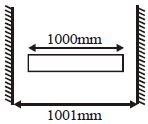
$A$ rod of length $1000\, mm$ and coefficient of linear expansion $a = 10^{-4}$ per degree is placed symmetrically between fixed walls separated by $1001\, mm$. The Young’s modulus of the rod is $10^{11} N/m^2$. If the temperature is increased by $20^o C$, then the stress developed in the rod is ........... $MPa$
Time period $T\,\propto \,{P^a}\,{d^b}\,{E^c}$  then value of $c$ is  given $p$ is pressure, $d$ is density and $E$ is energy
Select the relative word for blank. Planet : Sun :: Moon : $............$
In a closed organ pipe the frequency of fundamental note is $50 Hz$. The note of which of the following frequencies will not be emitted by it .... $Hz$
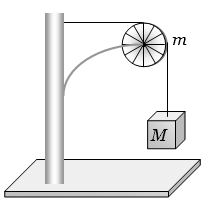
A string of negligible mass going over a clamped pulley of mass m supports a block of mass M as shown in the figure. The force on the pulley by the clamp is given by
A shell in free space initially at rest explodes into two pieces, $A$ and $B$ , which then move in opposite directions. Piece $A$ has less mass than piece $B$ . Ignore all external forces. Identify correct statement