MCQ
Dimensions of luminous flux are
  • A
    $M{L^2}{T^{ - 2}}$
  • $M{L^2}{T^{ - 3}}$
  • C
    $M{L^2}{T^{ - 1}}$
  • D
    $ML{T^{ - 2}}$

Answer

Correct option: B.
$M{L^2}{T^{ - 3}}$
b
Luminous flux is nothing but power per unit time. Its dimension is equal to the dimension of
power.

luminous flux $=$ power $=\left[M L^{2} T^{-3}\right]$

Need a full question paper?

Generate a complete, print-ready paper with questions like this in minutes — across 16+ boards, with answer keys.
Start Generating Free

Similar questions

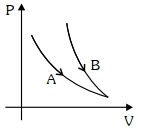
Choose the correct statement for processes $A$  & $B$ shown in figure.
Pressure exerted by a gas is found to be $50\, N/m^2$ , then the value of pressure in $CGS$ system is
$A$ particle is moving along a circular path of radius $R$ in such a way that at any instant magnitude of radial acceleration & tangential acceleration are equal. If at $t = 0$ velocity of particle is $V_0$, the time period of first revolution of the particle is 
The average distance a molecule can travel without colliding is called as:
A bird weighs $2 kg$ and is inside a closed cage of $1 kg$. If it starts flying, then what is the weight of the bird and cage assembly  ........... $kg$
In changing the state of thermodynamics from $A$ to $B$ state, the heat required is $Q$ and the work done by the system is $W.$ The change in its internal energy is
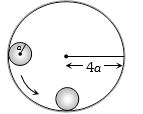
A ring of radius $4a$ is rigidly fixed in vertical position on a table. A small disc of mass $m$ and radius $a$ is released as shown in the fig. When the disc rolls down, without slipping, to the lowest point of the ring, then its speed will be
The total energy of a particle, executing simple harmonic motion is
A motorcycle is going on an overbridge of radius $R$. The driver maintains a constant speed. As the motorcycle is ascending on the overbridge, the normal forces on it is
A particle is moving in a straight line and passes through a point $O$ with a velocity of $6\;m{s^{ - 1}}.$ The particle moves with a constant retardation of $2\;m{s^{ - 2}}\;$ for $4$ s and there after moves with constant velocity. How long after leaving $O$ does the particle return to $O$..........$s$