MCQ
The total energy of a particle, executing simple harmonic motion is
  • A
    $ \propto x$
  • B
    $ \propto {x^2}$
  • Independent of$x$
  • D
    $ \propto {x^{1/2}}$

Answer

Correct option: C.
Independent of$x$
c
(c)Total energy $ = \frac{1}{2}m{\omega ^2}{a^2}$= constant

Need a full question paper?

Generate a complete, print-ready paper with questions like this in minutes — across 16+ boards, with answer keys.
Start Generating Free

Similar questions

If two tuning forks $A$ and $B$ are sounded together, they produce $4$ beats per second. $A$ is then slightly loaded with wax, they produce $2$ beats when sounded again. The frequency of $A$ is $256.$ The frequency of $B$ will be
A pendulum is swinging in an elevator. Its period will be greatest when the elevator is
The acceleration of a body in a non-uniform circular motion is $5\, ms^{-2}$. Which one of the following is correct?
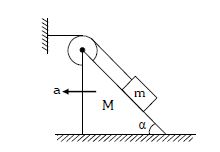
In the adjoining figure if acceleration of $M$ with respect to ground is $a$, then
Which of the following quantities remain constant in a planetary motion $($consider elliptical orbits$)$ as seen from the sun?
A Carnot engine has an efficiency of $50 \%$ when its source is at a temperature $327^{\circ}\,C$. The temperature of the sink is $.........^{\circ} C$
For which combination of working temperatures the efficiency of Carnot’s engine is highest
Moment of inertia of a dise of mass $M$ and radius ' $R$ ' about any of its diameter is $\frac{ MR ^2}{4}$. The moment of inertia of this disc about an axis normal to the disc and passing through a point on its edge will be, $\frac{ x }{2} MR ^2$. The value of $x$ is $..........$.
Given that $u_x=$ horizontal component of initial velocity of a projectile, $u_y=$ vertical component of initial velocity, $R=$ horizontal range, $T=$ time of flight and $H=$ maximum height of projectile. Now match the following two columns.
Column $I$ Column $II$
$(A)$ $u_x$ is doubled, $u_y$ is halved $(p)$ $H$ will remain unchanged
$(B)$ $u_y$ is doubled $u_x$ is halved $(q)$ $R$ will remain unchanged
$(C)$ $u_x$ and $u_y$ both are doubled $(r)$ $R$ will become four times
$(D)$ Only $u_y$ is doubled $(s)$ $H$ will become four times
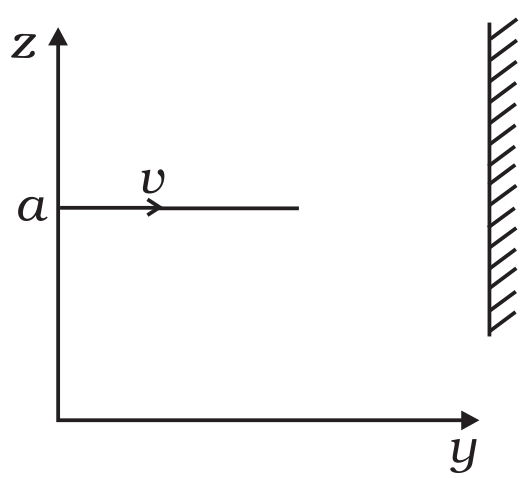
A particle of mass $m$ is moving in $yz-$plane with a uniform velocity $v$ with its trajectory running parallel to $+ve\ y-$axis and intersecting $z-$axis at $z = a.$ The change in its angular momentum about the origin as it bounces elastically from a wall at $y =$ constant is: