Question
Discuss $p-n$ junction diode under forward bias.

Answer

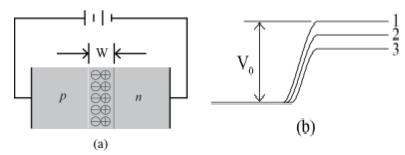
→ When an external voltage V is applied across a semi-conductor diode such that $p$-side is connected to the positive terminal of the battery and the $n$-side to the negative terminal (fig. (a)), it is said to be forward biased.
Image
→ Here, the voltage applied to the diode across the two terminals of the depletion region and the direction of the applied voltage
(V) is opposite to the built-in potential (V).
→ As a result, the depletion layer width decreases and the barrier height is reduced (Fig. (b)). The effective barrier height under forward bias is $\left( V _0- V \right)$.
→ If the applied voltage is small, the barrier potential will be reduced only slightly below the equilibrium value and only a small number of carriers in the material - those that happen to be in the uppermost energy levels - will possess enough energy to cross the junction. So the current will be small.
→ If we increase the applied voltage significantly, the height of the barrier potential reduces, and more number of charge carriers gain enough energy to cross the depletion region, due to which the current also increases.
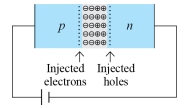
→ "Due to the applied voltage, electrons from the n -side cross the depletion region and reach p -side (Where they are minority carriers). Similarly, holes from the p -side cross the junction and reach the n -side. (Where they are minority carriers.) This process under forward bias is known as minority carrier injection."
→ At the junction boundary, on each side, the minority carrier concentration increases significantly compared to the locations far from the junction.
→ Due to this concentration gradient, the injected electrons on $p$-side diffuse from the junction edge of $p$-side to the other end of $p$ side. Likewise, the injected holes on $n$-side diffuse from the junction edge of $n$-side to the other end of $n$-side. This is shown in fig. below.
Image
→ This motion of charged carriers on either side gives rise to current. The total diode forward current is sum of hole diffusion current and conventional current due to electron diffusion. The magnitude of this current is usually in mA .

Need a full question paper?

Generate a complete, print-ready paper with questions like this in minutes — across 16+ boards, with answer keys.
Start Generating Free

Similar questions

Radioactive 131I has a half-life of 8.0 days. A sample containing 131I has activity $20\mu\text{Ci}$ at t = 0.
  1. What is its activity at t = 4 days?
  2. What is its decay constant at t = 4.0 days?
The phenomenon of diffraction is commonly seen in sound waves. But generally not in light waves, why?
A charged particle oscillates about its mean (equilibrium) position with a frequency of 109Hz. What is the frequency of the electromagnetic waves produced by the oscillator?
At noon, the sun and the earth pull the objects on the earth's surface in opposite directions. At midnight the sun and the earth pull these objects in same direction. Is the weight of an object, as measured by a spring balance on the earth's surface, more at midnight as compared to its weight at noon?
The average kinetic energy of molecules in a gas at temperature T is 1.5kT. Find the temperature at which the average kinetic energy of the molecules of hydrogen equals the binding energy of its atoms. Will hydrogen remain in molecular from at this temperature? Take k = 8.62 × 10⁻⁵eVK-1.
A proton and a deuteron are accelerated through the same accelerating potential. Which one of the two has,
  1. greater value of de-Broglie wavelength associated with it, and
  2. less momentum?
Give reasons to justify your answer.
What is the resistance of an intrinsic semiconductor at 0K?
Estimate the average drift speed of conduction electrons in a copper wire of cross-sectional area 1.0 x10⁻⁷ m2 carrying a current of 1.5 A. Assume the density of conduction electrons to be 9 x1028 m–3.
Can a gravitational field be added vectorially to an electric field to get a total field?
Give examples where:
  1. The velocity of a particle is zero but its acceleration is not zero.
  2. The velocity is opposite in direction to the acceleration.
  3. The velocity is perpendicular to the acceleration.