→ The nucleus is made up of neutrons and protons. Therefore, it may be expected that the mass of the nucleus is equal to the total mass of its individual protons and neutrons. → But the nuclear mass M is found to be always less than the total mass of its individual protons and neutrons. → For example : $8^{ O ^{16}}$, a nucleus which has 8 neutrons and 8 protons. Mass of 8 neutrons $=8 \cdot 1.00866 u$ Mass of 8 protons $=8 \cdot 1.00727 u$ Mass of 8 electrons $=8-0.00055 u$ → Therefore, the expected mass of ${ }_8 O ^{16}$ nucleus $ \begin{array}{l} =(8-1.00866+8 \cdot 1.00727) \\ =8(1.00866+1.00727) \\ =8 \cdot 2.01593 u \\ =16.12744 u \end{array} $ → The atomic mass of ${ }_8 O ^{16}$ found from mass spectroscopy experiments is seen to be 15.99493 u . → Subtracting the mass of 8 electrons ( $8-0.00055 u=0.0044 u$ ) from this we get the experimental mass of ${ }_8 O ^{16}$ nucleus to be $15.99053 u$. → Thus, the mass of the ${ }_8 O ^{16}$ nucleus is less than the total mass of its constituents by $ (16.12744-15.99053)=0.13691 u $ → "The difference in mass of a mucleus and its constituents, $\Delta M$ is called the mass defect" and is given by $ \Delta M=\left[Z m_p+(A-Z) m_n\right]-M $ Where, $Z=$ number of protons $ \begin{array}{l} A-Z=N=\text { neutron number } \\ m_p \text {-mass of proton } \\ m_n \text {-mass of neutron } \\ M \text { - mass of a nucleus } \end{array} $ → The energy equivalent to this mass defect is called the binding energy of nucleus. $ \therefore \text { Binding energy } E_b=\Delta M c^2 $ → Binding energy per nucleon is the binding energy divided by the total number of nucleons. $ \therefore E_{\text {hn }}=\frac{E_b}{A} $ → The binding energy per nucleon gives a measure of the stability of the nucleus. → A nucleus for which the value of $E _{b n}$ is comparatively higher is said to be more stable and for a nucleus for which the value of $E _{b n}$ is comparatively less is said to be less stable.
A hydrogen atom initially in the ground level absorbs a photon, which excites it to the $n=4$ level. Determine the wavelength of photon. \[\left(h=6.625 \times 10^{-34} Js \& c=3 \times 10^8 ms^{-1}\right)\]
Answer
$ → n=4 $ $ \begin{array}{l} \lambda=? \\ v=? \end{array} $ → Total energy of electron $E _n=-\frac{\frac{13.6}{n^2}}{e}$$e V$....(1) → For ground state, $n=1$ $ \begin{array}{l} E_1=-\frac{13.6}{1^2} eV \\ =-13.6 eV \end{array} $ → Using $n=4$ in equation (1) $ \begin{array}{l} E_4=-\frac{-13.6}{(4)^2} eV \\ =\frac{-13.6}{16} e V \\ E_4=-0.85 eV \end{array} $ → Energy of incident photon $ \begin{array}{l} E_4-E_1=-0.85-(-13.6) \\ E_4-E_1=12.75 e V \end{array} $ But, $E _i- E _f=h v$ $ \begin{array}{l} h v=12.75 eV \\ \therefore v=\frac{12.75 \times 1.6 \times 10^{-19}}{6.625 \times 10^{-34}} \\ \therefore v=3.08 \times 10^{15} Hz \end{array} $ → Wavelength of incident radiation $ \begin{array}{l} \lambda=\frac{c}{v}=\frac{3 \times 10^8}{3.08 \times 10^{15}} \\ \therefore \lambda=0.974 \times 10^{-7} m \\ \therefore \lambda=97.4 nm \end{array} $
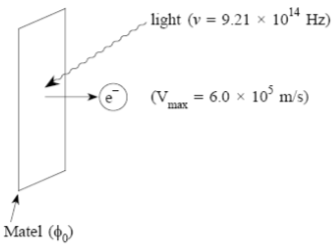
Light of frequency $9.21 \times 10^{14} Hz$ is incident on a metal surface. Electrons with a maximum speed $6.0 \times 10^5 ms^{-1}$ are ejected from the surface. What is the threshold frequency for photoemission of electrons? \[\left(h=6.625 \times 10^{-34} Js\right)\]
Answer
$ →\begin{array}{l}v=9.21 \times 10^{14} Hz \\ v_{\max }=6.0 \times 10^5 m / s \\ → v_0=?\end{array}$ → According to Einstein's equation, $\begin{aligned} K _{\max } & =h v-\phi_0 \\ \therefore \frac{1}{2} m v_{\max }^2 & =h v-\phi_0 \quad\left(\because K_{\max }=\frac{1}{2} m v_{\max }^2\right)\end{aligned}$ $\therefore \quad \phi_0=h v-\frac{1}{2} m v_{\max }^2$ $\therefore \quad h v_0=h v-\frac{1}{2} m v_{\max }^2 \quad\left(\because \phi_0=h v_0\right)$ $\therefore \quad v_0=v-\frac{ mV _{\max }^2}{2 h}$ $\therefore \quad v_0=\left(9.21 \times 10^{14}\right)-\left(\frac{9.1 \times 10^{-31} \times\left(6.0 \times 10^5\right)^2}{2 \times 6.625 \times 10^{-34}}\right)$ $\begin{array}{l}v_0=\left(9.21 \times 10^{14}\right)-\left(2.472 \times 10^{14}\right) \\ v_0=6.78 \times 10^{14} Hz\end{array}$
80 pF capacitor is being charged by an external source. The charging current is constant and equal to 0.15 A . Calculate the rate of change of potential difference between the plates. Also obtain the displacement current across the plates.
Answer
$→ I=C \frac{d V}{d t} $ where $I =$ Electric Current (A) $C =$ Capacitance ( F ) $ \begin{array}{l} \frac{d V}{d t}=\text { Rate of change in electrical condition (Volts Per Second) } \\ C=80 pF=80 \times 10^{-2} F \\ I=0.15 A \end{array} $$\frac{d V}{d t}$ is Multiplication of, $ \begin{array}{l} 0.15=80 \times 10^{-12} \times \frac{d V}{d t} \\ \frac{d V}{d t}=\frac{0.15}{80 \times 10^{-12}}=\frac{0.15}{80 \times 10^{-11}} \\ =1.875 \times 10^9 V / S \\ \text { displacement }=\varepsilon_0 \cdot A \cdot \frac{d E}{d t} \end{array} $ displacement (Id displacement) and I is changing in displacement and electrice current $ I_{\text {displacement }}=I=0.15 A $
A short bar magnet has a magnetic moment of $0.50 JT ^{-1}$. Calculate the magnitude of the magnetic field produced by the magnet at a distance of 10 cm from the centre of the magnet on (a) the axis of the magnet and (b) the equatorial line of the magnet
Answer
$ \begin{aligned} m= & 0.48 J / T \\ & r=10 cm=0.1 m=10^{-1} m \end{aligned} $ (a) Magnetic field on the axis of magnet at distance ' $r$ ' $ \begin{array}{l} B_1=\frac{\mu_0}{4 \pi} \cdot \frac{2 m}{r^3} \\ B_1=\frac{10^{-7} \times 2 \times 0.48}{10^{-3}} \\ B_1=0.96 \times 10^{-4} T \\ =0.96 G \end{array} $ → Direction of this magnetic field will be in the direction of magnetic moment of the magnet. (Which will be from S to N ) (b) Magnetic field at distance ' $r$ ' on the equatorial line of magnet, $ \begin{array}{l} B_2=\frac{\mu_0}{4 \pi} \cdot \frac{m}{r^3} \\ B_2=\frac{10^{-7} \times 0.48}{10^{-3}} \\ B_2=0.48 \times 10^{-4} T \\ =0.48 G \end{array} $ → Direction of this magnetic field will be in the direction opposite to the magnetic moment (Which will be from N to $S$ direction.)
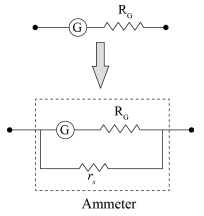
State the two difficulties in using the galvanometer directly as an ammeter to measure the value of the electric current. What should be done to overcome these difficulties?
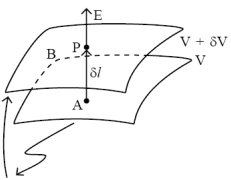
Write any four general properties of electric field lines.
Answer
(i) Electric field lines are imaginary curves drawn in such a way that the tangent to it of each point shows the direction of electric field at that point. (ii) Field lines start from positive charges and end at negative charges. If there is a single charge, they may start or end at infinity. (iii) In a charge-free region, electric field lines can be taken to be continuous curves without any breaks. (iv) Two field lines never cross each other. (v) Electrostatic field lines do not form any closed loops. (vi) Distribution of electric field lines gives an idea of electric field intensity in that region. (vii) Field lines of a uniform electric field are mutually parallel and equidistant.