Question
Discuss the following:Radioactive wastes.

Answer

Radioactive wastes: Radioactive wastes such as uranium, are used as fuel in the atomic power plant. The accidental leakage and disposal of radioactive wastes are the most serious problems. All safety measures for this purpose should be strictly enforced. Highlevel radioactive wastes generate a lot of heat and thus require cooling, as well as special protective shield during handling and transport. Radiation, that is given off by nuclear wastes is extremely harmful to the organisms, because it causes mutation at a very high rate. At high doses, nuclear radiation is lethal but at lower doses, it creates various disorders, the most frequent of all being cancer. Therefore, nuclear waste is an extremely potent pollutant and has to be dealt with utmost caution.
Need a full question paper?

Generate a complete, print-ready paper with questions like this in minutes — across 16+ boards, with answer keys.

Start Generating Free

Similar questions

Restriction enzymes are found in bacteria (and other prokaryotes). They recognize and bind to specific sequences of DNA, called restriction sites. Each restriction enzyme recognizes just one or a few restriction sites.
When it finds its target sequence, a restriction enzyme will make a double-stranded cut in the DNA molecule.
i. Write the palindromic nucleotide sequence for the following DNA segment.
5'-GAATTC-3'
ii. Name the restriction endonuclease that recognises this sequence.
iii. How are sticky ends produced? Mention their role.
A true breeding pea plant homozygous for axial violet flowers is crossed with another pea plant with terminal white flowers (aavv).
Give the phenotypic ratio of $F_2$ generation.
“Maintenance of personal and public hygiene is necessary for prevention and control of many infectious diseases”. Justify the statement giving suitable examples.
List 10 modern day animals and using the various resources available link it to a corresponding ancient fossil. Name both of them.
  1. Following are the responses of different animals to various abiotic factors. Describe each one with the help of an example.
  1. Regulate.
  2. Conform.
  3. Migrate.
  4. Suspend.
  1. If 8 individuals in a population of 80 butterflies die in a week, calculate the death rate of population of butterflies during that period.
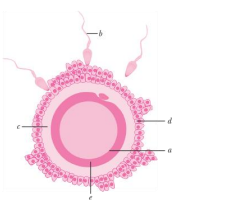
Study the illustration given and answer the questions that follow:

Draw a diagram of ‘b’ separately and label the parts:
  • That help its entry into ‘a’;
  • That carry genetic material;
  • That help in its movement.
Enlist the salient features of the double helix structure of DNA.
Explain the difference between the following :
(i) Nucleoside and nucleotide
(ii) DNA and RNA
(iii) Codon and anticodon
(iv) Transcription and translation
(v) Inductive regulation and inhibitory regulation
(vi) RNA splicing and RNA editing
What does the lac operon consist of? How is the operator switch on and off in the expression of gene in this operon? Explain.
In which categories have been classified the contraceptive methods. Describe any three methods in detail.