Question
List 10 modern day animals and using the various resources available link it to a corresponding ancient fossil. Name both of them.

Answer

Animal Ancient Fossil
Horse Pliohippus
Camel procamelus
Elephant Stegolophodon
Octopus Belemnite
Nautilus Gyrouros
Gibbon Propliopithecus
Orangutan Dryopithecus
Man Homo sapiens neanderthalensis
Chimpanzee Dryopithecus
Gorilla Dryopithecus

Need a full question paper?

Generate a complete, print-ready paper with questions like this in minutes — across 16+ boards, with answer keys.
Start Generating Free

Similar questions

(i) Write full name of AIDS.
(ii) Write four ways of transmission of HIV infection.
(iii) Write a way to prevent HIV infection.
Write the components of nucleotide. Write one important feature of the structure of double helical DNA. Draw a labelled diagram of double helical DNA.
Differentiate between homology and analogy. Also discuss the homologous and vestigeal organs with example and how do they explain the evidence of evolution.
A pregnant human female was advised to undergo M.T.P. It was diagnosed by her doctor that the foetus she is carrying has developed from a zygote formed by an XX egg fertilised by Y–carrying sperms. Why was she advised to undergo M.T.P.?
What will be the P/ R ratio of a climax community and a pioneer community. What explanation could you offer for the changes seen in P/ R ratio of a pioneer community and the climax community.
In the medium where E. coli was growing, lactose was added, which induced the lac operon. Then, why does lac operon shut down some time after addition of lactose in the medium?
Explain how xerarch succession progresses from serie to mesic condition and forms a stable climax community. You may use a flow chart.
Describe the components of an ecosystem.
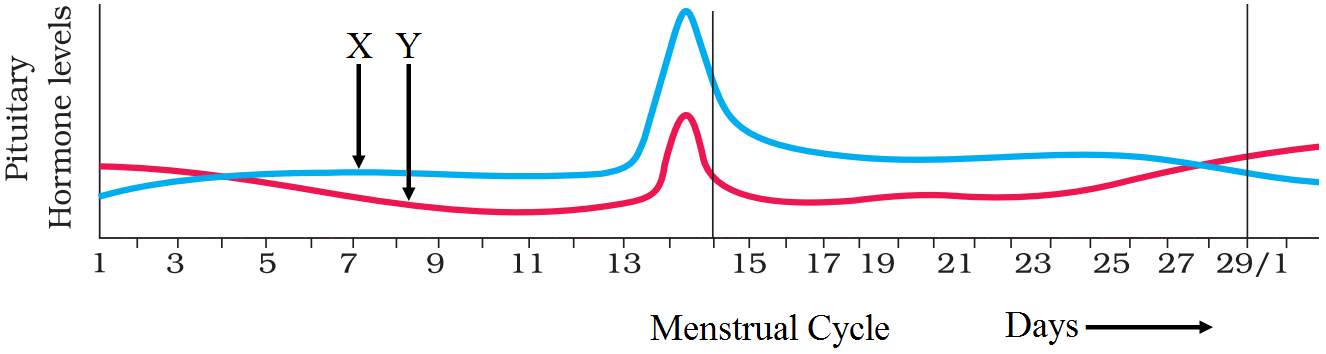
Study the graph given below and answer the questions that follow:
Explain the ovarian events (i), (ii) and (iii) under the influence of hormones ‘X’ and ‘Y’.
Differentiate between the following:
  1. Polygenic inheritance and Pleiotropy.
  2. Dominance, Codominance and Incomplete dominance.