Question
Discuss the types of seeds. Also describe its structure.

Answer

On the basis cotyledons seeds are of two types :
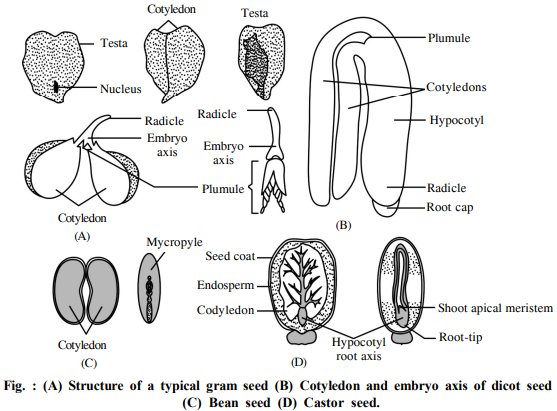
Monocot seed : It has only one cotyledon which is called scutellum in grass family. It is shield shaped. Scutellam is situated on one side of the embryonal axis laterally at the lower and the embryonal axis has the radical and root cap and closed in an undifferentiated sheet called coleorrhiza. The portion of the embryonal above the level of attrachment of scutellum is the epicotyl. Epicotyl has a shoot apex and a few leaf primordia enclosed in a hollow foliar structure, the oleoptile (Fig.).
Image
Dicot Seed : Seed is covered by one or two envelope called seed coat. The outer seed coat is called testa and inner seed coat is tegmen. Some seeds have only one seed coat. Outer covering is thick and hard which protect the embryo in adverse condition and during dormancy period. Tegmen is very thin.
Dicot has two cotyledons situated laterally to embryonal axis on both side. The portion of embryonal axis above the level of cotyledons is the epicotyls which terminates with the plumule or stem tip. The cylindrical portion below the level of cotyledons is hypocotyl terminates at its lower and in the radical or root tip. The root tip is covered with a root cap. Those cotyledons which do not have endosperm they become thick and pulpy by absorbing the endosperm. In some seeds, cotyledons come about the surface of soil during germination and synthesize the food by carrying out photosynthesis till the first leaf be formed.
On the basis of presence or absence of endosperm seeds are of two types:
Endospermic seed : In some sheets embryo is bounded by a special parenchyma tissue which stores the food in plenty and provide nourishment to the developing embryo this tissue is called endosperm and those in which endosperm is present are called endospermic or albuminous seeds. Most of the monocot plant e.g. wheat maize, rice, barley and some of the dicot seed like castor bean are endospermic seeds.
Non-endospermic seed : Some plants like gram peer, bean, bottle gourd sunflower etc. seeds are divided of endosperm as it is used by the developing embryo. The sheets are also called X album in a sheet and they store the food in cotyledons thereby they are thick and pulpy.

Need a full question paper?

Generate a complete, print-ready paper with questions like this in minutes — across 16+ boards, with answer keys.

Start Generating Free

Similar questions

Answer the following questions:
Why is follicular phase in the menstrual cycle also referred as proliferative phase? Explain.
List the attributes that populations but not individuals possess.
What is floriculture? Describe the structure of a stamen. Also draw a well labelled diagram of a typical stamen.
“Microbes play a dual role when used for sewage treatment as they not only help to retrieve usable water but also generate fuel”. Explain.
Read the following and answer any four questions from (i) to (v) given below:

Crown gall is a neoplastic disease of most dicotyledonous plants and is caused by the soil bacterium Agrobacterium tumefaciens. A large extra chromosomal plasmid in these bacteria was found to be responsible for this disease. The plasmid is known as Ti plasmid. Bacteria free crown gall cells can be cultured in the absence of phytohormones. Ti plasmid is widely used in genetic engineering to deliver the desirable genes. The part of Ti plasmid transferred into plant cell DNA is called T-DNA. T-DNA with desired DNA segment is inserted into the chromosome of the host plant where it produces copies of itself.

  1. Which of the following is the full full of T-DNA?
  1. Transfer DNA.
  2. Tumour inducing DNA.
  3. Transgenic DNA.
  4. None of these.
  1. Ti plasmid cannot infect and develop crown gall in,
  1. Tomato.
  2. Maize.
  3. Soybean.
  4. sunflower.
  1. While making transgenic plant, T-DNA is inserted into the host cell, it is then:
  1. Integrated into the target host genome.
  2. Lie independent of the host genome.
  3. Rupture the host cell wall.
  4. Produce oncogenic factors in the host.
  1. Agrobacterium mediated gene transfer in plants:
  1. Allows relatively large segment of DNA.
  2. Transfer of DNA with defined ends and minimal rearrangement.
  3. High quality and fertility in transgenic plants.
  4. All of these.
  1. Assertion: In Agrobacterium mediated gene transfer in plants, transgenic plants do not develop tumors.

Reason: In T-DNA tumor producing genes are deleted during the process of gene transfer.
  1. Both assertion and reason are true and reason is the correct explanation of assertion.
  2. Both assertion and reason are true but reason is not the correct explanation of assertion.
  3. Assertion is true but reason is false.
  4. Both assertion and reason are false.
Trace the origin and evolution of Man.
Meiotic division during oogenesis is different from that in spermatogenesis. Explain how and why?
State and explain the “law of independent assortment” in a typical Mendelian dihybrid cross.
Answer the following questions with respect to recombinant DNA technology:
i. Why is plasmid considered to be an important tool in rDNA technology? From where can plasmids be isolated? (Any two sources)
ii. Explain the role of ori and selectable marker in a cloning vector.
iii. r-DNA technology cannot proceed without restriction endonuclease. Justify.
  1. How does the study of fossils help to understand evolution?
  2. How did SL Miller provide an experimental evidence in favour of Oparin and Haldane's hypothesis? Explain.