Question
Displacement current is continuous:

Answer

  1. when electric field is changing in the circuit
Explanation:
Displacement current is a quantity appearing in Maxwell's equations that is defined in terms of the rate of change of electric displacement field.
When electric field is changing with time continuously, the displacement current is constant.

Need a full question paper?

Generate a complete, print-ready paper with questions like this in minutes — across 16+ boards, with answer keys.
Start Generating Free

Similar questions

A crystal diode is a (a) Non-linear device(b) Amplifying device(c) Linear device(d) Fluctuating device
       
A positive point charge Q is brought near an isolated metal cube.
  1. The cube becomes negatively charged.
  2. The cube becomes positively charged.
  3. The interior becomes positively charged and the surface becomes negatively charged.
  4. The interior remains charge free and the surface gets nonuniform charge distribution.
An emf is induced in an aeroplane during its ascent and descent in east-west direction due to.
An e.m.f. of 5 volt is produced by a self inductance, when the current changes at a steady rate from 3 A to 2 A in 1 millisecond. The value of self inductance is(a) Zero(b) 5 H(c) 5000 H(d) 5 mH
       
A current $i$ ampere flows along the inner conductor of a coaxial cable and returns along the outer conductor of the cable, then the magnetic induction at any point outside the conductor at a distance $r$ metre from the axis is
The focal length of a convex lens is 10 cm and its refractive index is 1.5.  If the radius of curvature of one surface is 7.5 cm, the radius of curvature of the second surface will be(a) 7.5 cm (b) 15.0 cm(c) 75 cm (d) 5.0 cm
       
The number of revolutions per second made by an electron in the first Bohr orbit of hydrogen atom is of the order of $3$
A rigid container of negligible heat capacity contains one mole of an ideal gas. The temperature of the gas increases by $1^\circ C$ if $3.0cal$ of heat is added to it. The gas may be:
In series connection of resistors, what happens to the current across each resistor?
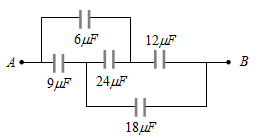
In the connections shown in the adjoining figure, the equivalent capacity between $A$ and $B$ will be